How can EIL reconstruct the broken L2 into a supercomputer?
In the previous installment of the Interop series, we introduced the Open Intents Framework (OIF)—a universal language that enables users to articulate intentions like “I want to buy an NFT cross-chain” and have solvers across the network understand them (see When “Intent” Becomes the Standard: How OIF Ends Cross-Chain Fragmentation and Returns Web3 to User Intuition? for more).
But understanding intent is only the first step; execution is essential. After you express your intent, how does your capital move securely from Base to Arbitrum? How does the destination chain verify your signature’s validity? Who covers the gas fees on the target chain?
This brings us to the core of the “Acceleration” phase in Ethereum’s interoperability roadmap—the Ethereum Interoperability Layer (EIL). At the recent Devconnect event, the Ethereum Foundation’s Account Abstraction team brought EIL to the forefront.
In essence, EIL aims to deliver a seamless user experience across all Layer 2s—making them feel like a single chain—without requiring a hard fork or changes to Ethereum’s underlying consensus.
I. What Is EIL?
To grasp EIL, don’t let the word “Layer” mislead you. EIL is not a new blockchain or a traditional cross-chain bridge.
Fundamentally, it is a set of standards and frameworks that merges Account Abstraction (ERC-4337) with cross-chain messaging, creating a virtual unified execution environment.
Currently, each Layer 2 in the Ethereum ecosystem is an isolated island. For example, your account (EOA) on Optimism and your account on Arbitrum may share the same address, but their states are completely separate:
- Signatures on chain A cannot be directly verified on chain B.
- Assets on chain A are invisible to chain B.
EIL seeks to break this isolation with two core components:
- ERC-4337-based smart accounts: Account abstraction decouples account logic from keys. The Paymaster mechanism addresses the lack of gas on the target chain, while the Key Manager enables multi-chain state synchronization.
- Trust-minimized messaging layer: This standard allows UserOps (user operations) to be bundled and securely transmitted to other chains via rollup official bridges or light client proofs.
Think of it this way: traditional cross-chain operations are like international travel—you need to exchange currency (cross-chain assets), apply for a visa (re-authorization), and follow local traffic rules (buy gas on the destination chain). In the EIL era, cross-chain activity becomes more like using a Visa card:
No matter where you are, swipe your card (sign once), and the underlying banking network (EIL) automatically handles exchange rates, settlement, and verification. You don’t even notice the borders.
The Ethereum Foundation’s Account Abstraction team’s EIL proposal envisions a future where users can complete cross-chain transactions with a single signature—no centralized relayers, no added trust assumptions. Users initiate transactions directly from their wallets and settle seamlessly across Layer 2s.

This is much closer to the ultimate form of account abstraction. Compared to today’s fragmented, high-barrier operations, this approach will let users automatically create accounts, manage private keys, and handle complex cross-chain transactions with ease.
Native account abstraction (AA) can turn every account into a smart account. Users no longer need to worry about gas fees—or even be aware of their existence—so they can focus entirely on on-chain experience and asset management.
II. From “Cross-Chain” to “Chain Abstraction”: A Paradigm Shift
If EIL becomes reality, it could bridge the final gap for Web3’s mass adoption. This marks Ethereum’s shift from multi-chain competition to chain abstraction, promising solutions to the most painful issues for users and developers.
For users, this means a truly unified “single-chain experience.”
Under the EIL framework, users no longer need to switch networks manually. For example, if your funds are on Base but you want to play a game on Arbitrum, simply click start in the game. The wallet prompts for a signature; you sign, and the game begins.
Behind the scenes, EIL automatically packages your UserOp from Base, transmits it to Arbitrum via the messaging layer, and the Paymaster covers gas and entry fees. For you, it’s as seamless as playing the game on Base.
From a security standpoint, this eliminates the single point of failure found in multisig bridges.
Traditional cross-chain bridges rely on external validator groups (multisigs). If hackers compromise these validators, billions in assets are at risk. EIL emphasizes trust minimization, leveraging the inherent security of Layer 2s (such as storage proofs) to verify cross-chain messages, rather than third-party trust. As long as Ethereum mainnet remains secure, cross-chain interactions are relatively safe.
For developers, EIL offers a unified account standard. Today, building a multi-chain DApp means maintaining multiple logic sets. With EIL, developers can assume users have a universal account and only need to implement ERC-4337 interfaces—no need to track which chain holds the user’s funds.
Yet, to realize this vision, a major challenge remains: How can hundreds of millions of existing EOA users enjoy this experience? (See From EOA to Account Abstraction: Will Web3’s Next Leap Occur in the “Account System”? for more.)
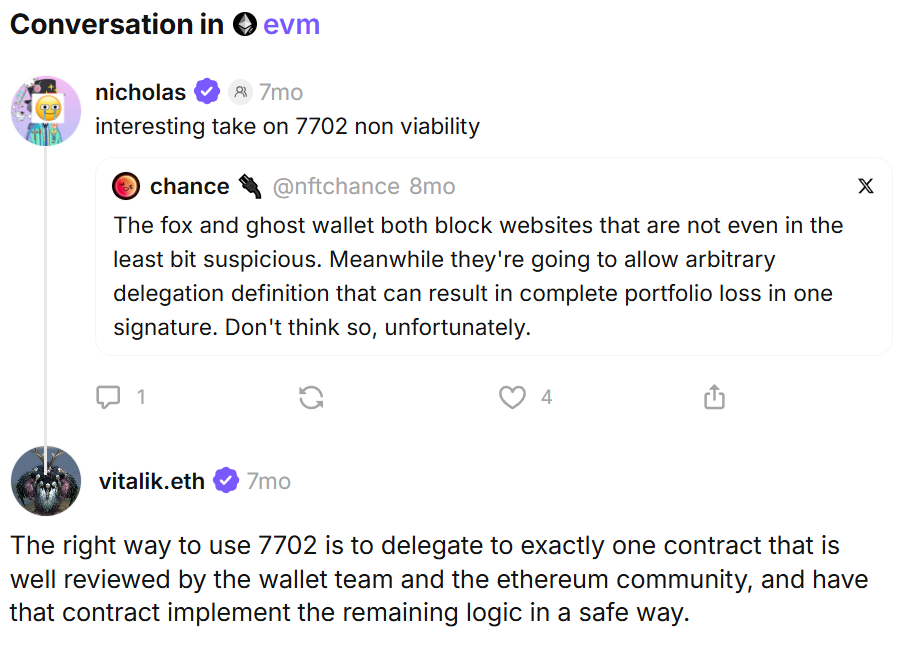
Migrating from EOA to AA requires users to move assets to a new address—a cumbersome process. Vitalik Buterin’s EIP-7702 proposal elegantly solves the compatibility disputes among EIP-4337, EIP-3074, and EIP-5003 by allowing existing EOAs to temporarily “transform” into smart contract accounts during transactions.
With this proposal, you don’t need to register a new wallet or move assets from your current wallet (like imToken) to a new AA address. Instead, EIP-7702 enables your existing account to temporarily gain smart contract features—such as batch authorization, gas sponsorship, and atomic cross-chain operations. After the transaction, it reverts to its original EOA state with full compatibility.
III. EIL’s Implementation and Future
Unlike the community-driven, bottom-up approach of OIF, EIL is spearheaded by the Ethereum Foundation’s Account Abstraction team—the creators of ERC-4337—giving it a more official character.
Current progress focuses on three critical areas:
- Multi-chain expansion of ERC-4337: The community is exploring how to extend the UserOp structure to include cross-chain information like target chain IDs—a foundational step toward cross-chain smart accounts.
- Integration with ERC-7702: As EIP-7702 advances, ordinary EOA users can seamlessly access the EIL network, dramatically lowering entry barriers.
- Standardized messaging interfaces: Just as OIF standardizes intent, EIL is driving standardization in message transmission. Projects like Optimism’s Superchain, Polygon’s AggLayer, and ZKsync’s Elastic Chain are exploring interoperability within their ecosystems, while EIL aims to connect these diverse networks into a universal messaging layer.
Beyond connectivity, EIL is also addressing a foundational need: privacy.
If EIP-7702 and AA solve accessibility, then Vitalik’s Kohaku privacy framework—announced at Devconnect—may be the next piece of the EIL puzzle, echoing the “Trustless Manifesto” principle of censorship resistance.
At Devconnect, Vitalik declared, “privacy is freedom,” emphasizing Ethereum’s ongoing privacy upgrade path to deliver real-world privacy and security. The Ethereum Foundation has assembled a privacy team of 47 researchers, engineers, and cryptographers dedicated to making privacy a first-class property of Ethereum.
This means that in the future, privacy protection will be as fundamental and seamless as transferring assets. The Kohaku framework is a key step—using your public key to generate a temporary stealth address, enabling private operations without exposing links to your main wallet.
With this design, future AA accounts will serve not only as asset management tools but also as privacy shields.
By integrating protocols like Railgun and Privacy Pools, AA accounts will let users provide “proof of innocence” for compliance while safeguarding transaction privacy. Anyone can prove their funds are legitimate without revealing spending details to the outside world.
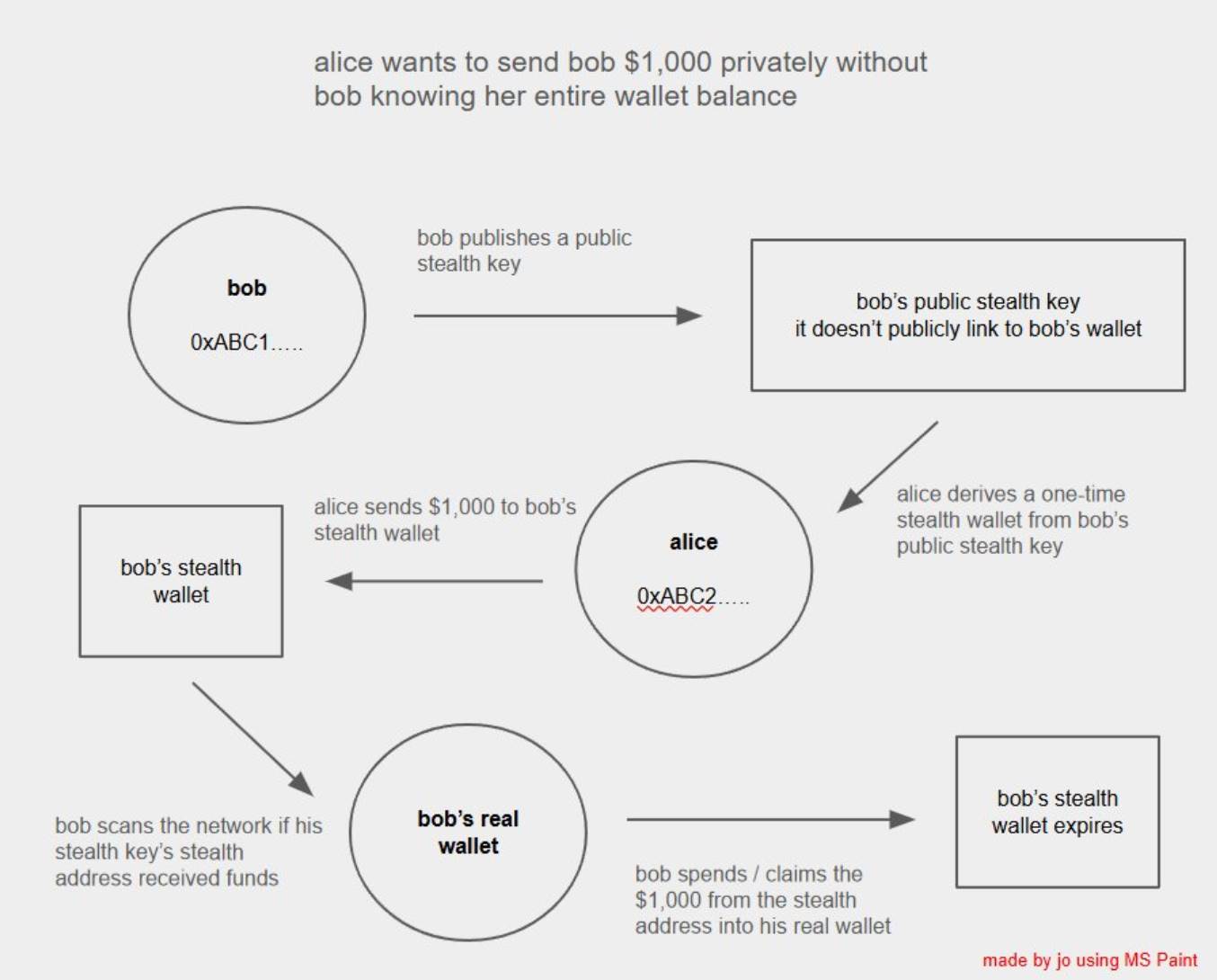
This brings the Ethereum interoperability roadmap into sharp focus:
- OIF (Intent Framework): Empowers the application layer to understand user needs.
- EIL (Interoperability Layer): Establishes the infrastructure for seamless execution.
This is a clear signal from the Ethereum Foundation: Ethereum should not be a loose federation of Layer 2s, but a unified, global supercomputer.
Once EIL is fully realized, new users may never need to learn what Layer 2s or cross-chain bridges are. All they’ll see are assets—no barriers between chains.
Disclaimer:
- This article is republished from [TechFlow]. Copyright belongs to the original author [imToken]. For republication concerns, please contact the Gate Learn team, who will handle the matter promptly in accordance with procedures.
- Disclaimer: The views and opinions expressed herein are solely those of the author and do not constitute investment advice.
- Other language versions of this article are translated by the Gate Learn team. Without reference to Gate, reproduction, distribution, or plagiarism of the translated article is strictly prohibited.
Share
Content


Related Articles

What Is Ethereum 2.0? Understanding The Merge

Reflections on Ethereum Governance Following the 3074 Saga
Our Across Thesis

What is Neiro? All You Need to Know About NEIROETH in 2025
An Introduction to ERC-20 Tokens