RSS3 vs NEAR: A Comprehensive Comparison of Two Leading Blockchain Platforms for Web3 Infrastructure


Introduction: RSS3 vs NEAR Investment Comparison
In the cryptocurrency market, comparisons between RSS3 and NEAR are topics that investors cannot overlook. The two assets not only show significant differences in market capitalization rankings, application scenarios, and price performance, but also represent different positioning within the crypto asset landscape. RSS3 (RSS3): Since its launch in 2022, it has gained market recognition by positioning itself as a decentralized content and social protocol designed to support efficient and decentralized information distribution. NEAR (NEAR): Since its inception in 2020, it has been recognized as a highly scalable base protocol that enables fast DApp execution on mobile devices, with the ambition to achieve linear scalability through state sharding. This article will conduct a comprehensive analysis of RSS3 vs NEAR's investment value comparison across historical price trends, supply mechanisms, and technical ecosystems, attempting to answer the question that investors care most about:
"Which is the better buy right now?"
Comparative Analysis Report: RSS3 vs NEAR Protocol
December 22, 2025
I. Historical Price Comparison and Current Market Status
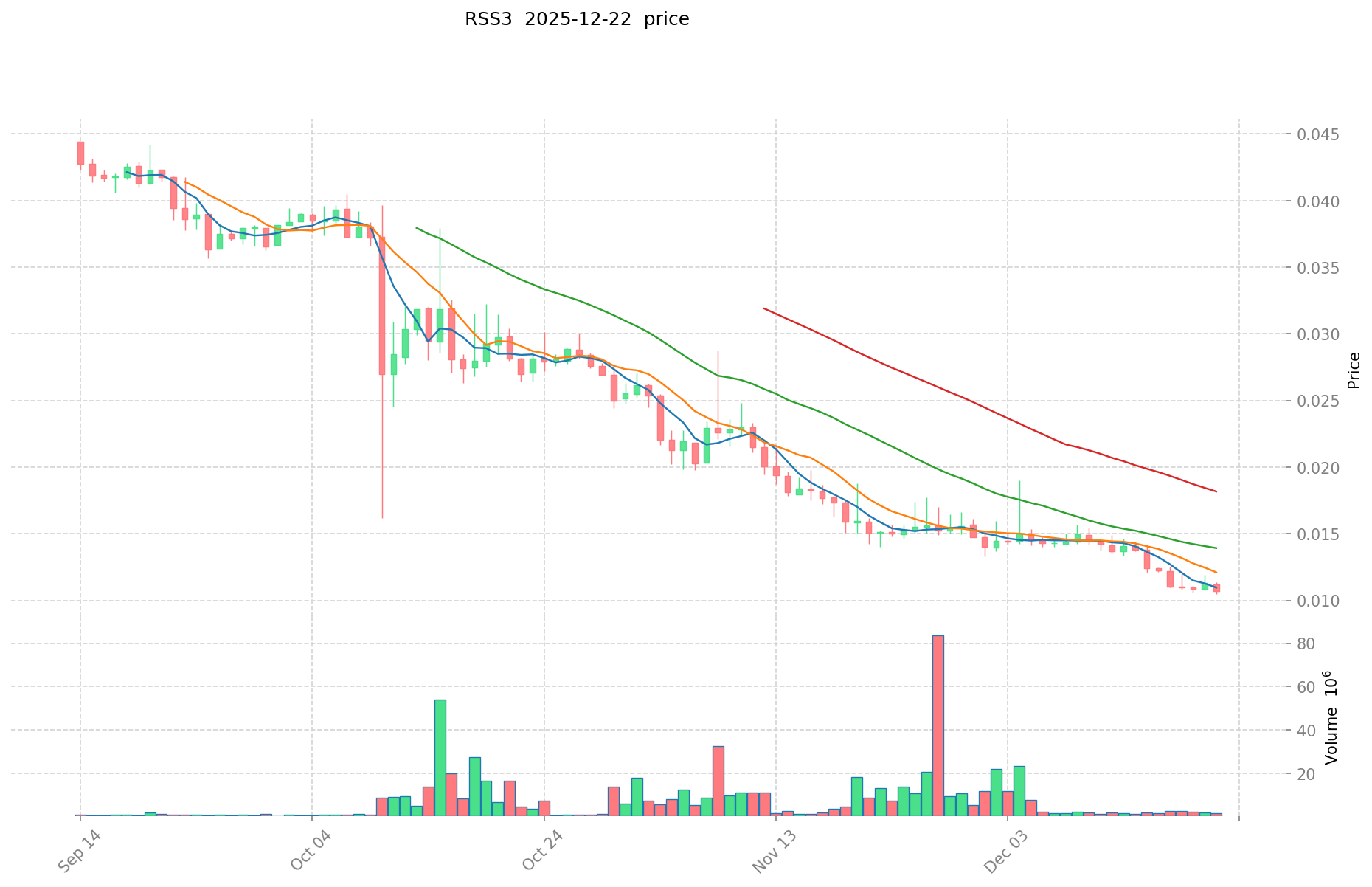
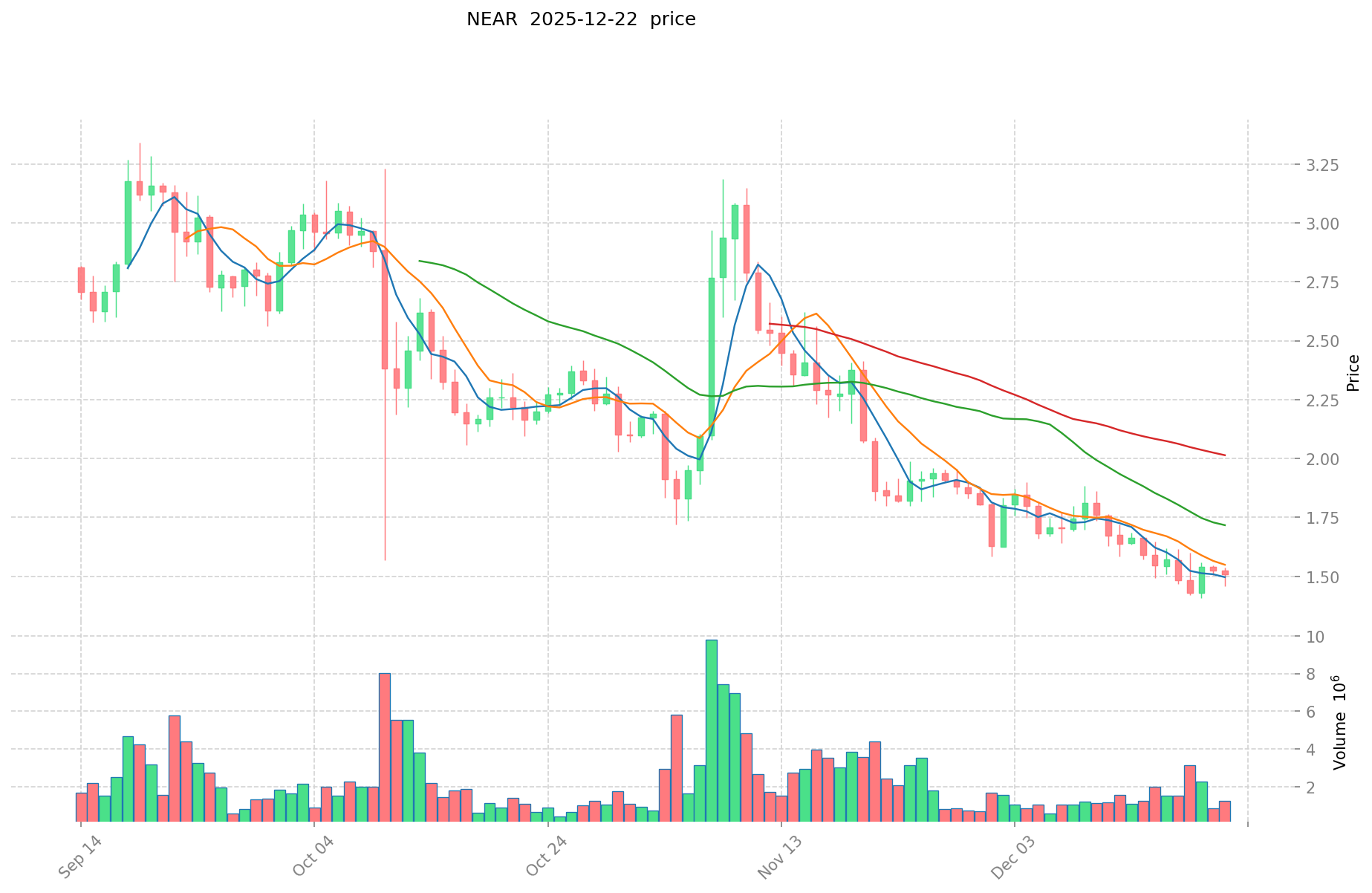
RSS3 and NEAR Protocol Price Trends
RSS3 Historical Performance:
- All-Time High: $0.687355 (February 15, 2022)
- All-Time Low: $0.01054354 (December 21, 2025)
- Current Price: $0.01069 (as of December 22, 2025)
- Decline from ATH to Current: 98.45%
NEAR Protocol Historical Performance:
- All-Time High: $20.44 (January 17, 2022)
- All-Time Low: $0.526762 (November 5, 2020)
- Current Price: $1.509 (as of December 22, 2025)
- Decline from ATH to Current: 92.62%
Comparative Analysis: Both projects have experienced substantial price depreciation since their 2022 peaks. RSS3 has declined more severely, dropping 98.45% from its all-time high, while NEAR Protocol has retreated 92.62% from its peak. The 2022 bear market significantly impacted both protocols, though NEAR has maintained relatively stronger price stability in the recovery period.
Current Market Status (December 22, 2025)
| Metric | RSS3 | NEAR Protocol |
|---|---|---|
| Current Price | $0.01069 | $1.509 |
| 24-Hour Change | -3.95% | +0.6% |
| 24-Hour Volume | $15,194.96 | $1,902,038.12 |
| Market Capitalization | $9,341,855.63 | $1,936,202,090.49 |
| Circulating Supply | 873,887,336.80 | 1,283,102,777 |
| Market Ranking | #1,211 | #49 |
| Market Dominance | 0.00034% | 0.060% |
Market Emotion Index: 25 (Extreme Fear)
Access real-time prices:
II. Technical Specifications and Utility
RSS3 Protocol Architecture
Project Overview: RSS3 is a decentralized content and social protocol designed to support efficient and decentralized information distribution. It functions as a distribution layer handling information aggregation and standardization.
Key Specifications:
- Total Supply: 1,027,345,670.88 tokens
- Circulating Supply: 873,887,336.80 tokens (87.39% circulated)
- Network: Ethereum (ERC-20)
- Contract Address: 0xc98d64da73a6616c42117b582e832812e7b8d57f
- Active Holders: 22,850
- Listed on: 15 exchanges
NEAR Protocol Architecture
Project Overview: NEAR Protocol is a highly scalable Layer-1 blockchain designed to support decentralized application (dApp) deployment. It employs sharding technology enabling linear network scalability with transaction node growth, targeting 100,000 transactions per second based on one million mobile nodes.
Key Specifications:
- Total Supply: 1,283,102,770 tokens
- Circulating Supply: 1,283,102,777 tokens (128.31% - indicates additional release mechanisms)
- Network: Independent Layer-1 blockchain
- Consensus Mechanism: Proof-of-Stake with Doomslug consensus and Nightshade 2.0 sharding
- Active Holders: 43,961
- Listed on: 53 exchanges
- Token Uses: Transaction fees, validator rewards, network staking, governance participation, data storage collateral
III. Price Performance Analysis
Short-Term Price Movements
| Time Period | RSS3 Change | NEAR Change |
|---|---|---|
| 1 Hour | +0.09% | -0.4% |
| 24 Hours | -3.95% | +0.6% |
| 7 Days | -22.08% | -7.19% |
| 30 Days | -28.49% | -19.93% |
| 1 Year | -91.18% | -70.12% |
Analysis: RSS3 demonstrates increased volatility and downward pressure compared to NEAR Protocol. Over the one-year period, RSS3 has depreciated 91.18%, significantly outpacing NEAR's 70.12% decline. The 7-day performance shows RSS3 declining 22.08% versus NEAR's 7.19% decline, indicating greater weakness in RSS3's current market position.
Market Capitalization and Trading Activity
RSS3 maintains a market capitalization of $9.34 million with daily trading volume of $15,194.96, reflecting limited liquidity and market interest. NEAR Protocol's market capitalization of $1.94 billion with daily volume of $1.90 million demonstrates substantially stronger market participation and liquidity. This represents a market cap differential of approximately 207 times, indicating vastly different market scales and investor confidence levels.
IV. Ecosystem and Development Status
RSS3 Ecosystem Resources
Official Channels:
- Website: https://rss3.io
- Twitter: https://twitter.com/rss3_
- GitHub: https://github.com/NaturalSelectionLabs/RSS3-Protocol
- Block Explorer: https://etherscan.io/token/0xc98d64da73a6616c42117b582e832812e7b8d57f
The protocol focuses on information distribution infrastructure with limited public documentation regarding ongoing development initiatives.
NEAR Protocol Ecosystem Resources
Official Channels:
- Website: https://near.org/
- Twitter: https://twitter.com/nearprotocol
- GitHub: Multiple repositories including near, nearprotocol/near-wallet, nearprotocol/nearlib, nearprotocol/nearcore
- Block Explorer: https://nearblocks.io/
- White Paper: https://near.org/papers/the-official-near-white-paper/
Development Focus: NEAR has demonstrated significant recent development momentum with multiple protocol upgrades implemented within recent periods. The protocol emphasizes artificial intelligence integration, user-owned AI agents, chain abstraction for seamless cross-chain transactions, and scalable infrastructure for DApp deployment.
V. Risk Assessment and Market Considerations
Liquidity and Market Exposure
RSS3 exhibits substantially lower liquidity with trading activity concentrated across 15 exchanges, whereas NEAR Protocol's presence on 53 exchanges provides superior market accessibility. The daily volume differential of approximately 125 times favors NEAR Protocol for institutional and retail trading activity.
Price Volatility
Both assets reflect significant volatility typical of speculative cryptocurrency markets. The extreme fear market sentiment (Fear & Greed Index: 25) indicates heightened market risk and potential for continued downward pressure on asset prices.
Holder Concentration
NEAR Protocol maintains 43,961 active token holders compared to RSS3's 22,850 holders, suggesting broader community participation and reduced concentration risk for NEAR.
VI. Summary
RSS3 and NEAR Protocol operate within distinct market segments and development stages. NEAR Protocol demonstrates superior market scale, liquidity, ecosystem maturity, and development momentum. RSS3 operates as a more specialized content distribution protocol with limited market penetration and trading volume. Current market conditions reflect extreme fear sentiment affecting both assets, with RSS3 experiencing more severe depreciation over extended time horizons. The 200-fold market capitalization differential underscores fundamental differences in project adoption, institutional support, and market recognition.
RSS3 Investment Value Analysis Report
I. Executive Summary
RSS3 is a decentralized protocol designed to index and structure open information across networks, enhancing accessibility and relevance in the Web3 ecosystem. This report analyzes the core factors influencing RSS3's investment value based on available market research and protocol characteristics.
II. Core Factors Affecting RSS3 Investment Value
Supply Mechanism and Scarcity
- Limited Token Supply: RSS3 features a finite token supply model, which creates scarcity dynamics that support potential value appreciation as demand increases.
- 📌 Scarcity Impact: Token scarcity combined with institutional adoption serves as a fundamental driver of long-term value sustainability, particularly in speculative crypto markets where supply constraints often correlate with price movements during bull cycles.
Institutional Adoption and Market Application
- Institutional Investment Potential: RSS3's investment value proposition is strengthened by its appeal to institutional investors seeking exposure to decentralized data infrastructure.
- Enterprise Adoption: The protocol's ability to provide structured, accessible information positions it as valuable for applications analogous to search engines (Google), social platforms (Twitter), and AI systems (OpenAI). Enterprise adoption in these sectors could significantly expand use cases.
- Regulatory Environment: As with all cryptocurrency assets, regulatory clarity in major jurisdictions remains an important consideration for institutional participation and mainstream adoption.
Technological Innovation and Ecosystem Development
- Decentralized Node Infrastructure: RSS3's core functionality relies on decentralized nodes that continuously index and structure data from open networks, ensuring information accessibility to all participants.
- Web3 Data Value Distribution: The protocol addresses a fundamental Web3 question regarding how value created through user data should be distributed back to data producers, with token economics serving as the mechanism for value redistribution.
- Ecosystem Growth: Development of the RSS3 ecosystem across Web3 applications directly impacts the protocol's utility and long-term value proposition.
Macroeconomic Environment and Market Dynamics
- Blockchain Technology Adoption: Continued development and proliferation of blockchain technology enhance the prominence of digital assets like RSS3 as institutional investors and enterprises recognize their value.
- Market Sentiment and Cycles: As with all cryptocurrency investments, RSS3's price and investment potential remain subject to broader market trends and macroeconomic conditions.
- Risk Monitoring: Investors should maintain close attention to market performance and associated investment risks inherent to the cryptocurrency asset class.
III. Key Investment Considerations
| Factor | Relevance |
|---|---|
| Limited Supply | Supports scarcity-driven value dynamics |
| Institutional Adoption | Enhances credibility and price stability potential |
| Technological Innovation | Drives ecosystem expansion and use case development |
| Macroeconomic Conditions | Influences market cycles and investor sentiment |
| Regulatory Clarity | Critical for mainstream institutional participation |
IV. Risk Factors
As with all cryptocurrency investments, investors should carefully monitor RSS3's market performance and remain cognizant of inherent volatility and regulatory risks associated with the digital asset class.
Report Date: December 22, 2025
Data Source: Market research from CoinMarketCap, Gate, Bitget, and CoinGlass
III. 2025-2030 Price Forecast: RSS3 vs NEAR
Short-term Forecast (2025)
- RSS3: Conservative $0.0077-0.0106 | Optimistic $0.0106-0.0141
- NEAR: Conservative $1.0220-1.5030 | Optimistic $1.5030-1.7435
Mid-term Forecast (2027-2028)
- RSS3 may enter a consolidation phase with recovery signals, projected price range $0.0086-0.0186
- NEAR may enter a growth expansion phase, projected price range $1.5958-3.0719
- Key drivers: Institutional capital inflows, ETF approvals, ecosystem development acceleration
Long-term Forecast (2029-2030)
- RSS3: Base case scenario $0.0173-0.0207 | Optimistic scenario $0.0249-0.0284
- NEAR: Base case scenario $2.5953-2.6472 | Optimistic scenario $2.6990-3.5207
Disclaimer: The above forecasts are based on historical data analysis and market modeling. Cryptocurrency markets are highly volatile and unpredictable. These predictions do not constitute investment advice. Investors should conduct their own due diligence and consult with financial professionals before making investment decisions. Past performance does not guarantee future results.
RSS3:
| 年份 | 预测最高价 | 预测平均价格 | 预测最低价 | 涨跌幅 |
|---|---|---|---|---|
| 2025 | 0.0140581 | 0.01057 | 0.0077161 | -1 |
| 2026 | 0.015515703 | 0.01231405 | 0.007142149 | 15 |
| 2027 | 0.01864593451 | 0.0139148765 | 0.00862722343 | 30 |
| 2028 | 0.01839685822065 | 0.016280405505 | 0.013024324404 | 52 |
| 2029 | 0.025661175156981 | 0.017338631862825 | 0.014911223402029 | 62 |
| 2030 | 0.028379872633071 | 0.021499903509903 | 0.014404935351635 | 101 |
NEAR:
| 年份 | 预测最高价 | 预测平均价格 | 预测最低价 | 涨跌幅 |
|---|---|---|---|---|
| 2025 | 1.74348 | 1.503 | 1.02204 | 0 |
| 2026 | 2.0452824 | 1.62324 | 1.5745428 | 7 |
| 2027 | 2.402882172 | 1.8342612 | 1.595807244 | 21 |
| 2028 | 3.0719289447 | 2.118571686 | 1.9067145174 | 40 |
| 2029 | 2.699060327964 | 2.59525031535 | 1.920485233359 | 71 |
| 2030 | 3.52071657780381 | 2.647155321657 | 2.3824397894913 | 75 |
Comparative Investment Analysis Report: RSS3 vs NEAR Protocol
IV. Investment Strategy Comparison: RSS3 vs NEAR
Long-term vs Short-term Investment Strategy
RSS3: Suitable for investors focused on emerging Web3 data infrastructure with high risk tolerance and extended investment horizons. The protocol's positioning as a decentralized content distribution layer appeals to investors betting on institutional adoption of data indexing infrastructure. However, current market conditions and limited liquidity suggest this represents a speculative, long-term thesis rather than near-term value realization.
NEAR Protocol: Suitable for investors seeking exposure to Layer-1 blockchain infrastructure with established ecosystem maturity and developer adoption. NEAR's positioning as a scalable base protocol with mobile-first architecture appeals to investors prioritizing technological infrastructure with demonstrated traction and reduced execution risk compared to earlier-stage protocols.
Risk Management and Asset Allocation
Conservative Investor Profile:
- RSS3: 0-5% portfolio allocation (speculative exposure only)
- NEAR Protocol: 15-25% allocation (core infrastructure holding)
- Hedge instruments: Stablecoin positioning (40-50%), Bitcoin/Ethereum correlation hedges (25-35%)
Aggressive Investor Profile:
- RSS3: 10-20% allocation (asymmetric upside potential despite downside risks)
- NEAR Protocol: 30-40% allocation (growth infrastructure exposure)
- Hedge instruments: Options strategies for volatility management, cross-protocol diversification (15-25%)
V. Comparative Risk Analysis
Market Risk
RSS3: Exhibits extreme market fragmentation with daily trading volume of $15,194.96 across 15 exchanges, creating significant liquidity risk and wide bid-ask spreads. Market capitalization of $9.34 million represents minimal institutional capital deployment, increasing vulnerability to individual trader actions and sentiment reversals. One-year price decline of 91.18% indicates severe market confidence erosion.
NEAR Protocol: Maintains substantially lower market risk through $1.90 million daily trading volume across 53 exchanges and $1.94 billion market capitalization. Broader exchange distribution reduces liquidity concentration risk, though one-year depreciation of 70.12% reflects broader cryptocurrency market weakness rather than protocol-specific concerns.
Technology Risk
RSS3: Protocol operates as an Ethereum-based ERC-20 token without independent consensus mechanism, creating dependency on Ethereum network security and scalability. Limited public documentation regarding technical roadmap and development priorities presents uncertainty regarding competitive positioning relative to alternative data indexing solutions.
NEAR Protocol: Implements Proof-of-Stake consensus with Doomslug finality mechanism and Nightshade 2.0 sharding architecture, demonstrating technological sophistication for horizontal scalability. Independent Layer-1 status eliminates protocol-layer dependency risks, though execution risks remain regarding sharding implementation effectiveness at scale.
Regulatory Risk
RSS3: As a decentralized information protocol with limited institutional adoption, regulatory exposure remains relatively contained. However, potential future regulation of data indexing, privacy preservation, or content moderation mechanisms could impact protocol utility and token value.
NEAR Protocol: Established Layer-1 blockchain status creates greater regulatory exposure, particularly regarding treatment as securities, staking reward taxation, and cross-chain bridge regulation. Broader institutional participation increases scrutiny from financial regulators across multiple jurisdictions.
VI. Conclusion: Which Is the Better Buy?
Investment Value Summary
RSS3 Advantages:
- Specialized focus on decentralized content distribution addresses genuine Web3 infrastructure gap
- Limited token supply (1.03 billion) creates scarcity dynamics
- Potential asymmetric upside if institutional adoption accelerates in data infrastructure sector
- Early-stage protocol positioned before potential mainstream recognition
NEAR Protocol Advantages:
- Established Layer-1 infrastructure with proven developer adoption and ecosystem maturity
- Superior market liquidity with 125x higher daily trading volume enables efficient entry/exit
- Broader exchange distribution (53 vs 15) reduces liquidity concentration risk
- Development momentum focused on AI integration, chain abstraction, and scalable infrastructure
- 43,961 active holders versus 22,850 for RSS3 indicates stronger community participation
- Market capitalization 207x larger reflects institutional confidence and reduced execution risk
Investment Recommendations
Beginner Investors: Recommend NEAR Protocol as primary exposure to Layer-1 blockchain infrastructure. The protocol's established ecosystem, superior liquidity, and broader holder base reduce learning curve complexity and execution risk. RSS3 exposure should be avoided until investor sophistication regarding speculative early-stage protocols increases.
Experienced Investors: Consider NEAR Protocol as core infrastructure holding (25-35% cryptocurrency allocation) combined with tactical RSS3 positions (5-10% allocation) for asymmetric upside if data infrastructure adoption accelerates. Implement disciplined rebalancing mechanisms and stop-loss parameters given extreme market sentiment conditions (Fear Index: 25).
Institutional Investors: NEAR Protocol represents more appropriate exposure through its presence on 53 exchanges, substantially larger market capitalization enabling meaningful position sizing, and established governance participation mechanisms. RSS3 remains unsuitable for institutional deployment given illiquidity constraints and limited public documentation regarding tokenomics and development roadmap.
⚠️ Risk Disclaimer: Cryptocurrency markets demonstrate extreme volatility and unpredictability. This analysis does not constitute investment advice. Both RSS3 and NEAR Protocol have experienced 70-98% depreciation from peak valuations, reflecting significant downside risk. The extreme fear market sentiment (Fear & Greed Index: 25) indicates heightened market stress conditions. Investors must conduct independent due diligence, understand personal risk tolerance, and consult qualified financial professionals before deploying capital. Past performance does not guarantee future results. Regulatory changes, technological failures, or market sentiment reversals could materially impair asset values.
Report Date: December 22, 2025
Data Sources: CoinMarketCap, Gate, Bitget, CoinGlass, Etherscan, Nearblocks
Market Conditions: Extreme Fear Sentiment (Fear & Greed Index: 25)
None
RSS3 vs NEAR Protocol: Frequently Asked Questions
VII. FAQ
Q1: Which asset demonstrates superior liquidity for trading purposes?
A: NEAR Protocol substantially outperforms RSS3 in liquidity metrics. NEAR maintains daily trading volume of $1,902,038.12 across 53 exchanges, compared to RSS3's $15,194.96 volume across 15 exchanges—representing a 125-fold volume differential. NEAR's broader exchange distribution and deeper order books enable institutional-scale position entry and exit with minimal slippage, whereas RSS3's fragmented liquidity creates significant bid-ask spread risk and potential execution delays. For active traders requiring reliable liquidity, NEAR Protocol remains the superior choice.
Q2: What explains the divergent price depreciation between RSS3 and NEAR since their 2022 peaks?
A: Both protocols experienced severe depreciation during the 2022 bear market, though RSS3 declined more dramatically. RSS3 dropped 98.45% from its $0.687355 all-time high to current $0.01069, while NEAR retreated 92.62% from its $20.44 peak to $1.509. This divergence reflects protocol-specific adoption challenges for RSS3 combined with broader market sentiment erosion. NEAR's superior market capitalization ($1.94 billion vs RSS3's $9.34 million) and institutional participation enabled more resilient price stabilization during market recovery phases.
Q3: Should conservative investors consider RSS3 given its extreme price depreciation?
A: Conservative investors should avoid RSS3 exposure entirely. The protocol exhibits extreme volatility, negligible liquidity, and limited ecosystem maturation despite its 98.45% decline from peak valuations. Conservative investor profiles require assets demonstrating established adoption, institutional backing, and reliable liquidity mechanisms—criteria RSS3 fails to satisfy. NEAR Protocol represents the appropriate conservative cryptocurrency exposure through its Layer-1 infrastructure positioning and 207-fold larger market capitalization, though cryptocurrency allocation should remain modest (15-25%) within overall portfolio construction.
Q4: How does token supply architecture impact long-term value appreciation potential?
A: RSS3 features finite token supply (1,027,345,670.88 total) with 87.39% circulation, creating scarcity dynamics theoretically supporting value appreciation during demand expansion. NEAR maintains 1,283,102,770 total supply with 128.31% circulating supply, indicating additional release mechanisms through validator rewards and inflation schedules. Scarcity-driven value appreciation requires sustained demand growth and institutional capital inflows—conditions RSS3 has failed to demonstrate. NEAR's supply mechanism balances scarcity with protocol incentive structures for validator participation and network security, representing more thoughtful tokenomics engineering aligned with Layer-1 infrastructure requirements.
Q5: Which protocol presents greater technological execution risk?
A: RSS3 presents elevated technological risk through its Ethereum ERC-20 token architecture without independent consensus mechanisms, creating dependency on Ethereum network performance and scalability solutions. Protocol documentation regarding technical roadmap and competitive differentiation remains limited. NEAR Protocol implements sophisticated Proof-of-Stake consensus with Doomslug finality and Nightshade 2.0 sharding architecture, demonstrating advanced engineering for horizontal scalability. However, NEAR faces execution risk regarding sharding implementation effectiveness at massive scale. Overall, NEAR's architectural sophistication and published technical documentation indicate lower execution uncertainty compared to RSS3's underdocumented protocol specifications.
Q6: What portfolio allocation percentages are appropriate for each protocol across investor profiles?
A: Conservative investors should allocate 15-25% cryptocurrency exposure to NEAR Protocol with 0-5% RSS3 allocation reserved for extremely high-risk tolerance investors only. Aggressive cryptocurrency investors may deploy 30-40% allocation to NEAR with 10-20% RSS3 allocation for asymmetric upside exposure. Institutional investors should restrict deployment to NEAR Protocol exclusively, as RSS3's illiquidity constraints ($15,194.96 daily volume) prevent meaningful institutional position sizing. Broader portfolio construction should maintain 40-50% stablecoin positioning (hedge instruments) and 25-35% Bitcoin/Ethereum correlation hedges to manage cryptocurrency-specific volatility.
Q7: How does the current market sentiment environment (Fear Index: 25) influence investment timing for each asset?
A: Extreme fear market conditions (Fear & Greed Index: 25) indicate heightened market stress but do not necessarily represent optimal entry points. For NEAR Protocol, extreme fear creates tactical accumulation opportunities for disciplined investors with extended investment horizons, though continued downside remains possible given 70.12% one-year depreciation. RSS3's extreme fear environment compounds existing illiquidity challenges, reducing execution reliability and increasing transaction costs through wider spreads. Neither asset presents immediate tactical urgency; investors should prioritize establishing positions during relative stability periods with disciplined dollar-cost averaging strategies rather than attempting to time extreme fear bottoms.
Q8: Which asset aligns with artificial intelligence and Web3 adoption trends through 2030?
A: NEAR Protocol directly targets artificial intelligence integration through development initiatives emphasizing user-owned AI agents and decentralized AI infrastructure deployment. The protocol's scalable architecture and mobile-first design position it advantageously for AI application deployment compared to RSS3's content distribution focus. RSS3's data indexing functionality could potentially support AI training and reasoning applications, though limited ecosystem development suggests uncertain pathway to institutional AI adoption. NEAR's established developer ecosystem and institutional backing provide more credible AI integration trajectory, whereas RSS3 remains speculative regarding AI sector positioning through 2030.
Report Date: December 22, 2025
Data Sources: CoinMarketCap, Gate, Bitget, CoinGlass, Etherscan, Nearblocks
Disclaimer: This analysis does not constitute investment advice. Cryptocurrency markets demonstrate extreme volatility and unpredictability. Investors must conduct independent due diligence and consult qualified financial professionals before deploying capital.
Share
Content
Introduction: RSS3 vs NEAR Investment Comparison
December 22, 2025
I. Historical Price Comparison and Current Market Status
II. Technical Specifications and Utility
III. Price Performance Analysis
IV. Ecosystem and Development Status
V. Risk Assessment and Market Considerations
VI. Summary
I. Executive Summary
II. Core Factors Affecting RSS3 Investment Value
III. Key Investment Considerations
IV. Risk Factors
III. 2025-2030 Price Forecast: RSS3 vs NEAR
IV. Investment Strategy Comparison: RSS3 vs NEAR
V. Comparative Risk Analysis
VI. Conclusion: Which Is the Better Buy?
VII. FAQ
How to Buy Cryptocurrency


Trending Cryptocurrencies



2025 KAIA Price Prediction: Expected Market Trends and Investment Outlook for the Innovative Digital Asset

2025 ALT Price Prediction: Analyzing Market Trends and Potential Growth Factors

What is IKA: A Comprehensive Guide to Understanding International Kinematics and Automation

Understanding Directed Acyclic Graphs in Blockchain Technology

Exploring DAG Technology in Blockchain Networks
Understanding Directed Acyclic Graph in Blockchain Technology

What are the main smart contract vulnerabilities and security risks in Syrup and DeFi protocols?

What is BITBOARD: A Comprehensive Guide to Chess Programming's Most Powerful Data Structure

What is on-chain data analysis? A complete guide to active addresses, whale movements, and transaction trends

What is TOKEN: A Comprehensive Guide to Understanding Digital Tokens in Blockchain and Cryptocurrency

What is BEEFI: A Comprehensive Guide to Bee Finance and Its Revolutionary Impact on DeFi Ecosystem