What is ETH: A Comprehensive Guide to Ethereum's Native Cryptocurrency

9-9-2025, 7:56:40 AM
Blockchain
DeFi
Ethereum
NFTs
Web 3.0
Article Rating : 4.1
0 ratings
This comprehensive guide explores Ethereum (ETH), its technical architecture, market performance, and significance as the second-largest cryptocurrency by market cap. Covering Ethereum's development history, decentralized network operation, smart contract functionality, and market metrics, it assists readers in understanding its ecosystem, partnerships, and challenges. Ideal for developers, investors, and cryptocurrency enthusiasts, the article delivers insights on Ethereum's blockchain technology, scalability issues, and community dynamics. It also suggests ways to participate in the Ethereum ecosystem, making it a valuable resource for those interested in decentralized finance and blockchain innovation.
What is ETH: A Comprehensive Guide to Ethereum's Native Cryptocurrency

Ethereum's Positioning and Significance

In 2015, Vitalik Buterin and co-founders launched Ethereum (ETH), aiming to address the limitations of existing blockchain platforms by introducing programmable smart contracts.

As the first major smart contract platform, Ethereum plays a crucial role in DeFi, NFTs, and decentralized applications (dApps).

As of 2025, Ethereum has become the second-largest cryptocurrency by market capitalization, boasting over 413 million unique addresses and a thriving developer ecosystem. This article will delve into its technical architecture, market performance, and future potential.

Origins and Development History

Birth Background

Ethereum was created by Vitalik Buterin and co-founders in 2015, with the goal of expanding blockchain technology beyond simple value transfer to support complex, programmable applications.

It emerged during the early blockchain boom, aiming to provide a platform for decentralized applications and smart contracts, opening up new possibilities for developers and users across various industries.

Important Milestones

  • 2015: Mainnet launch, introducing smart contract functionality to blockchain technology.
  • 2022: The Merge upgrade transitioned Ethereum from Proof-of-Work to Proof-of-Stake, significantly reducing energy consumption.
  • 2023: Shanghai upgrade enabled staking withdrawals, enhancing liquidity for ETH stakers.
  • 2025: Ecosystem explosion, with thousands of dApps and DeFi protocols built on Ethereum.

With support from the Ethereum Foundation and a global community of developers, Ethereum continues to optimize its technology, security, and real-world applications.

How Does Ethereum Work?

No Central Control

Ethereum operates on a decentralized network of computers (nodes) worldwide, free from control by banks or governments. These nodes collaborate to validate transactions, ensuring system transparency and attack resistance, granting users greater autonomy and enhancing network resilience.

Blockchain Core

Ethereum's blockchain is a public, immutable digital ledger recording every transaction. Transactions are grouped into blocks, linked through cryptographic hashes to form a secure chain. Anyone can view the records, establishing trust without intermediaries. Layer 2 solutions and upcoming sharding technology further enhance performance.

Ensuring Fairness

Ethereum uses Proof-of-Stake (PoS) consensus to validate transactions and prevent fraudulent activities like double-spending. Validators stake ETH to maintain network security and receive ETH rewards. This innovative approach is significantly more energy-efficient than the previous Proof-of-Work system.

Secure Transactions

Ethereum uses public-private key cryptography to protect transactions:

  • Private keys (like secret passwords) are used to sign transactions
  • Public keys (like account numbers) are used to verify ownership

This mechanism ensures fund security while transactions remain pseudonymous. Additional features like smart contract audits and formal verification enhance security for decentralized applications built on Ethereum.

Ethereum's Market Performance

Circulation Overview

As of September 9, 2025, Ethereum's circulating supply is 120,705,000.4650543 coins, which is also its total supply. The maximum supply is infinite, indicating an inflationary model.
New coins enter the market through mining and staking rewards, influencing its supply and demand dynamics.

Price Fluctuations

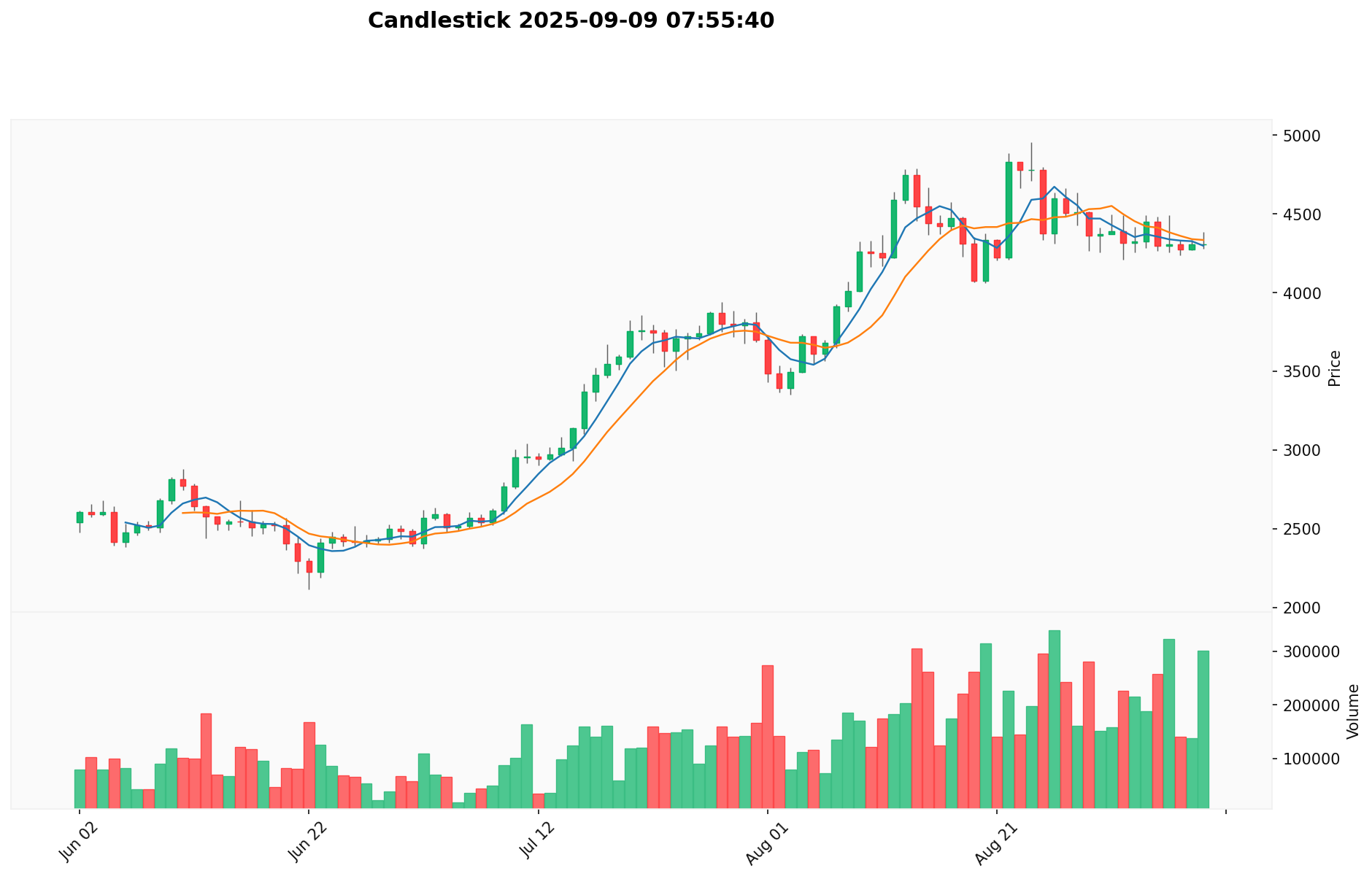
Ethereum reached its all-time high of $4,946.05 on August 25, 2025, driven by increased institutional adoption and the successful implementation of network upgrades.
Its lowest price was $0.432979, occurring on October 20, 2015, during the early stages of the project's development.
These fluctuations reflect market sentiment, adoption trends, and external factors affecting the cryptocurrency space.

Click to view the current ETH market price
price-image

On-Chain Metrics

  • Daily Transaction Volume: $1,434,183,913.81 (indicating network activity)
  • Active Addresses: 413,897,185 (reflecting user engagement)
  • Staking Rate: Data not available in the provided information

Ethereum Ecosystem Applications and Partnerships

Core Use Cases

Ethereum's ecosystem supports various applications:

  • DeFi: Uniswap, providing decentralized exchange services.
  • NFTs: OpenSea, driving digital collectibles and art marketplaces.
  • GameFi: Axie Infinity, promoting blockchain-based gaming.

Strategic Collaborations

Ethereum has established partnerships with Microsoft, ConsenSys, and Enterprise Ethereum Alliance, enhancing its technological capabilities and market influence. These partnerships provide a solid foundation for Ethereum's ecosystem expansion.

Controversies and Challenges

Ethereum faces the following challenges:

  • Technical Issues: Scalability bottlenecks and high gas fees
  • Regulatory Risks: Potential SEC scrutiny on ETH's security status
  • Competitive Pressure: Rise of alternative Layer 1 blockchains

These issues have sparked discussions within the community and market, driving Ethereum's continuous innovation.

Ethereum Community and Social Media Atmosphere

Fan Enthusiasm

Ethereum's community is vibrant, with daily transaction volumes exceeding 1 million and wallet addresses growing to over 200 million. On X, Ethereum-related posts and hashtags like #Ethereum frequently trend, with monthly post volumes reaching millions. Price surges and upgrades like EIP-1559 have ignited community enthusiasm.

Social Media Sentiment

Sentiment on X shows polarization:

  • Supporters praise Ethereum's strong security and decentralization, viewing it as the "foundation of future finance".
  • Critics focus on scalability issues and environmental concerns.

Recent trends indicate generally bullish sentiment during market uptrends.

Hot Topics

X users actively discuss Ethereum's regulatory uncertainties, energy consumption, and the transition to Proof-of-Stake, highlighting both its transformative potential and challenges in mainstream adoption.


More Information Sources on Ethereum

  • Official Website: Visit Ethereum's official website for features, use cases, and latest updates.
  • Whitepaper: Ethereum Whitepaper authored by Vitalik Buterin, detailing its technical architecture, goals, and vision.
  • X Updates: On X, Ethereum uses @ethereum, with over 3 million followers as of September 2025, Posts cover technical upgrades, community events, and partnership news, generating thousands of likes and retweets.

Ethereum's Future Roadmap

  • 2026: Launch sharding, enhancing transaction throughput and reducing fees
  • Ecosystem Goal: Support 10,000 DApps and attract 1 billion users
  • Long-term Vision: Become the global standard for decentralized applications and smart contracts

How to Participate in Ethereum?

  1. Purchase Channels: Buy ETH on Gate.com
  2. Storage Solutions: Use MetaMask for secure storage
  3. Participate in Governance: Engage in community decisions through Snapshot platform
  4. Build on Ethereum: Visit Ethereum Developer Portal to develop DApps or contribute code

Summary

Ethereum has redefined digital currency through blockchain technology, offering transparency, security, and efficient smart contract execution. Its active community, rich resources, and strong market performance make it stand out in the cryptocurrency space. Despite facing regulatory and scalability challenges, Ethereum's innovative spirit and clear roadmap secure its important position in the future of decentralized technology. Whether you're a novice or an experienced player, Ethereum is worth watching and participating in.

FAQ

What is ETH used for?

ETH is used to pay for transactions, execute smart contracts, and secure the Ethereum network. It's also a digital asset for investment and decentralized finance applications.

How much is 1 ETH worth right now?

As of September 9, 2025, 1 ETH is worth $4,375.42. This price reflects a 1.83% increase in the last 24 hours.

Why is ETH worth money?

ETH has value due to its utility in the Ethereum network, serving as fuel for transactions and smart contracts. Its scarcity and growing demand also contribute to its worth.

What does ETH mean for payment?

ETH means using Ethereum cryptocurrency for secure, digital transactions. It's a method to send and receive payments on the Ethereum network.

* The information is not intended to be and does not constitute financial advice or any other recommendation of any sort offered or endorsed by Gate.
Related Articles
What Is the Ethereum Mainnet? Understanding the Core Blockchain

What Is the Ethereum Mainnet? Understanding the Core Blockchain

Explore the Ethereum mainnet, the pivotal backbone of the Ethereum ecosystem, where real transactions, smart contracts, and dApps thrive. This article elucidates core concepts such as transactions, validators, and gas fees vital for understanding blockchain functionality. It highlights differences between mainnet and testnet environments and examines features catalyzing the Web3 revolution, including smart contracts and NFTs. Ideal for developers, blockchain enthusiasts, and beginners, it offers insights into navigating Ethereum through platforms like Gate, enhancing your grasp of decentralized finance and digital ownership.
9-12-2025, 5:26:24 PM
How to Measure Crypto Community Engagement: A Deep Dive into Social Media Metrics and DApp Ecosystems

How to Measure Crypto Community Engagement: A Deep Dive into Social Media Metrics and DApp Ecosystems

The article explores how to measure crypto community engagement by diving into social media metrics, community interaction, developer contributions, and DApp ecosystems. It highlights Ethereum's strengths with detailed insights into Twitter and Telegram influences, Reddit engagement, and GitHub activity, offering valuable data for cryptocurrency projects and investors. Key queries addressed include how social media presence impacts market value and how developer contributions affect platform growth. With sections dedicated to each metric category, the article effectively guides readers through understanding and applying these insights, making it ideal for crypto enthusiasts and analysts.
10-27-2025, 11:29:36 AM
How Does Ethereum's Community Vibrancy Impact Its Ecosystem Growth in 2025?

How Does Ethereum's Community Vibrancy Impact Its Ecosystem Growth in 2025?

This article explores the influence of Ethereum's vibrant community on its ecosystem growth in 2025, highlighting its social media dominance with 15 million Twitter followers and active developer contributions from over 4,000 weekly developers. It delves into Ethereum’s thriving developer ecosystem with 31,869 active participants and its expansive decentralized application (DApp) landscape, boasting over 3,000 active DApps and 1 million daily users. The analysis addresses cryptocurrency enthusiasts, developers, and investors interested in Ethereum’s ecosystem dynamics. Key sections cover social media metrics, community engagements, developer insights, and DApp proliferation, emphasizing Ethereum's leadership in blockchain innovation.
10-23-2025, 10:57:45 AM
What is Ethereum's Fundamental Analysis and How Does it Impact Investment Decisions?

What is Ethereum's Fundamental Analysis and How Does it Impact Investment Decisions?

Explore Ethereum's fundamental analysis and discover its impact on investment decisions. This article covers the core logic of Ethereum's revolutionary design with smart contracts and decentralized applications, highlighting Ethereum's role in DeFi, NFTs, and Web3. It addresses the transition to proof-of-stake efficiency and prospects with experts projecting Ethereum's growth. Readers will gain insights into how these elements affect valuation and investor strategies. Ideal for investors, developers, and enthusiasts, the article illuminates Ethereum's potential in reshaping the digital economy.
11-25-2025, 8:17:15 AM
What is ESE: Understanding the Electrical and Systems Engineering Field

What is ESE: Understanding the Electrical and Systems Engineering Field

The article explores Eesee, a digital asset liquidity solution launched in 2024, designed to enhance the trading volume in the Web3 ecosystem. It covers Eesee's origins, milestones, and its decentralized operation on Ethereum blockchain, emphasizing secure and fair transactions. Readers will gain insights into Eesee's market performance, ecosystem applications, and community dynamics. The article addresses issues such as market competition and regulatory concerns, while outlining Eesee's future roadmap. Suitable for digital asset enthusiasts, it highlights ways to engage with Eesee, including purchasing ESE tokens on Gate.
11-24-2025, 5:41:21 AM
Understanding ENS: A Comprehensive Guide to Ethereum Name Service

Understanding ENS: A Comprehensive Guide to Ethereum Name Service

This article provides a comprehensive guide to Ethereum Name Service (ENS), detailing its functionality, importance, and applications within the decentralized web ecosystem. It addresses the need for simpler, human-readable names for Ethereum addresses, enhancing accessibility and user-friendliness. Covering ENS's operation, significance, and how to use it, the article highlights potential applications in DeFi and decentralized identity systems. The text structure includes sections on ENS basics, operation, importance, usage, and potential impact, focusing on clear, concise information for easy scanning and quick comprehension.
12-4-2025, 2:48:16 PM
Recommended for You
Understanding Decentralized Stablecoins: A Comprehensive Guide to Dollar-Pegged Assets

Understanding Decentralized Stablecoins: A Comprehensive Guide to Dollar-Pegged Assets

This article provides a comprehensive guide to understanding decentralized stablecoins, focusing on DAI, a dollar-pegged asset created by MakerDAO. The content addresses key aspects of DAI, including its operational mechanisms, governance by the MakerDAO community, and its role in the DeFi ecosystem. Readers will learn about the unique benefits and risks associated with DAI, its history and milestones, and practical usage across transactions and financial activities. Designed for those interested in decentralized finance, the article ensures quick, easy scanning with optimized keyword density for enhanced readability and accessibility.
12-20-2025, 11:50:12 PM
What is MITO: A Comprehensive Guide to Mitochondrial DNA Testing and Its Impact on Personal Health

What is MITO: A Comprehensive Guide to Mitochondrial DNA Testing and Its Impact on Personal Health

This article delves into Mitosis, a pioneering liquidity protocol redefining cross-chain infrastructure in the DeFi landscape. The guide explores Mitosis' innovative derivative token mechanism, enabling liquidity providers to maximize capital efficiency across various blockchain networks. It addresses the challenges of cross-chain liquidity, offering solutions ideal for DeFi enthusiasts and investors. The article outlines Mitosis' architecture, market performance, and technical foundations, providing a comprehensive overview for those interested in multi-chain DeFi optimization. Gate is highlighted for trading MITO tokens securely and effectively.
12-20-2025, 11:42:37 PM
What is CAMP: Understanding the Cyclic Adenosine Monophosphate Signaling Pathway in Cellular Communication
What is CAMP: Understanding the Cyclic Adenosine Monophosphate Signaling Pathway in Cellular Communication

This article explores the Camp Network (CAMP), a specialized Layer-1 blockchain focused on intellectual property management and AI agent deployment within the Web3 ecosystem. It addresses fragmentation, inefficient IP registration, royalty distribution, and lack of standardized frameworks for tokenizing AI agents. By embedding IP governance with a Proof of Provenance Protocol, Camp Network empowers creators to securely manage and monetize IP. The article outlines its origins, operations, market performance, and community engagement, with CAMP available for trading on Gate. Keywords include: intellectual property, AI agents, blockchain, tokenization, decentralization.
12-20-2025, 11:41:47 PM
What is TSTBSC: A Comprehensive Guide to Understanding Time Series Time-Bounded Statistical Computing
What is TSTBSC: A Comprehensive Guide to Understanding Time Series Time-Bounded Statistical Computing

The article delves into TSTBSC, a test token on the Binance Smart Chain designed for educational purposes. It offers insights into the token's technical architecture, market performance, and educational significance. Readers will benefit from understanding blockchain mechanics, decentralized finance, and tokenomics, aimed at developers and learners. Structured sections explore origins, performance metrics, transaction processes, and market analysis. Optimized for readability, the article emphasizes keywords like Binance Smart Chain, BEP-20, and Gate, ensuring quick content absorption and comprehension.
12-20-2025, 11:41:45 PM
ZOO Token Buying Guide: Listing Info, Price Forecast, and Purchase Steps

ZOO Token Buying Guide: Listing Info, Price Forecast, and Purchase Steps

The article provides a comprehensive guide to Zoo (ZOO) token, detailing its launch on major exchanges like Gate, price trends, and purchasing methods. It addresses the needs of gamers and investors by offering insights into the Telegram-based gaming platform's features, such as play-to-earn mechanics and blockchain integration. Structured logically, it first introduces Zoo's gaming concept, outlines listing details, predicts price potential, and ends with step-by-step buying instructions. This streamlined overview enhances keyword density and readability for quick scanning, suited for those interested in blockchain-based gaming investments.
12-20-2025, 11:41:29 PM
What is VANRY: A Comprehensive Guide to Understanding This Innovative Digital Platform

What is VANRY: A Comprehensive Guide to Understanding This Innovative Digital Platform

The article provides a comprehensive guide to Vanar (VANRY), an innovative L1 blockchain aimed at real-world adoption, focusing on gaming, metaverse, AI, and enterprise solutions. It outlines Vanar's unique ecosystem, technical architecture, market performance, and core applications. The content addresses challenges and opportunities in Web3 integration and emphasizes VANRY's role in transaction processing and community engagement. Key insights include market volatility analysis and investment considerations, offering valuable information for potential investors and tech enthusiasts.
12-20-2025, 11:40:58 PM
