Bitcoin liquidity is quietly tightening as exchange balances sink to levels not seen since November 2017, signaling a shrinking pool of readily tradable supply just as market demand cycles intensify.
Bitcoin Exchange Supply Shrinks as Long-Term Holding Trend Accelerates
A shift in bitcoin’s liquid supply is drawing attention after a key on-chain metric reached an eight-year low. Crypto analytics platform Santiment shared on social media platform X on March 13 that the percentage of bitcoin held on centralized exchanges has dropped to its lowest level since November 2017. The firm wrote:
“Based on available tracked wallets, the percentage of bitcoin on exchanges has dropped to its lowest level since November, 2017. In the over eight years since, it’s fair to say that quite a bit has changed in both crypto and the world.”
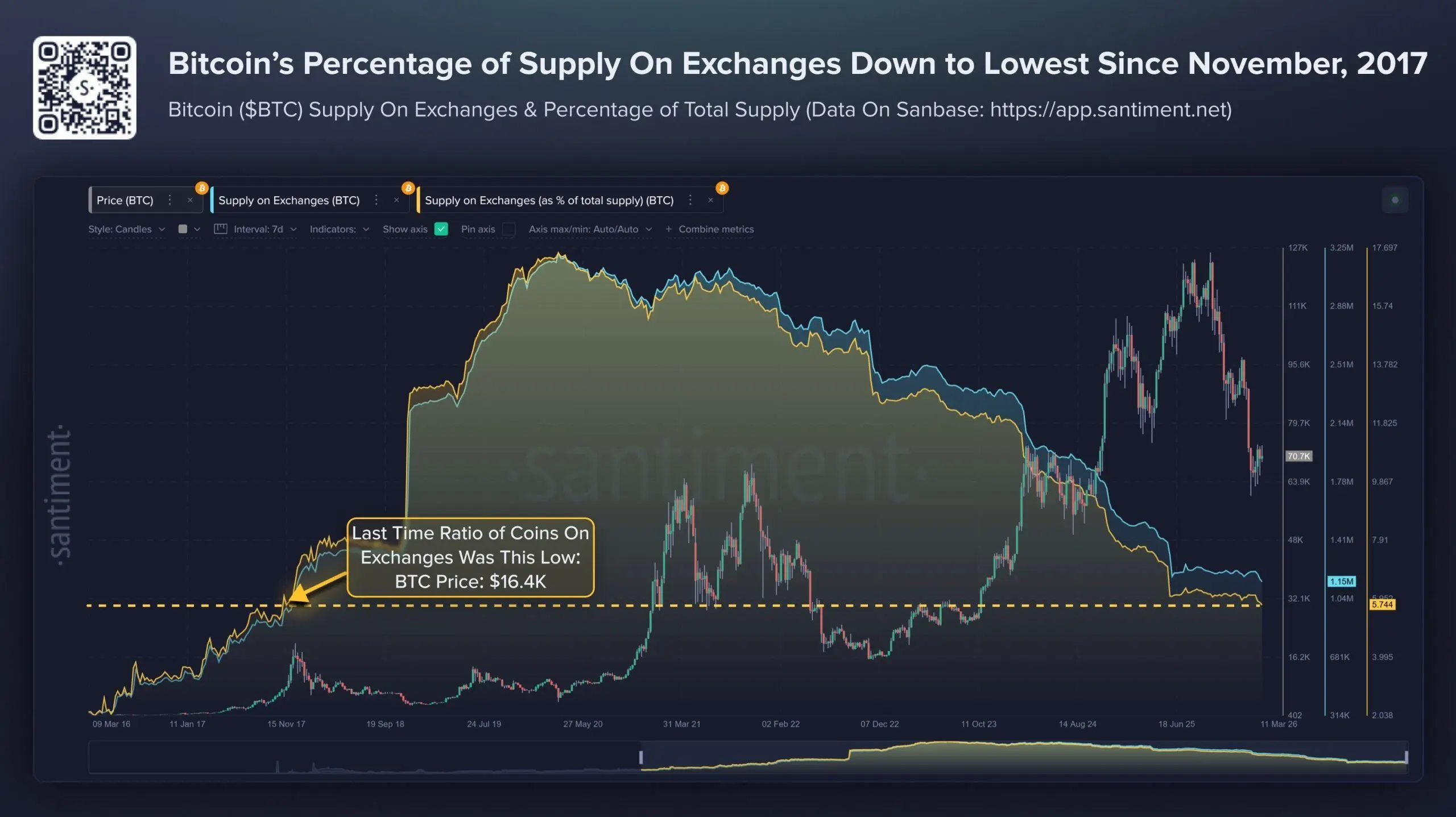
Santiment also shared a chart comparing bitcoin’s exchange supply ratio with market price and the total number of coins held in known wallets on centralized trading platforms across multiple market cycles. The data shows the percentage of bitcoin supply on exchanges has declined to roughly 5.74% of total supply, while the amount of BTC held on exchanges stands near 1.15 million BTC. Historical data in the same chart shows exchange balances previously climbed above 3 million BTC during earlier market cycles before entering a prolonged downward trend.
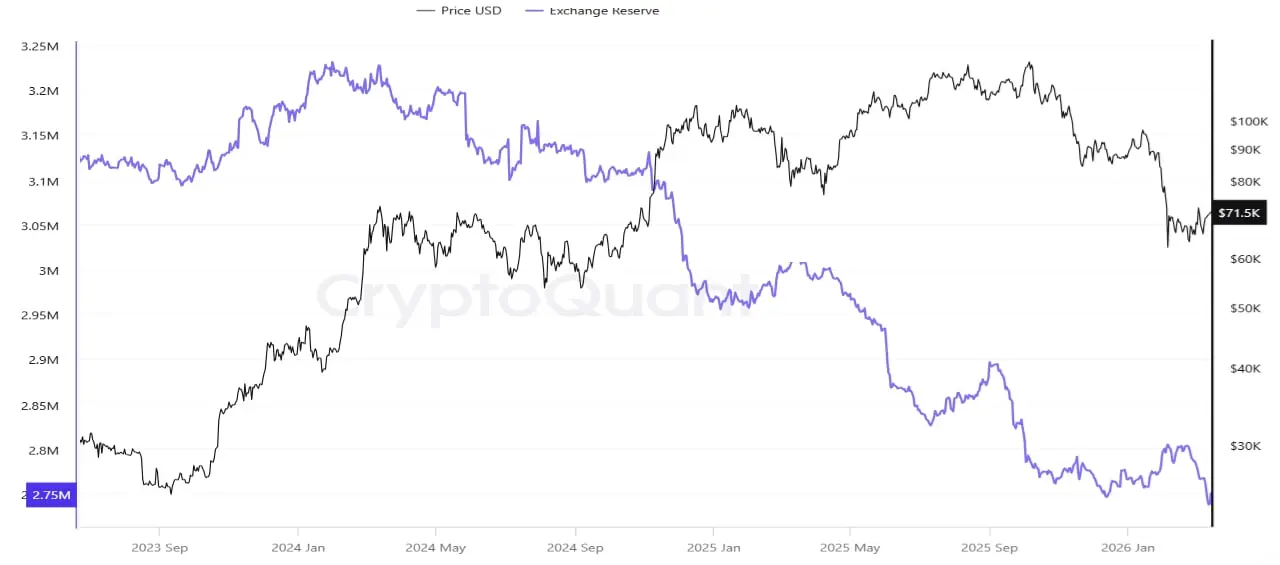
Meanwhile, data from crypto analytics platform Cryptoquant highlights a similar trend in exchange reserves over recent years. The data shows the total number of bitcoin held on exchanges declining from above 3.2 million BTC during 2024 to roughly 2.73 million BTC by March 2026. It also compares exchange-held balances with bitcoin’s market price, which is around $70,500 in the latest reading. The timeline spans roughly 2022 through March 2026, illustrating how exchange reserves steadily trended downward while bitcoin moved through multiple market cycles.
Such declines in exchange balances are often interpreted as a shift from short-term trading activity toward longer-term holding behavior among investors. When bitcoin moves off exchanges into private wallets or cold storage, those coins are typically no longer immediately available to sell on the open market. With fewer coins available on exchange order books, the market may become more sensitive to demand shifts, meaning relatively smaller buy or sell orders can have a larger effect on price movements compared with periods of higher exchange liquidity.
FAQ 🧭
- Why are falling bitcoin exchange balances important for investors?
Lower exchange balances suggest fewer coins are available to sell, which can tighten supply and amplify price moves during periods of rising demand.
- What does Santiment’s exchange supply metric measure?
It tracks the percentage of bitcoin held in wallets associated with centralized exchanges relative to the asset’s circulating supply.
- How can declining exchange reserves affect bitcoin price volatility?
With fewer coins on exchanges, smaller buy or sell orders can move the market more aggressively due to reduced liquidity.
- What does the shrinking remaining bitcoin supply mean for the market?
With more than 20 million coins mined and less than 5% remaining, scarcity dynamics may increasingly influence long-term valuation.
Disclaimer: The information on this page may come from third parties and does not represent the views or opinions of Gate. The content displayed on this page is for reference only and does not constitute any financial, investment, or legal advice. Gate does not guarantee the accuracy or completeness of the information and shall not be liable for any losses arising from the use of this information. Virtual asset investments carry high risks and are subject to significant price volatility. You may lose all of your invested principal. Please fully understand the relevant risks and make prudent decisions based on your own financial situation and risk tolerance. For details, please refer to
Disclaimer.
Related Articles
Bitcoin Breaks Below $74K as 24-Hour Decline Reaches 0.02%
Gate News message, April 16 — Bitcoin fell below the $74,000 level, currently trading at $73,906 with a 24-hour decline of 0.02%.
GateNews11m ago
Newly Created Wallet Withdraws 1,470 BTC Worth $109M from Major CEX
Gate News message, April 16 — According to Onchain Lens, a newly created wallet withdrew 1,470 BTC, valued at approximately $109 million, from a major CEX.
GateNews13m ago
BTC falls below 74000 USDT
Gate News bot message, Gate quotes show that BTC has fallen below 74000 USDT, with the current price at 73988.8 USDT.
CryptoRadar22m ago
Charles Schwab Launches Schwab Crypto Spot Trading for Bitcoin and Ethereum
Charles Schwab launched Schwab Crypto on April 16, a spot cryptocurrency trading service for retail customers. It supports direct trading of Bitcoin and Ethereum and offers education and support, integrating with existing financial services.
GateNews27m ago
BTC dips 0.50% over 15 minutes: high-leverage liquidation in the derivatives market triggers a passive pullback in spot
2026-04-16 13:30 to 13:45 (UTC), the BTC price fluctuated within the range of 74481.3 to 75000.0 USDT, with a return of -0.50% over 15 minutes and a swing of 0.69%. During this round of abnormal movement, market attention increased, shown by intensified short-term volatility, but it did not trigger widespread panic.
The main driver of this abnormal movement is localized forced liquidation under the high-leverage positioning environment in the derivatives market. Existing data shows that BTC perpetual futures open interest has been running at consistently high levels; leverage has accumulated in the market. Within the abnormal-movement window, long leverage is passively deleveraged, which triggers a liquidation cascade and, in turn, causes the spot price to passively dip. ETF fund flows remain neutral, contrasting with net outflows of large on-chain funds, further confirming that this price decline is mainly driven by endogenous risk release within the derivatives market.
In addition, daily-level data shows that large addresses (\u003e$10M) continue to record net outflows, with a total amount of -12,987.03 BTC. This should have provided support for the price, but during the abnormal movement period, no large-scale concentrated sell-off or a surge in on-chain activity has been observed. On the ETF side, mainstream ETF fund flows show no significant abnormal movement, indicating that institutions have not engaged in trend-based selling. Spot and derivatives trading volumes remain high. The position structures of some top platforms are highly concentrated, and with multiple factors resonating simultaneously, the effect of localized forced liquidation is amplified, which then transmits to the spot market.
The market is still in a high-leverage operating phase. Investors should be alert to the risk of a new round of forced liquidation pressure brought on by amplified future volatility. Focus on indicators such as the exchanges’ BTC net inflow/outflow, minute-level large transfers, derivatives market positions, funding rates, and liquidation volume. If there is a sudden change in fund flows on the derivatives or ETF side, there may be systemic downside risk. In the short term, the risk of sharply fluctuating market conditions is prominent, and investors should closely monitor subsequent market data and on-chain developments.
GateNews27m ago
Soluna Holdings Acquires Project Dorothy 1A for $16.5M, Accelerates AI Computing Expansion
Soluna Holdings acquired full ownership of Project Dorothy 1A for $16.5 million and completed a $53 million acquisition of the Briscoe wind farm, aiming to enhance its green data centers for AI computing and Bitcoin mining.
GateNews28m ago


