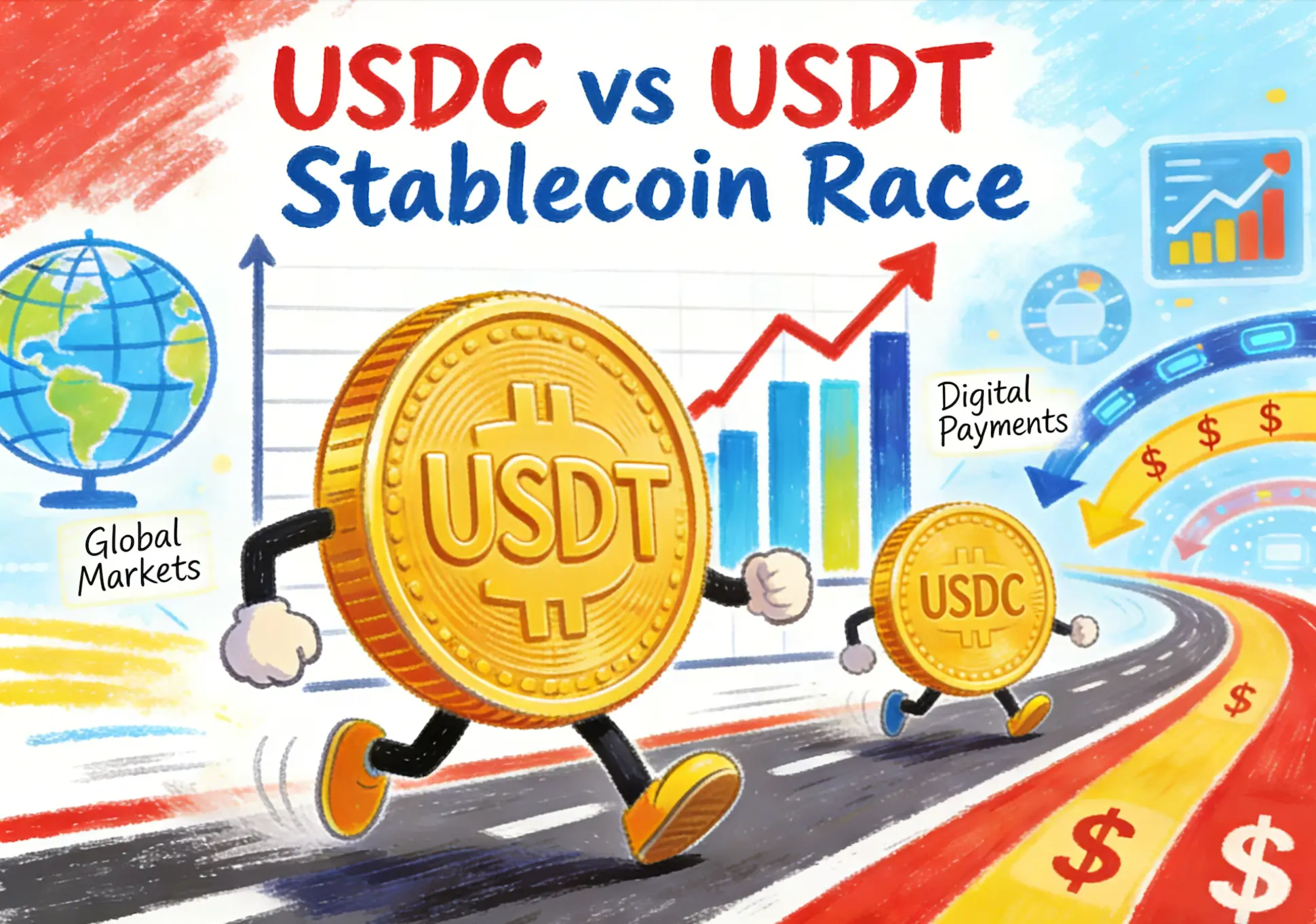
Circle’s USDC stablecoin has surpassed Tether’s USDT in adjusted transaction volume for the first time since 2019, processing approximately $2.2 trillion year-to-date compared to USDT’s $1.3 trillion, according to March 13 research from Mizuho Financial Group.
The milestone coincides with USDC supply surging past $79 billion—up from $70 billion in early February—and country-level ownership data showing USDC leading USDT in Colombia, South Africa, Germany, Brazil, and the United States. The shift reflects deepening market fragmentation driven by regulatory divergence, with USDC compliant under Europe’s Markets in Crypto-Assets (MiCA) regulation and the U.S. GENIUS Act framework, while Tether has opted out of MiCA compliance to focus on Asian and non-Western markets.
Despite USDT maintaining a $184 billion market capitalization—more than double USDC’s $79 billion—analysts at Mizuho argue that adjusted transaction volume may be a more reliable predictor of long-term dominance in stablecoin utility.
Adjusted Volume Reversal: Measuring Real Economic Activity
Definition and Significance
Adjusted transaction volume filters out automated or repetitive activity, focusing on transfers involving centralized exchanges, decentralized exchanges, and identified entities that represent genuine value movement—such as companies paying suppliers, users betting on prediction markets, or funds moving between trading venues.
Volume Breakdown
Year-to-date adjusted volumes reveal a sharp reversal of historical trends:
During the 2019-2025 period, USDT consistently dominated adjusted volume, with USDC averaging only about 30%.
Mizuho analysts raised Circle’s stock price target from $100 to $120, citing expanding USDC use cases in prediction markets and agentic commerce as evidence that the stablecoin winner will be determined by everyday economic activity rather than market capitalization alone.
Country-Level Data: Five Markets Where USDC Leads
BVNK/YouGov Survey Findings
The BVNK Stablecoin Utility Report 2026, based on a survey of 4,658 respondents across 15 countries, reveals fragmented adoption patterns.
In five surveyed markets, USDC ownership rates exceeded those of USDT. Colombia registered 29% USDC ownership compared to 25% for USDT. South Africa showed 29% USDC ownership versus 23% for USDT. In the United States, 26% of respondents reported owning USDC, outpacing USDT at 22%. Germany recorded 17% USDC ownership against 15% for USDT. Brazil rounded out the list with 16% USDC ownership compared to 14% for USDT.
USDT-Dominant Markets
USDT maintains strong leads in Nigeria (59% vs. 48% for USDC), India, the Philippines, Singapore, Thailand, Argentina, France, and the United Kingdom—markets often characterized by currency volatility or early-stage crypto adoption.
The data indicates that USDC is gaining ground in regulated Western markets while USDT retains dominance in emerging economies with established network effects.
Regulatory Strategy Divergence: MiCA and GENIUS Act Driving Market Fragmentation
Circle’s Compliance-First Approach
USDC, issued by Circle Internet Group, has obtained electronic money institution (EMI) licenses under Europe’s MiCA framework and aligns with the U.S. GENIUS Act requirements for payment stablecoins. MiCA, which entered full application for stablecoins in 2024, requires issuers to be authorized credit institutions or EMI entities with transparent reserve reporting and redemption guarantees.
Circle’s compliance has enabled USDC to maintain availability on European exchanges, while its transparent reserve disclosures and regular audits have strengthened institutional confidence in regulated markets.
Tether’s Non-Western Focus
Tether has opted out of MiCA compliance, concentrating growth in Asia and other non-Western markets where regulatory frameworks are less prescriptive. This strategy allows USDT to maintain dominance in emerging economies where demand is driven by local currency volatility and established exchange integrations, but has resulted in delistings or restrictions on European platforms.
Capital Flow Dynamics: Middle East Demand and Real Estate Rotation
Dubai OTC Activity Surge
Market observers attribute part of USDC’s recent demand to capital rotation from the UAE, as Dubai’s real estate market experiences sharp declines. Over-the-counter desks in Dubai have reportedly struggled to keep pace with USDC orders amid the shift.
Market Context
The DFM Real Estate Index has fallen approximately 31% from a recent peak of 16,800 to around 11,516. When investors in oil-rich economies move into USDC rather than traditional dollar accounts, it signals that digital dollar forms are competing with physical dollar instruments.
Broader Market Context and Outlook
Total Stablecoin Market Growth
The stablecoin market has reached a record $315 billion as of mid-March 2026, reflecting growing institutional demand across both trading and non-trading applications.
USDC Supply Trajectory
USDC circulating supply has climbed from just over $70 billion in early February to $75 billion at the start of March, surpassing $79 billion by mid-month—among the fastest supply increases for any major stablecoin.
Analyst Outlook
Analysts suggest that adjusted volume may matter more than market capitalization when predicting long-term stablecoin winners. Whether USDC can sustain its volume lead while narrowing USDT’s capitalization gap will depend on how quickly regulatory preferences and regional adoption patterns continue to fragment the market.
Frequently Asked Questions
What is “adjusted transaction volume” and why does it matter?
Adjusted transaction volume filters out automated or repetitive on-chain activity to focus on transfers representing genuine economic value—such as payments, exchange flows, and institutional settlement. Unlike raw volume or market capitalization, this metric aims to capture real-world usage and utility. Analysts argue it may be more predictive of long-term stablecoin dominance than market cap alone, as it reflects actual economic activity rather than passive holdings.
Why does USDC lead in some countries while USDT dominates others?
The divergence reflects different strategic positioning. USDC prioritizes regulatory compliance under frameworks like Europe’s MiCA and the U.S. GENIUS Act, making it attractive in markets with stringent regulatory requirements and institutional adoption. USDT focuses on network effects and accessibility in emerging economies where demand is driven by local currency volatility and established exchange integrations, but has opted out of MiCA compliance, limiting its European availability.
How significant is USDC’s transaction volume lead given USDT’s larger market cap?
Analysts view the volume lead as potentially significant for long-term positioning. While USDT’s $184 billion market cap reflects its role as a store of value and trading pair base, USDC’s $2.2 trillion in adjusted volume suggests deeper penetration in payments, institutional settlement, and emerging applications like prediction markets and agentic commerce. The divergence indicates that different stablecoins may dominate different use cases rather than a single winner-take-all outcome.
Disclaimer: The information on this page may come from third parties and does not represent the views or opinions of Gate. The content displayed on this page is for reference only and does not constitute any financial, investment, or legal advice. Gate does not guarantee the accuracy or completeness of the information and shall not be liable for any losses arising from the use of this information. Virtual asset investments carry high risks and are subject to significant price volatility. You may lose all of your invested principal. Please fully understand the relevant risks and make prudent decisions based on your own financial situation and risk tolerance. For details, please refer to
Disclaimer.


