BlackRiderCryptoLord

vip
Age 0.7 Year
Peak Tier 0
No content yet
#ShareYourUSStocksWinNvidia
#SPYX
SPY (SPDR S&P 500 ETF Trust) sits at 753.7 as of early June 2026, and the market is at a fascinating inflection point. After a relentless bull run that has seen the S&P 500 index gain roughly 26 percent in 2025, 25 percent the year before, and 18 percent in 2023, SPY is now trading near all-time highs, testing the upper boundaries of a well-defined range that traders have been watching closely for weeks. The current price of 753.7 places SPY squarely in the middle of a battleground between bulls who want to push toward 760 and beyond, and bears who are eyein
HighAmbition
#ShareYourUSStocksWinNvidia
#SPYX
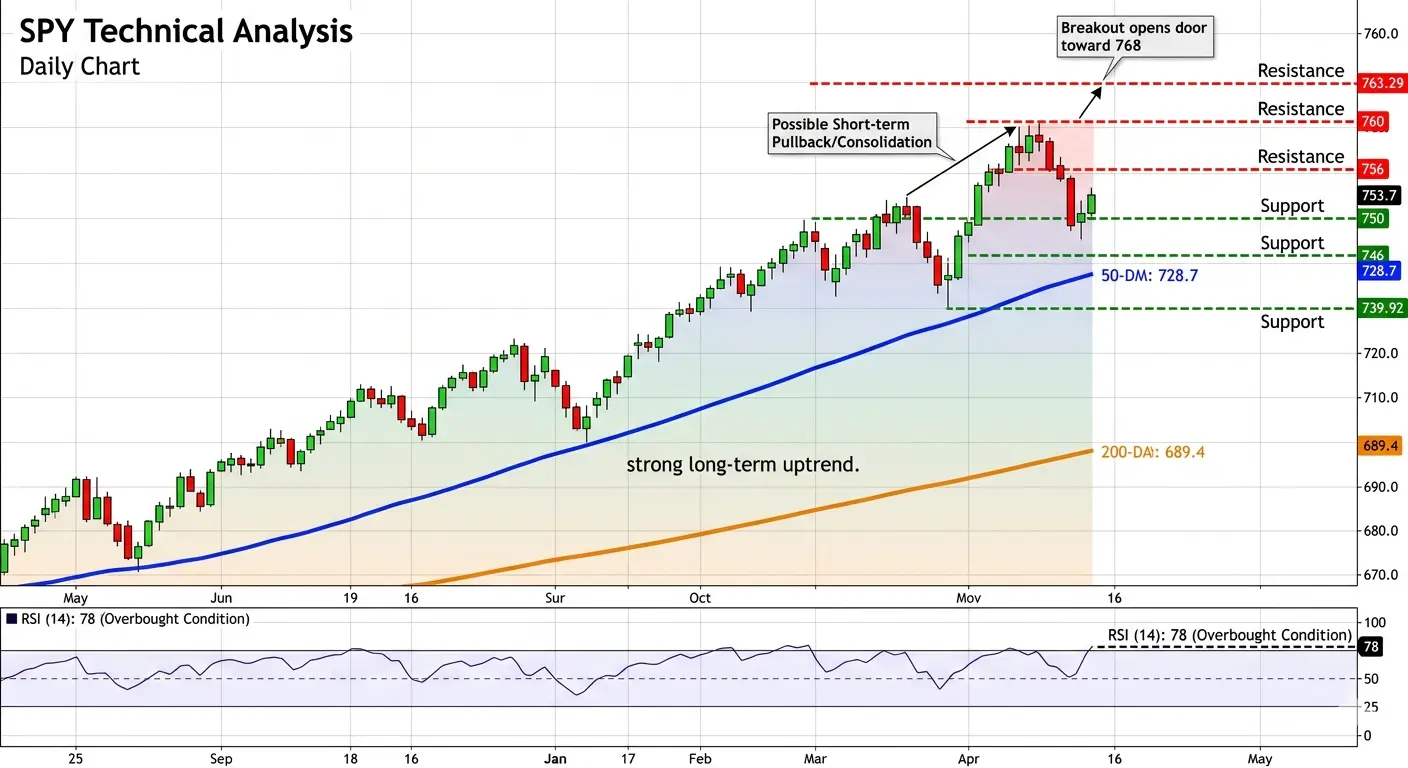
SPY (SPDR S&P 500 ETF Trust) sits at 753.7 as of early June 2026, and the market is at a fascinating inflection point. After a relentless bull run that has seen the S&P 500 index gain roughly 26 percent in 2025, 25 percent the year before, and 18 percent in 2023, SPY is now trading near all-time highs, testing the upper boundaries of a well-defined range that traders have been watching closely for weeks. The current price of 753.7 places SPY squarely in the middle of a battleground between bulls who want to push toward 760 and beyond, and bears who are eyeing a pullback toward the 750 and 746 support cluster. Let us break down every key level, every moving average signal, and every strategy consideration that matters right now.
Current Price: 753.7. This is where SPY closed the most recent session, and it tells you several things immediately. The price is above the 50-day moving average, which currently sits at approximately 728.7, and well above the 200-day moving average at roughly 689.4. When the 50-day MA trades above the 200-day MA, you have a classic golden cross formation, and that is one of the strongest bullish signals on the higher timeframe. SPY has been in this configuration for months, and the gap between these two averages has been widening, which tells you the trend is accelerating, not weakening. However, the RSI at 78.4 is flashing an overbought warning. An RSI above 70 does not mean the market will crash tomorrow, but it does mean that momentum is stretched and a healthy pullback or sideways consolidation is the most likely next phase. Traders who ignore RSI readings above 70 often get caught entering positions right at the top of a swing, only to watch the price dip 2 to 4 percent before resuming its uptrend.
Key Resistance Levels. The immediate resistance sits at 756, which is the high-volume level that bulls defended aggressively on June 3. When a high-volume level is defended, it means large institutional players stepped in with significant buy orders at that price, creating a floor that is hard to break through on the first attempt. Above 756, the next resistance is 760, which has been described by multiple analysts as the key battleground. SPY touched a new high at 760.31 recently but could not sustain above it, falling back into the range. This tells you 760 is not just a psychological round number; it is a genuine supply zone where sellers have been stepping in. The third major resistance is 763, which Intellectia AI identified as the immediate resistance level, and specifically 763.29, where a breakout could signal a full bull continuation toward new all-time highs. Above 763, you have 764 and then the 765 to 768 zone, which would represent the next leg of the rally if the market can clear 763 convincingly.
Key Support Levels. On the downside, the first support to watch is 750. This is a psychological round number that often attracts buyers simply because it looks like a clean entry point. Below 750, you have 752, which has been a consistent intraday support during the recent consolidation phase. The next critical support is 746, and below that, 739.92, which Intellectia identified as strong support. If SPY breaks below 739.92, the picture changes from a minor pullback to a more significant correction, potentially targeting the 50-day moving average at 728.7. That would represent a roughly 3.3 percent decline from the current price, which is within the range of a normal pullback in a strong uptrend. The 200-day moving average at 689.4 remains the ultimate floor for the bull case; any sustained break below that level would signal a trend change.
Forecast and Price Targets. Wall Street is remarkably optimistic about the S&P 500 for the remainder of 2026. Goldman Sachs has raised its year-end S&P 500 target to 8,000 from an earlier 7,600 projection, citing upgraded earnings estimates and AI-driven productivity gains. Deutsche Bank also targets 8,000 for year-end. HSBC and JPMorgan both call for 7,500 with upside to 8,000 if the Fed continues cutting rates. Wells Fargo targets 7,800. If you translate these index targets to SPY prices, you are looking at a range of approximately 780 to 835 by December 2026, which implies upside of 3.5 percent to 10.8 percent from the current 753.7 level. Financhill's AI-powered model projects a 52-week target of 835.81 for SPY, which aligns with the more aggressive Wall Street forecasts. Morgan Stanley's midyear outlook is constructive but not complacent, emphasizing that AI momentum is bolstering global markets while energy shocks and inflation risks remain real threats.
Trading Strategy Plans. For Swing Traders looking to go long, the ideal entry zone is between 750 and 754, where you have multiple layers of support. Place your stop loss at 746 or tighter at 739.92 depending on your risk tolerance. Your first profit target should be 760, and your second target should be 763.29. If SPY breaks above 763 with strong volume, consider holding for 768 or even 780. The risk-to-reward ratio on a long entry at 752 with a stop at 746 and a target at 763 is approximately 1.83 to 1, which is acceptable for a swing trade. For Day Traders, the 756 level is your primary focus. If SPY opens above 756 and holds, look for a push toward 760.31. If it opens below 756, watch for a test of 752 or 750. The intraday expected move for options expiring June 4 is roughly plus or minus 1.20, giving a range of 755.53 to 757.93, which tells you the market is pricing in very low volatility for the immediate session. This low expected move actually favors breakout strategies: if price moves beyond the expected range, it tends to continue in that direction with momentum. For Short Sellers or Hedgers, the overbought RSI at 78.4 provides a tactical window. A short entry near 760 with a stop at 763.29 and a target at 752 offers a risk-to-reward of roughly 1.37 to 1. This is not a high-conviction short setup because the broader trend is bullish, but it can work as a scalp or as a hedge against existing long positions. Avoid shorting below 750 unless you see a confirmed break of the 746 support.
Economic Catalysts to Monitor. The next few weeks are packed with data releases that could move SPY significantly. CPI data remains a wild card; core CPI came in hotter than expected in mid-May, which triggered a tech-led selloff. If upcoming CPI prints continue to show sticky inflation, the Fed may pause or slow its rate-cut cycle, which would pressure SPY toward the lower end of its range. PCE data, the Fed's preferred inflation gauge, is also on the radar and has already contributed to nervous positioning in small caps, with put activity surging on IWM. NFP and employment data will shape the rate-cut narrative as well. Strong employment with sticky inflation is the worst combination for SPY because it removes the dual mandate cover for rate cuts. Oil prices are another factor; they surged in mid-May before retreating, and any renewed spike could feed into inflation expectations and weigh on consumer discretionary sectors. The AI investment cycle remains the strongest bullish catalyst. Goldman Sachs estimates AI-driven productivity will add 0.4 percentage points to S&P 500 earnings growth this year and 1.5 percentage points in 2027. Enterprise AI adoption is still in early stages, meaning the earnings impact is likely to accelerate, which supports the bullish case for tech-heavy indices like SPY over the medium term.
Risk Management Tips. Never enter a position without a defined stop loss. In the current overbought environment, a pullback of 2 to 4 percent is statistically likely before the next leg up, so size your positions accordingly. Use the 756 level as your real-time indicator: if SPY holds above 756, the bull case is intact; if it loses 756 and then 750, reduce long exposure and wait for a confirmed bottom near 746 or the 50-day MA at 728.7. Avoid chasing breakouts at 760 without confirmation; the false breakout at 760.31 that reversed back into the range is a textbook example of why you wait for a closing price above resistance before committing additional capital. Keep an eye on the MACD: if the MACD line crosses below the signal line on the daily chart, that is an early warning of momentum loss even if the price has not yet broken support. Monitor volume on any move above 763 or below 746; volume confirmation is what separates a genuine breakout or breakdown from a trap.
The bottom line is that SPY at 753.7 is in a strong but stretched uptrend. The path of least resistance remains higher, supported by bullish moving average alignment, institutional accumulation above key supports, and a Wall Street consensus that targets 780 to 835 by year-end. However, the overbought RSI, the false breakout at 760.31, and the pending economic data releases all argue for patience and disciplined entry rather than aggressive buying at current levels. The best strategy right now is to wait for a pullback to the 750 to 754 zone, enter long with a stop at 746, and target 763 and then 768. If you are already long, hold but tighten your stop to 750 and prepare to add on a confirmed breakout above 763.29 with volume. The market is constructive, but complacency is the enemy. Stay sharp, respect the levels, and let price confirm your next move.
@Gate_Square #PredictNBAFinalsWin20000U #TradeCFDWinGold #ShareYourUSStocksWinNvidia
repost-content-media
  • Reward
  • 1
  • Repost
  • Share
HighAmbition:
Steadfast HODL💎
#PredictNBAFinalsWin20000U
NBA Finals 2026: Knicks vs Spurs
The 2026 NBA Finals have arrived, and the prediction market landscape on Polymarket has already experienced a dramatic shift following Game 1. This is a rematch of the iconic 1999 Finals, when the Spurs captured their first championship against these same Knicks. Twenty-seven years later, the stakes are just as high, but the market dynamics tell a completely different story now.
Polymarket Current Odds After Game 1
Right now on Polymarket, the New York Knicks sit at approximately 53.6 cents per share, translating to a 53.6 percent i
HighAmbition
#PredictNBAFinalsWin20000U
NBA Finals 2026: Knicks vs Spurs
The 2026 NBA Finals have arrived, and the prediction market landscape on Polymarket has already experienced a dramatic shift following Game 1. This is a rematch of the iconic 1999 Finals, when the Spurs captured their first championship against these same Knicks. Twenty-seven years later, the stakes are just as high, but the market dynamics tell a completely different story now.
Polymarket Current Odds After Game 1
Right now on Polymarket, the New York Knicks sit at approximately 53.6 cents per share, translating to a 53.6 percent implied probability of winning the championship. The San Antonio Spurs are trading at roughly 46.6 cents, implying a 46.6 percent chance of taking the title. The total trading volume on this market has surpassed 410 million dollars, making it one of the most heavily traded sports prediction markets in Polymarket history. This is a massive swing from where the market stood before Game 1 tipped off on June 3.
Before Game 1: Spurs Were Clear Favorites
Heading into Game 1, Polymarket had the Spurs as heavy favorites at around 64 to 66 percent implied probability, with the Knicks sitting at just 35 to 36 percent. The Vegas sportsbooks echoed this sentiment. DraftKings opened the Spurs as minus-220 favorites on the moneyline, which translates to approximately 68.75 percent implied odds. The Knicks were plus-180 underdogs. FanDuel listed the Spurs as 4.5-point home favorites for Game 1, with an over-under of 218.5 total points. The market consensus was clear: Victor Wembanyama and the Spurs, with their dominant 62-20 regular season record and the second seed in the West, were expected to control this series from the opening tip.
Game 1 Changed Everything
Then Game 1 happened, and the market flipped. The Knicks walked into Frost Bank Center in San Antonio and pulled off a statement victory, defeating the Spurs 105 to 95. The Knicks now lead the series 1 to 0. This was not a fluke win. Jalen Brunson, who briefly suffered a knee scare in the first quarter that sent a wave of panic through Knicks fans, shook it off and delivered a masterclass. He scored 30 points on 12-of-31 shooting from the field and 4-of-4 from the free throw line, including 13 crucial points in the fourth quarter when the game was on the line. Brunson was surgical in the closing minutes, hitting shot after shot as the Knicks erased what had been a 14-point Spurs lead in the third quarter.
Josh Hart was the unsung hero of Game 1, grabbing 15 rebounds with 13 on the defensive end and 2 on the offensive glass. His physicality on the boards gave the Knicks second chances and prevented the Spurs from establishing their preferred interior dominance. On the Spurs side, Victor Wembanyama recorded 26 points on 6-of-21 shooting with 12-of-13 free throws and pulled down 12 rebounds. The 6-of-21 field goal shooting, however, tells the story: Wembanyama was effective but not efficient, and the Knicks defense clearly disrupted his rhythm. DeAaron Fox contributed 5 assists but was relatively quiet as a scoring threat.
The Significance of Stealing Game 1
In NBA Finals history, the team that wins Game 1 goes on to win the series approximately 73 percent of the time. The Knicks not only won Game 1 but won it on the road, which amplifies the significance even further. For a team that was given just a 35 percent chance of winning the entire series before tip-off, stealing the opener in San Antonio is a seismic result. The Spurs had been 6-0 all-time in Game 1 of the NBA Finals before this loss. This was the first time they ever dropped the opening game of a championship series, and it clearly rattled the prediction markets.
Polymarket Series Outcome Predictions Before Game 1
Before the series began, Polymarket traders had mapped out specific series outcomes. The most likely scenario was Spurs in 5 games, at 21 percent probability. Spurs in 6 and Spurs in 7 were each at 19 percent. Combined, that meant the market saw an approximately 59 percent chance that the Spurs would win but the series would go at least five games. Knicks-specific outcomes were all priced significantly lower, with each individual Knicks-winning scenario below 10 percent. After Game 1, these numbers are surely shifting toward Knicks-friendly outcomes, though the exact updated series-specific percentages have not yet settled.
Vegas Series Spread
The Vegas series spread tells an interesting story too. Before the series, you could find Spurs minus-3.5 at plus-700 odds, meaning a big payout if the Spurs won by four or more games, but the Knicks plus-3.5 at minus-1100 reflected the market belief that even if the Knicks lost the series, they would likely push it to at least a competitive length. Spurs minus-2.5 was plus-220 and Knicks plus-2.5 was minus-275. Spurs minus-1.5 was plus-120 and Knicks plus-1.5 was minus-145. These numbers all indicated the market expected a Spurs victory but a close series. After Game 1, those expectations are being recalibrated rapidly.
Playoff Paths That Shaped Market Perception
Understanding the playoff journeys of both teams helps explain the pre-series market positioning. The Spurs entered the Finals with a 62-20 regular season record as the second seed in the Western Conference. They defeated the Portland Trail Blazers 4-1 in the first round, survived the Minnesota Timberwolves 4-2 in the second round, and then prevailed over the Oklahoma City Thunder in a grueling 4-3 series that required a Game 7 victory. That seven-game Western Conference Finals against the Thunder, where the Spurs won Game 7 by a score of 111 to 103, was a testament to their resilience but also revealed some vulnerability against elite competition.
The Knicks entered as the third seed in the East with a 53-29 regular season record. They beat the Atlanta Hawks 4-2, then swept the Philadelphia 76ers 4-0, and swept the Cleveland Cavaliers 4-0 in the Eastern Conference Finals. That back-to-back sweep of two quality opponents in the 76ers and Cavaliers built tremendous momentum and showed the Knicks were playing their best basketball at exactly the right time. The market, however, seemed to discount this momentum in favor of the Spurs superior regular season record and the sheer presence of Wembanyama.
The 410 Million Dollar Market Volume
The sheer volume on Polymarket for this NBA Champion market, exceeding 410 million dollars, demonstrates how captivated the global prediction market community is by this Finals matchup. This is not just a niche sports betting market. It is a mainstream financial event in the prediction market space, drawing participants from crypto enthusiasts, sports fans, and quantitative traders alike. The fact that volume has continued to surge even after Game 1 shows that the market sees this series as far more uncertain now than it did just days ago, and traders are actively positioning themselves on both sides.
My Personal Prediction and Analysis
Here is my take. The Knicks are going to win this series, and the Polymarket shift after Game 1 is not an overreaction but a justified correction. The pre-series odds were overweighting the Spurs regular season dominance and underweighting the Knicks playoff form. New York swept two consecutive series before the Finals. They have an elite point guard in Brunson who elevates his game in fourth quarters. They have versatile wing defenders who can bother Wembanyama. They have Karl-Anthony Towns providing interior scoring and rebounding that complements their perimeter attack. The Knicks roster is built for playoff basketball.
The Spurs have Wembanyama, who is the most transformative defensive presence in the league and a growing offensive force. But Game 1 showed that even Wembanyama at 26 points on inefficient shooting is not enough when Brunson takes over in the fourth quarter. The Spurs also just played a draining seven-game series against the Thunder before the Finals, while the Knicks arrived fresh after two sweeps. Fatigue could become a factor as this series deepens.
I predict the Knicks win in 6 games. Game 2 on June 5 in San Antonio is the pivotal contest. If the Knicks win that one and go up 2 to 0, the series is essentially over given how dominant New York has been at home throughout these playoffs. Even if the Spurs win Game 2 to tie the series at 1 to 1, the Knicks returning to Madison Square Garden for Games 3 and 4 gives them a massive home-court edge. New York City is in an absolute frenzy right now, with fans filling subway stations and Spike Lee traveling to San Antonio for Game 1. The energy at MSG for Games 3 and 4 will be overwhelming.
The Polymarket price of roughly 53.6 cents on the Knicks right now might actually be undervalued. If you believe the Knicks will win, buying at that price gives you a nearly 1-to-1 payout ratio on a outcome that, based on Game 1 evidence and the broader playoff context, looks increasingly probable. Conversely, the Spurs at 46.6 cents are priced close to fair value but carry the risk that Game 1 was not an anomaly but a signal that the Knicks are simply the better team in this particular matchup.
Series Schedule Ahead
Game 2 is scheduled for Friday, June 5 at 8:30 PM in San Antonio. Game 3 shifts to New York on Monday, June 8. Game 4 is Wednesday, June 10 also at MSG. If needed, Game 5 would be Saturday, June 13 back in San Antonio, Game 6 on Tuesday, June 16 in New York, and a potential Game 7 on Friday, June 19 in San Antonio. The schedule favors the Knicks once they get back home, and they have already proven they can win on the Spurs home floor.
Polymarket as a Window Into Collective Intelligence
What makes this Polymarket data so compelling is that it represents real financial commitment, not just opinion polls or fan sentiment. When someone buys Knicks shares at 53.6 cents, they are staking real money on that outcome. The 410 million dollars in cumulative volume means millions of individual decisions have been aggregated into these prices. The dramatic shift from Spurs 64 percent to Knicks 53.6 percent after just one game shows how responsive prediction markets are to new information. This is collective intelligence in action, and it is fascinating to watch.
Final Word
The 2026 NBA Finals between the Knicks and Spurs is shaping up to be one of the most compelling championship series in recent memory. Polymarket has already recorded a historic swing in odds after Game 1, from Spurs heavy favorites to Knicks slight favorites. The Knicks proved they can win on the road, Brunson proved he can dominate clutch moments, and the Spurs proved they are vulnerable in ways the market did not fully anticipate before June 3. My prediction stands firm: Knicks in 6. The Polymarket price on the Knicks at around 53.6 cents reflects a market that is still catching up to what Game 1 revealed. This series is far from over, but the Knicks have taken control of the narrative and the momentum. The Spurs need a response in Game 2, and if they do not get one, this Finals could end sooner than anyone expected when the odds were Spurs 64 percent and Knicks 35 percent just one week ago.
#PredictNBAFinalsWin20000U #ShareYourUSStocksWinNvidia #TradeCFDWinGold @Gate_Square for

repost-content-media
  • Reward
  • 1
  • Repost
  • Share
HighAmbition:
Steadfast HODL💎
#ETHPlunges5PercentBelow1800
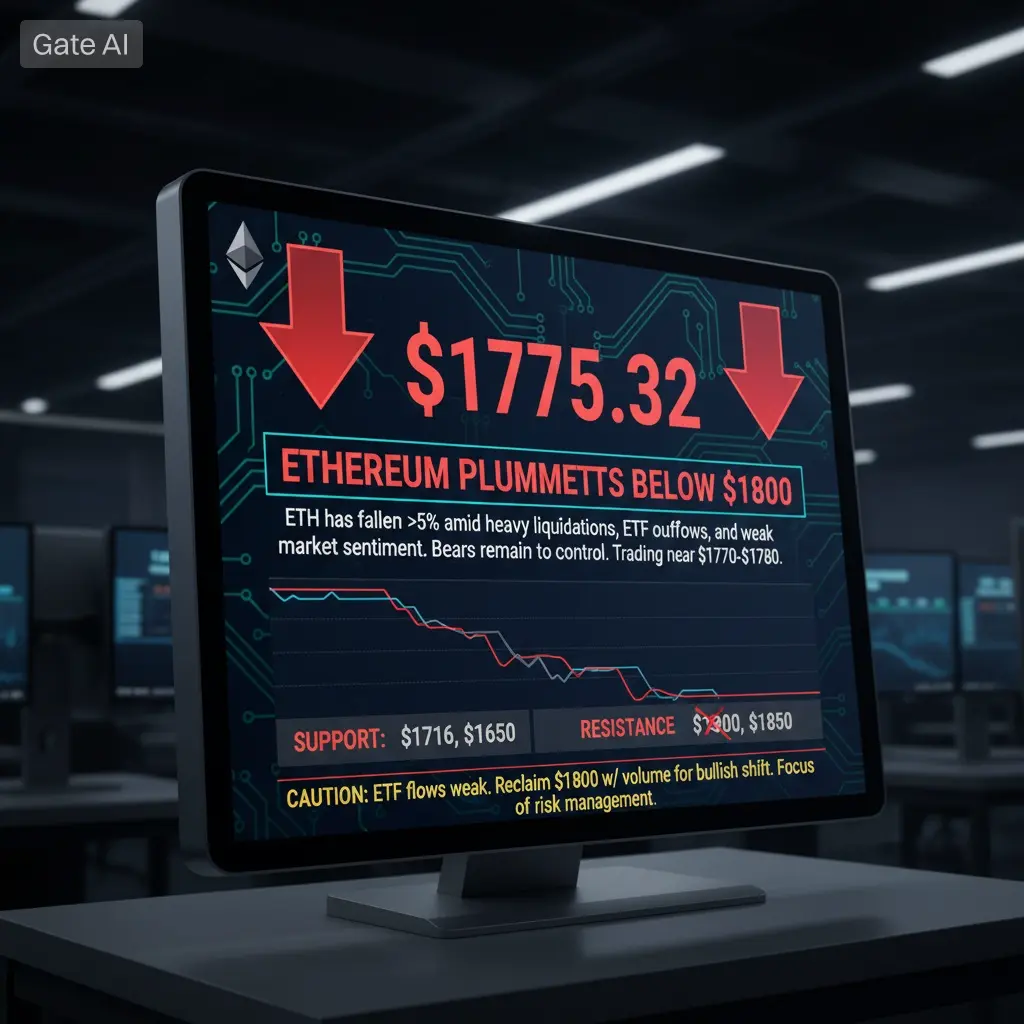
Ethereum has crashed through the critical 1800 dollar psychological support level, dropping approximately 5 percent in a single session and reaching a multi-month low near 1772 dollars, as a brutal combination of macro headwinds, cascading long liquidations, persistent ETF outflows, and a broader risk-off environment has overwhelmed buyers and left bulls struggling to survive. This is not a random dip but rather a structural collapse driven by real forced selling and institutional withdrawal, amplified by the worst weekly crypto liquidation event of 2026 so far.
W
ETH-9.03%
BTC-3.31%
HighAmbition
#ETHPlunges5PercentBelow1800
Ethereum has crashed through the critical 1800 dollar psychological support level, dropping approximately 5 percent in a single session and reaching a multi-month low near 1772 dollars, as a brutal combination of macro headwinds, cascading long liquidations, persistent ETF outflows, and a broader risk-off environment has overwhelmed buyers and left bulls struggling to survive. This is not a random dip but rather a structural collapse driven by real forced selling and institutional withdrawal, amplified by the worst weekly crypto liquidation event of 2026 so far.
WHY ETH IS FALLING CONTINUOUSLY - THE ROOT CAUSES
The biggest factor behind ETH weakness is the recent liquidation cascade across the crypto derivatives market. Approximately 1.8 billion dollars in leveraged positions were liquidated during the selloff including 1.57 billion dollars in long positions. ETH accounted for nearly 480 million dollars of those liquidations while BTC saw approximately 833 million dollars. As ETH fell from 1889 dollars toward 1800 dollars and later 1772 dollars forced selling accelerated and intensified downside momentum.
ETF outflows have also weighed heavily on sentiment. ETH ETFs recently recorded more than 170 million dollars in weekly outflows while Bitcoin ETFs saw nearly 484 million dollars leave in a single day. Reduced institutional demand removes an important support layer that previously helped stabilize prices during corrections.
The macroeconomic environment remains challenging. Negative funding rates show bearish positioning in derivatives markets while elevated bond yields and uncertainty regarding future rate cuts continue to pressure risk assets. Capital has increasingly moved toward AI-related equities and other growth sectors instead of cryptocurrencies.
Bitcoin weakness has added further pressure. BTC dropped below 67000 dollars and recorded one of its largest weekly declines of 2026. Historically when Bitcoin weakens ETH often experiences larger percentage declines. The ETH BTC ratio has remained under pressure since 2022 and continues to favor Bitcoin during periods of market stress.
CURRENT PRICE AND MARKET STATUS
ETH currently trades between 1772 and 1784 dollars after failing to maintain support above 1800 dollars. Recent trading activity produced a low near 1716 dollars while recovery attempts have struggled near 1800 dollars and 1850 dollars.
The market remains below the recent swing high at 1889 dollars and below several important moving averages. Technical momentum remains weak while 1800 dollars has shifted from support into resistance. Price action between 1716 dollars and 1889 dollars will likely determine the next major move.
FORECAST AND HOW HIGH ETH CAN GO
The short-term outlook remains cautious while ETH trades below 1800 dollars. For sentiment to improve ETH would need to reclaim 1800 dollars then push toward 1850 dollars and 1889 dollars. A successful breakout above 1889 dollars could open the path toward 2000 dollars and 2120 dollars.
If ETH establishes support above 2120 dollars the next upside targets become 2300 dollars 2500 dollars and potentially 2700 to 2900 dollars. Some long-term projections continue to target levels above 2266 dollars by year end while more aggressive forecasts envision significantly higher prices over several years if institutional adoption and ETF demand improve.
On the downside failure to hold 1716 dollars could expose ETH to 1650 dollars followed by the major support zone between 1600 dollars and 1550 dollars. If market conditions deteriorate further the next major support area sits between 1500 dollars and 1400 dollars.
KEY SUPPORT AND RESISTANCE LEVELS
Support Levels:
1889 dollars - Previous swing high
1800 dollars - Former support now resistance
1716 dollars - Recent swing low
1650 dollars - Major support
1600 dollars - Strong demand zone
1550 dollars - Critical support
1500 dollars - Psychological support
1400 dollars - Long-term support
Resistance Levels:
1800 dollars - Immediate resistance
1850 dollars - Recovery barrier
1889 dollars - Trend reversal level
2000 dollars - Major psychological resistance
2120 dollars - Key breakout level
2300 dollars - Medium-term target
2500 dollars - Strong resistance
2700 dollars - Bullish target
2900 dollars - Extended bullish target
4946 dollars - All-time high reference
TRADING STRATEGY AND WHAT IS THE NEXT PLAN
Traders should closely monitor the 1716 dollar and 1800 dollar levels. As long as ETH remains below 1800 dollars the market may continue facing selling pressure. A recovery above 1800 dollars followed by a breakout through 1850 dollars and 1889 dollars would strengthen the bullish case.
Conservative traders may prefer waiting for confirmation above 1800 dollars while aggressive traders may watch for accumulation opportunities between 1716 dollars and 1650 dollars. If ETH breaks below 1716 dollars attention should shift toward 1650 dollars 1600 dollars and 1550 dollars.
The most important catalysts remain ETF flow data Bitcoin price stability above 67000 dollars and upcoming Federal Reserve decisions. If ETF outflows slow and ETH successfully reclaims 1800 dollars the market could target 2000 dollars and 2120 dollars. Until then risk management remains essential as volatility is likely to remain elevated.@Gate_Square #ShareYourUSStocksWinNvidia #PredictNBAFinalsWin20000U
repost-content-media
  • Reward
  • 1
  • Repost
  • Share
HighAmbition:
Steadfast HODL💎
#HYPEHitsAllTimeHigh
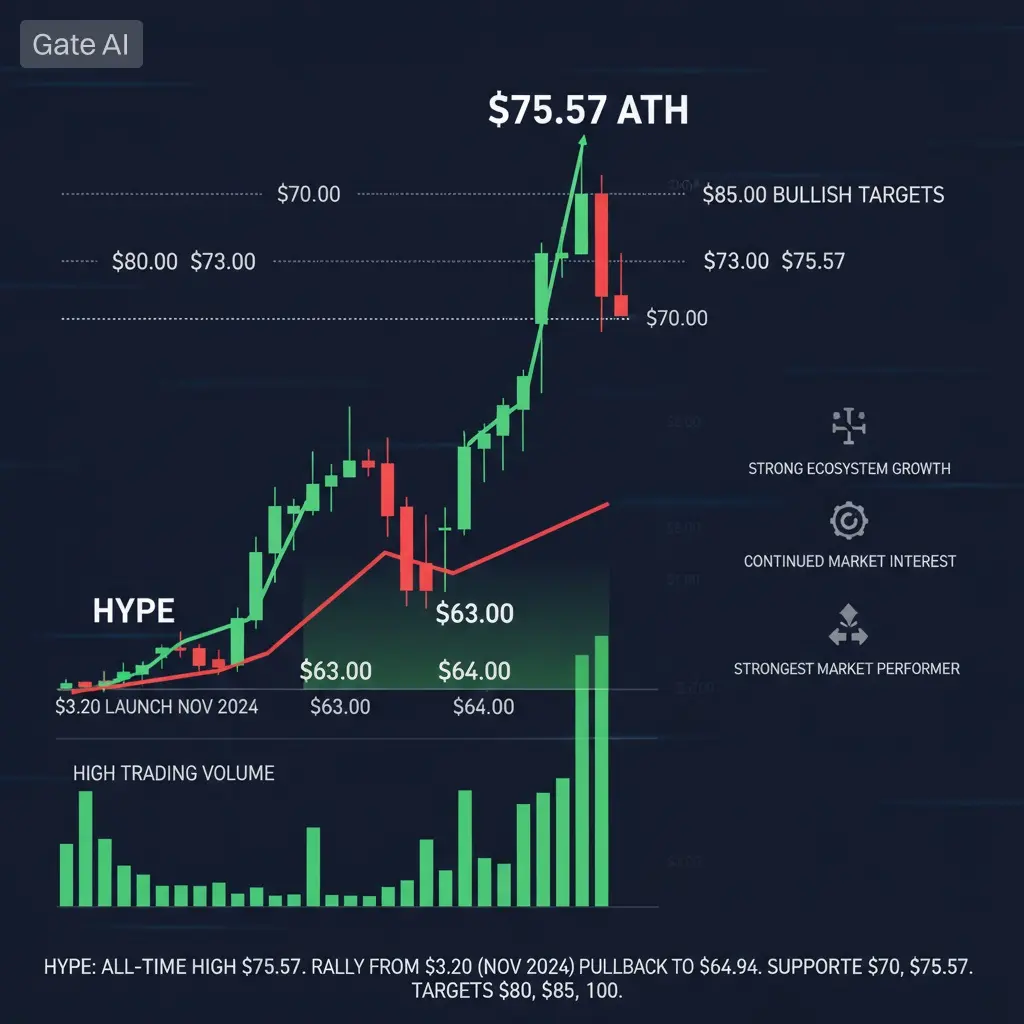
Hyperliquid (HYPE) has officially reached its All-Time High, marking one of the most significant milestones in the DeFi sector this year. The current price of HYPE stands at approximately $64.94, having recently surged past previous records to establish a new ATH at $75.57. This achievement signals that buyer momentum has overwhelmed every historical resistance level, and the token is now exploring entirely new price territory. The journey from its launch price of $3.20 on November 29, 2024, to the current ATH represents a staggering gain of over 2,260%, making HYPE one o
HighAmbition
#HYPEHitsAllTimeHigh
Hyperliquid (HYPE) has officially reached its All-Time High, marking one of the most significant milestones in the DeFi sector this year. The current price of HYPE stands at approximately $64.94, having recently surged past previous records to establish a new ATH at $75.57. This achievement signals that buyer momentum has overwhelmed every historical resistance level, and the token is now exploring entirely new price territory. The journey from its launch price of $3.20 on November 29, 2024, to the current ATH represents a staggering gain of over 2,260%, making HYPE one of the best-performing DeFi tokens of 2025.
Current Price and Recent K-Line Analysis
The latest one-hour K-line data shows HYPE trading around $64.94 with significant volatility in recent sessions. Over the past 24 hours, the price range has oscillated between a low of $62.95 and a high of $75.07, with the recent ATH peak touching $75.57. The 24-hour trading volume reached approximately 2.2 million HYPE tokens, representing roughly $149.9 million in USDT volume. This high volume during the ATH breakout confirms strong market participation and genuine buying interest, not just a thin-market spike. The hourly candlestick pattern over recent days reveals a classic volatility expansion: HYPE surged from the $72 range up toward $75, then experienced a sharp correction down toward $63 before recovering to the $64-65 zone. This price action suggests that after the ATH breakout, profit-taking by early holders created temporary selling pressure, but buyers are stepping back in at lower levels.
All-Time High Significance and Market Psychology
When a token hits its ATH, every previous resistance level has been shattered. There is no overhead historical supply to absorb buying pressure, which means the price can move freely into uncharted territory. The ATH breakout on HYPE generated massive attention across social media, news outlets, and trading communities. New investors who were watching from the sidelines finally entered, adding fresh capital to the rally. However, ATH events also trigger profit-taking from long-term holders who have been waiting for this moment to realize gains. This dual dynamic explains the sharp price swing from $75.57 down to $62.95 and back. The key observation is whether the volume continues to expand on recovery moves, which would indicate sustained bullish conviction, or whether volume fades, suggesting exhaustion and a potential deeper correction.
Forecast Price and How Much Higher HYPE Can Go
Based on current technical and fundamental analysis, multiple forecast scenarios exist for HYPE. The conservative near-term target after the ATH consolidation is the $70 to $75 range, which represents a retest of the recent peak. If HYPE can hold above $64 as support and rebuild buying momentum, the next logical resistance targets are $80 and then $100. Price predictions from various analysts anticipate HYPE could reach $56 to $80 by the end of 2025, though the token has already exceeded many of these earlier forecasts. For 2026, some projections suggest a range between $79 and $96, with an average price around $88. Longer-term forecasts for 2027 through 2030 paint an even more bullish picture, with targets ranging from $100 to $212 depending on DeFi adoption rates and Hyperliquid protocol development. The fundamental driver behind these forecasts is Hyperliquid position as a high-speed, low-fee decentralized perpetual futures platform that has attracted significant institutional and retail trading volume. The $50 million ecosystem fund announced for Q3 2025 and upcoming protocol upgrades introducing enhanced DeFi integrations and cross-chain compatibility provide strong catalysts for continued price appreciation.
Support and Resistance Levels
Identifying precise support and resistance zones is critical for any trading plan. On the downside, immediate support sits at $64, which is where the current price is consolidating. Below that, the $63 level represents the recent 24-hour low, and a deeper support zone exists at $60 to $62, which was a trading range before the ATH breakout. Further major support levels are at $55, $50, and the psychologically important $45 zone. On the resistance side, the immediate overhead resistance is the ATH itself at $75.57. Before reaching that again, HYPE must clear $70, then $73, and then challenge the $75 zone. Beyond the current ATH, the next targets would be $80, $85, and $100, which represent round-number psychological barriers where selling pressure often intensifies.
K-Line Technical Indicators and Pattern Recognition
The recent K-line pattern reveals a Head-and-Shoulders formation that developed between late May and early June, with the third peak forming around June 3 near $75. This pattern typically signals a bearish reversal, and indeed HYPE did decline sharply from the head peak. However, the subsequent drop to $62.95 and the recovery toward $64.94 suggest the neckline near $67 to $68 is being tested. The RSI currently reads approximately 55, indicating neutral momentum rather than extreme overbought or oversold conditions. If RSI drops below 30 near the $60 support, that would signal oversold conditions and a potential buying opportunity. The MACD line is approaching a bearish crossover, which aligns with the post-ATH correction scenario. A bullish MACD crossover above $70 would validate a resumption of the uptrend. Bollinger Bands show that after the ATH spike, HYPE touched the upper band and has now retreated toward the middle band, suggesting a consolidation phase rather than a collapse. Volume analysis confirms that the highest volume bars appeared during the sharp decline from $75 to $63, indicating that the correction was driven by real selling activity, not just thin-market manipulation.
Trading Strategy and Next Plan
For traders navigating HYPE at these levels, a disciplined approach is essential. Three primary strategies emerge depending on your risk tolerance and market view. First, for bullish traders who believe the ATH breakout will resume, the plan is to accumulate gradually in the $63 to $65 support zone with a stop-loss placed below $60. The target would be a retest of $75 and potentially $80 or $85 if volume confirms the move. Position sizing should be limited to 1 to 3 percent of your total portfolio to manage the inherent volatility. Second, for neutral or cautious traders, a grid trading strategy between $60 and $75 makes sense. This range captures the current volatility pocket, allowing you to profit from oscillations without committing to a directional bias. Set grid buys at $62, $64, and $66, with grid sells at $70, $73, and $75. Third, for bearish traders who see the Head-and-Shoulders pattern as a valid reversal signal, short positions can be initiated if HYPE breaks below $63 with high volume and bearish MACD confirmation. The target for shorts would be $55 or $50, with a tight stop-loss above $67. However, shorting an asset that just hit ATH carries significant risk because breakout momentum can override technical reversal patterns.
Trader Tips and Risk Management
Never allocate more than 2 to 3 percent of your portfolio to a single volatile trade. HYPE has demonstrated 329 percent growth in just two months earlier this year, and the recent ATH move added another layer of volatility. Use tight stop-losses of 2 to 3 percent above or below your entry point, especially around key support and resistance zones. Always confirm entry signals with at least two technical indicators, for example a volume spike plus a MACD crossover, rather than acting on a single signal. Watch whale activity closely, as large purchases or transfers to exchanges can shift the price rapidly. Recent on-chain data showed a whale depositing $4 million USDC to buy 110,663 HYPE at an average price of $36, signaling institutional confidence. Conversely, 500,000 HYPE tokens were transferred to an exchange, creating potential selling pressure. Trailing stops are particularly useful during ATH breakout phases because prices can move fast in both directions, and you want to lock in profits automatically without manual intervention. Monitor the broader DeFi sector and BTC direction, as HYPE tends to correlate with macro crypto trends. If BTC enters a correction phase, HYPE will likely follow despite its strong individual fundamentals.
Conclusion
HYPE hitting its All-Time High at $75.57 is a landmark event that confirms the market confidence in Hyperliquid as a leading DeFi perpetuals platform. The current price around $64.94 represents a post-ATH consolidation phase where profit-taking and new buying are competing. Support at $63 to $64 and resistance at $75.57 define the immediate trading range. The forecast points toward potential further gains to $80 and beyond if the breakout resumes with volume confirmation, while a failure to hold $60 could trigger a deeper correction toward $50. Trading strategies should be tailored to your risk profile, with strict position sizing and stop-loss discipline. The combination of technical indicators, K-line patterns, whale activity, and protocol fundamentals suggests HYPE remains one of the most dynamic and opportunity-rich tokens in the current crypto market, but its volatility demands careful risk management at every step.
@Gate_Square #PredictNBAFinalsWin20000U #ShareYourUSStocksWinNvidia #TradeCFDWinGold #SpaceXTargets1.75TrillionIPO
repost-content-media
  • Reward
  • 1
  • Repost
  • Share
HighAmbition:
Steadfast HODL💎
#WinGoldBarsWithGrowthPoints
Win Gold Bars With Growth Points: Complete Guide
The Win Gold Bars With Growth Points campaign on Gate offers community members a genuine opportunity to win physical 10g golden bars through active participation in the platform's social features. This promotional program connects the Growth Points system with a lucky draw mechanism, rewarding engaged users with premium prizes including real gold bars, exclusive merchandise, token airdrops, and trading vouchers. The current active edition is Growth Points Summer Draw Round 19, running from May 26, 2026 through June
SHIB-7.48%
HighAmbition
#WinGoldBarsWithGrowthPoints
Win Gold Bars With Growth Points: Complete Guide
The Win Gold Bars With Growth Points campaign on Gate offers community members a genuine opportunity to win physical 10g golden bars through active participation in the platform's social features. This promotional program connects the Growth Points system with a lucky draw mechanism, rewarding engaged users with premium prizes including real gold bars, exclusive merchandise, token airdrops, and trading vouchers. The current active edition is Growth Points Summer Draw Round 19, running from May 26, 2026 through June 8, 2026, featuring a 20,000 USDT total prize pool.
Growth Points serve as the core currency of the Gate Square community engagement system. They accumulate through everyday social activities including posting content, commenting on discussions, liking posts, sharing material, and sending messages or trade cards in chat groups. The system operates across two primary categories: Post Tasks which reward publishing posts (100 points each), commenting, and liking; and Chat Tasks which reward messaging and trade card sharing. The fundamental principle is clear: more engagement equals more points, which translates to more draw entries for winning gold bars.
The Growth Points framework features a 12-level progression system. As points accumulate, your community level rises and unlocks additional features. At Level 6 and above, you gain Highlighted Comments that remain visible for 72 hours. At Level 10 and above, you unlock Square Styling for designing distinctive post cards. Each level displays a badge next to your avatar, signaling your standing within the community.
To check your progress, open the Gate App, navigate to Square, tap your avatar to enter your profile, then tap the shield icon to access the Community Center. Here you can view your current level, total Growth Points, activity breakdown, and leaderboard rankings. Growth Points data refreshes daily at 8:00 AM.
The lucky draw conversion is straightforward: every 300 Growth Points equals one draw entry. The system allows a maximum of 10 draws per day. Access the draw through Gate App, Square, then Community Center. Each draw randomly selects from the prize pool which includes the headline 10g golden bar, Inter Milan shirt, 2026 WCTC T-shirt, SHIB Tokens, Position Vouchers valid 7 days and stackable, Trading Fee Rebate Vouchers offering 20 percent rebate for 30 days and stackable, VIP+1 Experience Card for 7 days, and Lucky Bags calculated through a proportional formula based on total distribution.
Eligibility requires completing identity verification before the event ends. Round 19 does not require minimum trading volume, making it accessible to community-focused participants. Sub-accounts and multiple accounts under one KYC are treated as single participants. Cheating results in disqualification, and restricted locations cannot participate.
To maximize points efficiently, post one original piece of content daily discussing market observations or trading insights, as posts yield the highest single activity reward. Comment meaningfully on popular posts from other members to earn points while increasing visibility. Like content regularly as this simple action still contributes to your total. In chat groups, share trade cards and participate actively, as this combines trading activity with social engagement.
For consistent accumulation, establish a daily routine: post original content, leave three to five comments, like ten to fifteen posts, and send messages or trade cards in groups. Maintained throughout the event duration, this generates substantial points translating into multiple draw entries.
Prize distribution follows specific timelines. Position Vouchers, tokens, and Lucky Bags distribute within 30 working days after the event. Physical merchandise including the golden bar delivers within 60 working days. Winners must claim merchandise on the prize page and provide shipping addresses; failure results in forfeiture. If delivery fails, conversion policies apply: the 10g golden bar becomes a 10,000 USDT Position Voucher, the Inter Milan shirt becomes 500 USDT, and the WCTC T-shirt becomes 200 USDT.
The key insight is consistency over intensity. The daily draw cap of 10 entries means spreading participation across the full event duration outperforms concentrated activity. Daily moderate engagement reliably produces draw entries without requiring extraordinary effort. Start engaging today, track your points through the Community Center, and make every interaction count toward your gold bar opportunity.@Gate_Square #ShareYourUSStocksWinNvidia #PredictNBAFinalsWin20000U

repost-content-media
  • Reward
  • 1
  • Repost
  • Share
HighAmbition:
Steadfast HODL💎
#SpaceXRoadshowHighlightsAsteroidMining
SpaceX Roadshow Highlights Asteroid Mining: Complete Analysis
SpaceX recently conducted its IPO roadshow, revealing ambitious plans for asteroid mining as part of its long-term vision. This disclosure has significant implications for traders across multiple markets including cryptocurrency.
Understanding the Concept
Asteroid mining involves extracting valuable resources from space rocks orbiting our solar system. These asteroids contain precious metals like platinum, gold, nickel, cobalt, and rare-earth elements that are scarce on Earth. SpaceX's S-1 fi
BTC-3.31%
TSLA-4.88%
HighAmbition
#SpaceXRoadshowHighlightsAsteroidMining
SpaceX Roadshow Highlights Asteroid Mining: Complete Analysis
SpaceX recently conducted its IPO roadshow, revealing ambitious plans for asteroid mining as part of its long-term vision. This disclosure has significant implications for traders across multiple markets including cryptocurrency.
Understanding the Concept
Asteroid mining involves extracting valuable resources from space rocks orbiting our solar system. These asteroids contain precious metals like platinum, gold, nickel, cobalt, and rare-earth elements that are scarce on Earth. SpaceX's S-1 filing with the SEC explicitly mentions asteroid mining as a potential future market opportunity, representing what could become multi-trillion dollar economic possibilities.
The Technology Behind It
SpaceX plans to use its Starship vehicle for transportation to asteroids, combined with autonomous robotic systems for extraction operations. These robots would identify resource-rich targets, deploy mining equipment, and process materials either on-site or transport them to orbital facilities. The economic rationale stems from declining terrestrial reserves and increasing demand for critical materials used in electronics and renewable energy systems.
SpaceX's Broader Vision
The asteroid mining disclosure fits within a comprehensive framework including point-to-point Earth travel, space tourism, lunar and Martarian settlements, orbital manufacturing, and energy production. The company aims to establish humanity as a multi-planetary species while creating new commercial frontiers beyond Earth.
Implications for Traders
Direct SpaceX Investment: The IPO targets approximately 1.75 trillion dollar valuation with 75 billion dollar fundraising. Revenue grew from 14.1 billion dollars in 2024 to 18.7 billion dollars in 2025. Morningstar values the company at 780 billion dollars, suggesting potential upside for investors.
Bitcoin and Cryptocurrency Impact: SpaceX disclosed holding 18,000 to 18,712 Bitcoin worth roughly 1.3 to 1.4 billion dollars. This validates Bitcoin as a legitimate corporate treasury asset and may encourage other companies to consider similar allocations. Traders might anticipate increased institutional and retail interest in cryptocurrencies surrounding the IPO.
Space Sector Stocks: Companies involved in satellite manufacturing, aerospace technology, and space tourism may experience heightened investor attention due to association with SpaceX's ambitious vision.
Commodity Markets: Successful asteroid mining could eventually alter supply dynamics for precious metals and rare-earth elements. However, operational timelines likely span decades, meaning near-term commodity traders need not radically adjust positions.
Technology and AI Sectors: SpaceX's emphasis on autonomous systems and AI integration highlights convergence between artificial intelligence and aerospace, creating opportunities in robotics and automation stocks.
Crypto Market Specific Effects
The SpaceX Bitcoin holdings disclosure carries particular weight for cryptocurrency markets. It joins MicroStrategy and Tesla in establishing precedent for corporate treasury diversification into digital assets. Elon Musk's substantial social media following creates potential for significant retail interest and trading volume in Bitcoin during key IPO milestones.
Space-themed cryptocurrency projects may experience renewed speculative interest, though traders should exercise caution and conduct thorough due diligence on such investments. The vision of space-based economies also suggests potential future use cases for blockchain technology in extraterrestrial commerce.
Risk Considerations
Traders should remain aware that SpaceX's ambitious projections regarding asteroid mining may not materialize within anticipated timeframes. The IPO carries typical new-issue risks including valuation uncertainty and price volatility. Cryptocurrency markets face additional regulatory and manipulation risks that require careful position management.
Conclusion
SpaceX's asteroid mining revelation represents a landmark moment in commercial space development. For traders, this creates opportunities across SpaceX equity, Bitcoin positions, space sector stocks, and technology investments. The disclosure of substantial Bitcoin holdings validates cryptocurrency as an institutional asset while potentially driving increased adoption. Traders should approach these opportunities with appropriate risk management, recognizing that space-based economic activity remains years from realization while maintaining disciplined execution strategies throughout the IPO process and beyond.
@Gate_Square #PredictNBAFinalsWin20000U #ShareYourUSStocksWinNvidia #Web3SecurityGuide #GMTokenLaunchAndPromotion
repost-content-media
  • Reward
  • 1
  • Repost
  • Share
HighAmbition:
Steadfast HODL💎
#GatePartnersWithAlpacaToBridgeCryptoAndStocks
Here is a comprehensive post about Gate's partnership with Alpaca, discussing all the key points in detail:
---
Gate Partners with Alpaca: A Revolutionary Bridge Between Crypto and Traditional Stock Markets
Gate has announced a groundbreaking strategic partnership with Alpaca, a leading global brokerage infrastructure provider, to launch real stock and ETF trading services for its users. This collaboration represents a significant milestone in the evolution of financial markets, effectively bridging the gap between digital assets and traditional
MSFT-1.56%
TSLA-4.88%
HighAmbition
#GatePartnersWithAlpacaToBridgeCryptoAndStocks
Here is a comprehensive post about Gate's partnership with Alpaca, discussing all the key points in detail:
---
Gate Partners with Alpaca: A Revolutionary Bridge Between Crypto and Traditional Stock Markets
Gate has announced a groundbreaking strategic partnership with Alpaca, a leading global brokerage infrastructure provider, to launch real stock and ETF trading services for its users. This collaboration represents a significant milestone in the evolution of financial markets, effectively bridging the gap between digital assets and traditional finance through a unified multi-asset trading platform.
Understanding the Partnership
The partnership between Gate and Alpaca brings together two powerful ecosystems. Gate contributes its extensive global digital asset trading infrastructure, while Alpaca provides its sophisticated brokerage infrastructure and market access capabilities. Together, they are creating a seamless investment experience that allows users to access both cryptocurrency markets and traditional stock markets from a single platform.
What This Means for the Crypto Market
This partnership delivers substantial benefits to the broader cryptocurrency market. First, it introduces a new level of legitimacy and integration between digital assets and traditional finance. By enabling crypto traders to access real stocks and ETFs, Gate is demonstrating that cryptocurrency platforms can evolve into comprehensive financial service providers. This integration helps normalize digital assets within the broader financial ecosystem and attracts traditional investors who may have been hesitant to engage with crypto-only platforms.
The collaboration also expands market accessibility significantly. Users can now diversify their portfolios across both asset classes without needing multiple accounts or platforms. This convenience factor reduces friction for investors and encourages greater participation in both markets. The ability to move between crypto and traditional assets within one interface represents a major step toward financial democratization.
Benefits for Traders
For individual traders and investors, this partnership offers numerous practical advantages. Users gain access to over 10,000 stocks and ETFs listed on major U.S. securities markets, including the New York Stock Exchange and Nasdaq. This extensive selection covers virtually every major company and sector, providing unprecedented diversification opportunities.
The platform supports fractional share trading with a minimum investment of just one dollar. This feature makes high-value stocks accessible to retail investors who may not have the capital to purchase full shares. For example, traders can invest in companies like Apple, Microsoft, or Tesla with small amounts while maintaining their crypto positions.
The unified interface means traders can monitor both their cryptocurrency holdings and stock portfolios simultaneously. This consolidated view improves portfolio management and enables quicker decision-making when market conditions change. Users can rebalance their investments across asset classes efficiently without transferring funds between different platforms.
Gate's Strategic Vision
This partnership reflects Gate's long-term commitment to building a comprehensive multi-asset platform. The company recognizes that modern investors demand flexibility and access to diverse investment opportunities. By integrating traditional stock trading into its crypto-native platform, Gate is positioning itself at the forefront of the next generation of financial services.
Dr. Han, Gate's Founder and CEO, emphasized that the financial system is moving toward greater integration and interconnectivity. As connections between digital assets and traditional markets strengthen, user demand for efficient access to diversified investments continues growing. This partnership addresses that demand by providing seamless access to real-world stock markets while maintaining the convenience and efficiency that crypto users expect.
Future Implications
The Gate-Alpaca partnership sets a precedent for the industry. Other cryptocurrency exchanges may follow similar paths, leading to broader convergence between digital and traditional finance. This trend benefits all market participants by creating more liquid, accessible, and interconnected financial ecosystems.
Both companies plan to continue exploring new models that connect digital assets with traditional finance. Future developments may include enhanced trading features, expanded asset classes, and improved integration between crypto and stock trading functionalities. This ongoing collaboration promises to deliver even more innovative solutions for global investors.
Conclusion
Gate's partnership with Alpaca represents a transformative development in the financial technology sector. By bridging cryptocurrency and stock markets, this collaboration offers users unprecedented access to diversified investment opportunities. Traders benefit from simplified portfolio management, fractional share accessibility, and the convenience of a unified platform. For the crypto market, this integration signals growing maturity and acceptance within the broader financial landscape. This strategic move by Gate demonstrates visionary leadership and positions the platform as a pioneer in the evolving world of multi-asset investing.
@Gate_Square #ShareYourUSStocksWinNvidia #PredictNBAFinalsWin20000U #Web3SecurityGuide #CryptoSurvivalGuide
repost-content-media
  • Reward
  • 1
  • Repost
  • Share
HighAmbition:
Steadfast HODL💎
#STRCFallsBelow95
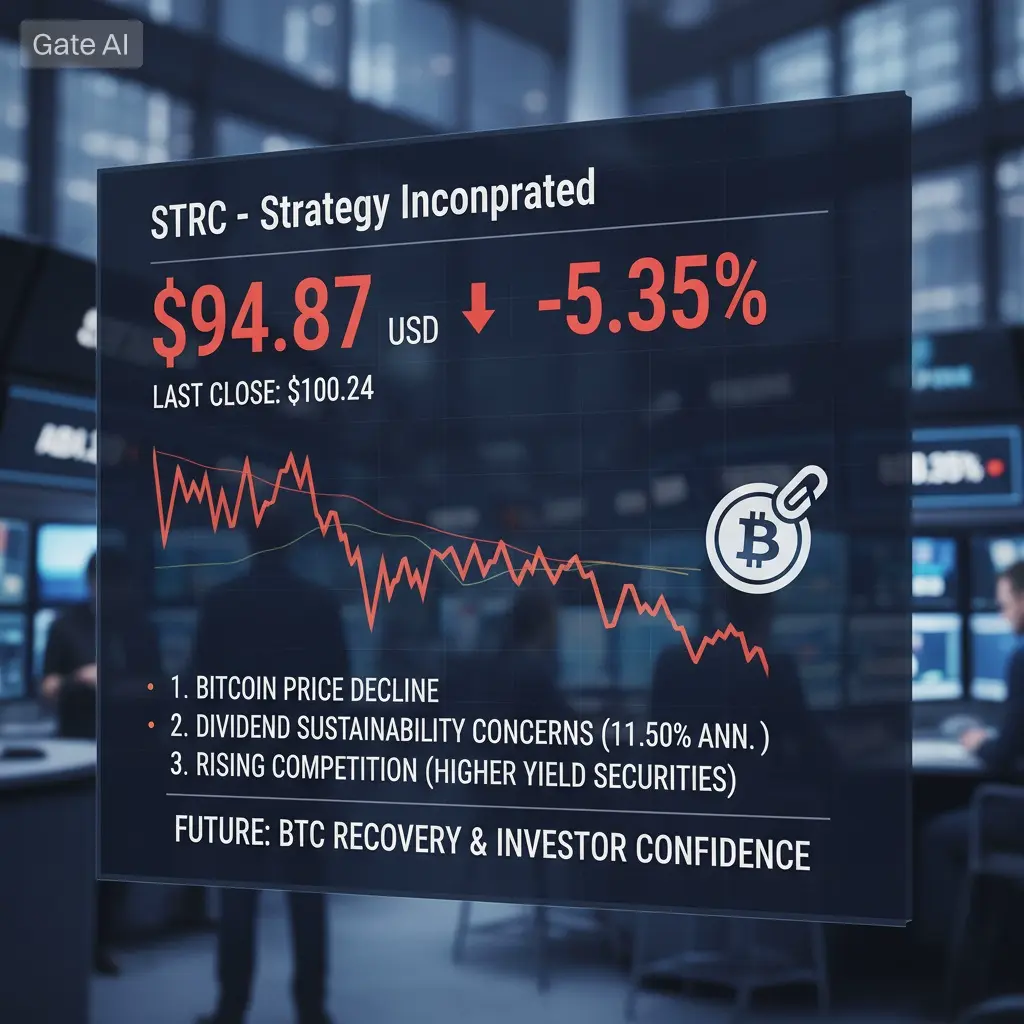
STRC, Strategy Incorporated’s perpetual preferred stock, has recently fallen below the critical $95 level, marking a significant shift in sentiment around one of the most closely watched Bitcoin-linked financial instruments in traditional markets. Strategy (formerly MicroStrategy) has built a unique corporate identity around holding Bitcoin as a primary treasury asset, and STRC has effectively become a barometer of investor confidence in that strategy.
This decline is not just a simple price movement. It reflects broader concerns about Bitcoin volatility, dividend sustainabi
BTC-3.31%
HighAmbition
#STRCFallsBelow95
STRC, Strategy Incorporated’s perpetual preferred stock, has recently fallen below the critical $95 level, marking a significant shift in sentiment around one of the most closely watched Bitcoin-linked financial instruments in traditional markets. Strategy (formerly MicroStrategy) has built a unique corporate identity around holding Bitcoin as a primary treasury asset, and STRC has effectively become a barometer of investor confidence in that strategy.
This decline is not just a simple price movement. It reflects broader concerns about Bitcoin volatility, dividend sustainability, rising competition in high-yield preferred securities, and the structural risks embedded in Strategy’s hybrid capital model.
What is STRC?
STRC (Variable Rate Series A Perpetual Preferred Stock, often referred to as “Stretch”) is a Nasdaq-listed preferred equity instrument issued by Strategy Incorporated.
Key characteristics include:
Par value of $100
Annual dividend yield of approximately 11.50%
Monthly cash dividend payments
Perpetual structure with no fixed maturity
Designed primarily as an income-generating security
Unlike common stock, STRC behaves like a hybrid between equity and fixed income. Investors prioritize stable yield rather than capital appreciation, making it highly sensitive to interest rates, credit perception, and company cash flow stability.
Preferred shareholders also have priority over common shareholders in dividend payments and liquidation scenarios, but they still carry risk if the issuing company faces financial stress.
Why STRC Matters in the Market
STRC has become more than just a preferred stock. It represents:
Investor confidence in Strategy’s Bitcoin treasury model
Market perception of Bitcoin-backed corporate finance
Stability of high-yield structured financial instruments
Because Strategy holds a massive Bitcoin reserve, STRC is indirectly tied to cryptocurrency market cycles, making it one of the most unconventional preferred securities in the US market.
Reasons Behind the Drop Below $95
1. Bitcoin Price Decline
The most significant driver of STRC’s weakness is Bitcoin’s correction. Strategy holds more than 843,000 BTC, making its balance sheet extremely sensitive to crypto volatility.
Recent Bitcoin decline of over 20% from highs around $82,000 toward the mid-$60,000 range has:
Reduced perceived asset strength
Increased concerns about dividend coverage
Triggered broad selling across Strategy-linked securities
2. First Bitcoin Sale in Years
Strategy recently sold a small portion of Bitcoin holdings to support dividend payments.
Although the amount was minimal relative to total holdings, the psychological impact was significant:
It broke the “never sell Bitcoin” narrative
Raised concerns about future liquidity needs
Created uncertainty about capital allocation priorities
This shift contributed to weakening sentiment in STRC.
3. Rising Competition in Preferred Securities
New competing high-yield instruments have entered the market, offering:
Higher yields (around 12–13%)
More frequent dividend distributions
Prices closer to par value stability
This has diverted income-seeking investors away from STRC, adding pressure on demand.
4. Technical and Quantitative Selling
Once STRC fell below key technical levels:
Algorithmic trading systems triggered sell orders
Stop-loss mechanisms accelerated downside momentum
Institutional rebalancing reduced exposure
These technical factors intensified the decline below $95.
Market Structure and Financial Risks
Dividend Sustainability Concerns
STRC currently pays an 11.50% annual dividend, which remains attractive in absolute terms.
However, sustainability depends heavily on:
Bitcoin price stability
Strategy’s cash flow flexibility
Access to capital markets
If Bitcoin remains weak, the company may need to rely on asset sales or refinancing to maintain payouts.
Impact of Capital Structure Pressure
A sustained price below $95 introduces several risks:
Higher cost of future capital raises
Reduced investor confidence in new preferred issuances
Potential upward adjustment in dividend obligations in certain scenarios
Increased financial pressure if Bitcoin declines further
Technical Market View
STRC’s price action has shifted from stability to volatility:
Breakdown below $100 par level created bearish sentiment
Support now observed around $92–$93 range
Strong resistance remains at $95 and psychological $100 level
Momentum indicators suggest oversold conditions but weak reversal signals
The market is currently in a sentiment-driven phase rather than fundamentals-only pricing.
Investor Psychology Shift
Previously, STRC was viewed as:
High-yield stable income instrument
Backed by strong Bitcoin reserves
Relatively safe preferred equity
Now sentiment has shifted toward:
Credit risk awareness
Bitcoin dependency concerns
Uncertainty around dividend continuity
This psychological transition has amplified selling pressure.
Strategy’s Bitcoin Treasury Model
Strategy holds one of the largest corporate Bitcoin treasuries globally, exceeding 843,000 BTC.
This creates:
Strong upside exposure during Bitcoin bull cycles
High vulnerability during corrections
Direct linkage between crypto volatility and traditional capital markets instruments like STRC
The STRC decline is therefore indirectly a reflection of Bitcoin market conditions.
Outlook Scenarios
Bullish Scenario
Bitcoin stabilizes or recovers
Dividend payments remain uninterrupted
STRC rebounds toward $100 par value
Investor confidence returns
Bearish Scenario
Continued Bitcoin weakness
Additional Bitcoin sales required for dividends
STRC moves toward $90 or lower
Increased funding pressure emerges
Base Scenario
Sideways Bitcoin movement
STRC trades in $92–$98 range
Ongoing volatility but no structural breakdown
Investment Perspective
For investors, STRC presents a risk-reward balance:
Pros:
High yield (~11.50%)
Monthly income stream
Backed by large Bitcoin treasury
Cons:
High sensitivity to Bitcoin volatility
Potential dividend sustainability risks
Competition from newer preferred securities
Capital loss risk below par value
STRC’s fall below $95 represents a critical turning point for Strategy’s capital structure narrative. It highlights the increasing tension between high-yield income appeal and underlying Bitcoin-linked volatility risk.
While default risk remains low in the short term, the instrument is now clearly being repriced by the market to reflect:
Bitcoin dependency
Competitive yield pressure
Technical breakdown below par value
Uncertainty around long-term dividend sustainability
Ultimately, STRC remains a hybrid financial instrument sitting at the intersection of traditional fixed income markets and cryptocurrency exposure. Its future trajectory will depend heavily on Bitcoin’s performance and Strategy’s ability to maintain financial stability without excessive reliance on asset sales.@Gate_Square
repost-content-media
  • Reward
  • 1
  • Repost
  • Share
HighAmbition:
Steadfast HODL💎
#BitcoinETFSees7272BTCOutflow
A Bitcoin ETF is a regulated financial product that holds Bitcoin on behalf of investors who want price exposure without managing coins directly. When 7272 BTC flows out of an ETF, it means investors redeemed their shares and withdrew that quantity of Bitcoin from the fund. At current prices near $63,000 per coin, this withdrawal represents approximately $457 million leaving the ETF structure. This is a substantial movement that signals a meaningful group of institutional and retail investors simultaneously chose to reduce their Bitcoin exposure through the regul
HighAmbition
#BitcoinETFSees7272BTCOutflow
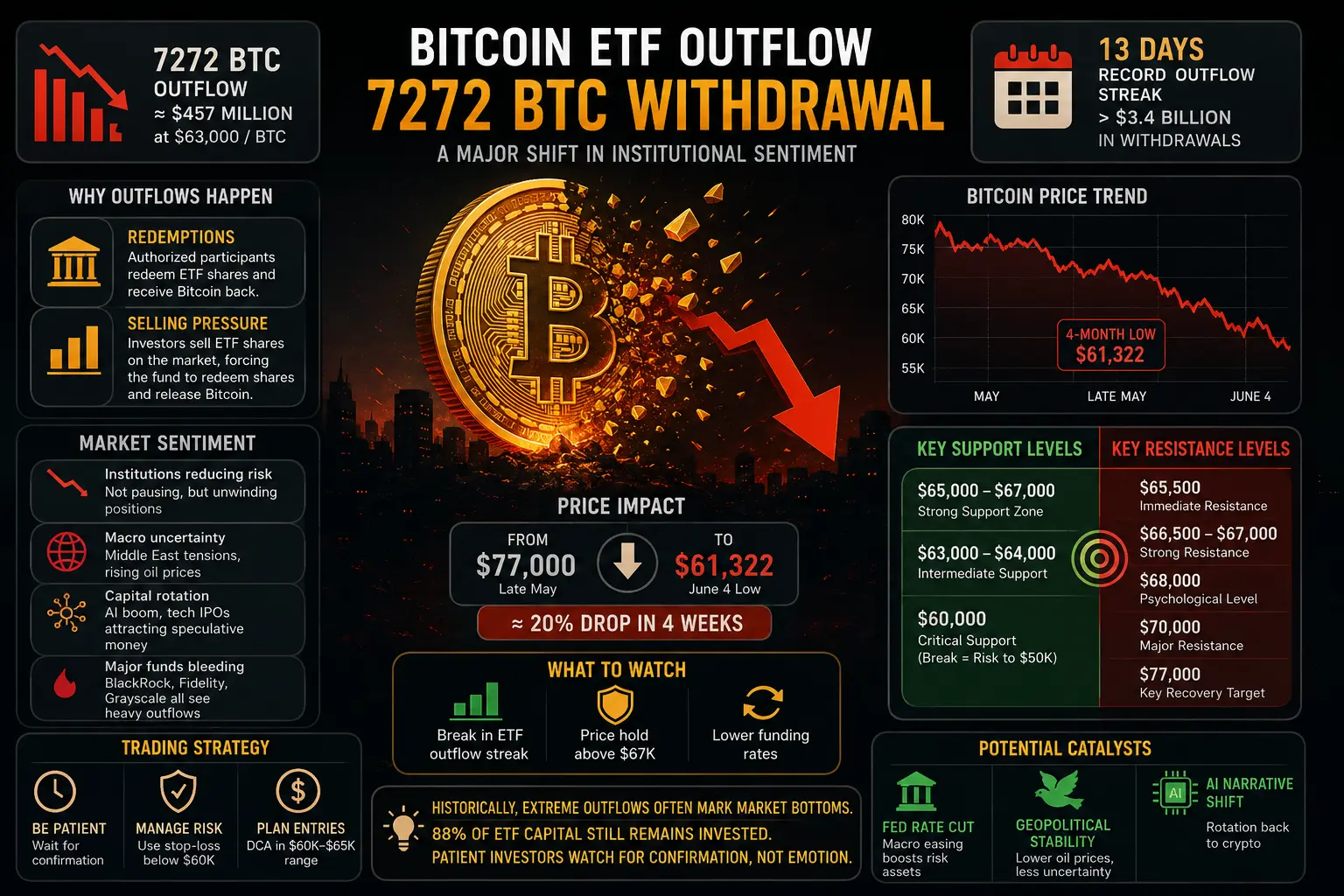
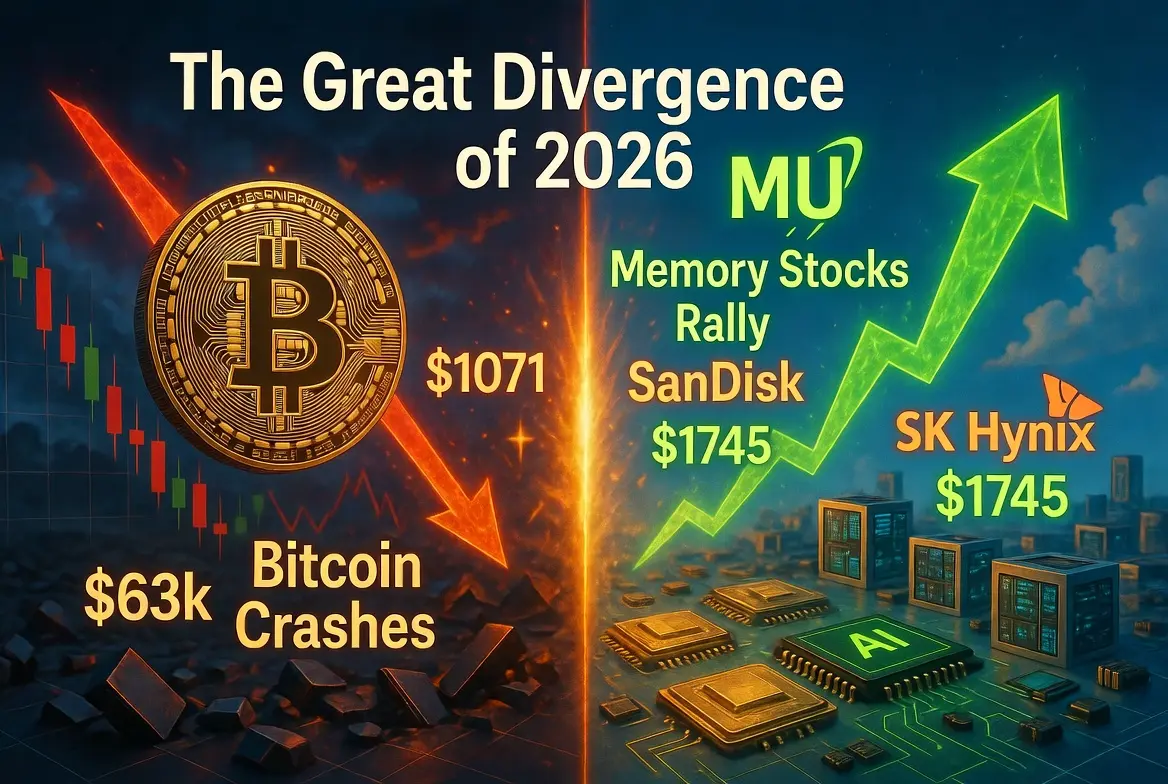
A Bitcoin ETF is a regulated financial product that holds Bitcoin on behalf of investors who want price exposure without managing coins directly. When 7272 BTC flows out of an ETF, it means investors redeemed their shares and withdrew that quantity of Bitcoin from the fund. At current prices near $63,000 per coin, this withdrawal represents approximately $457 million leaving the ETF structure. This is a substantial movement that signals a meaningful group of institutional and retail investors simultaneously chose to reduce their Bitcoin exposure through the regulated channel.
Outflows occur through two mechanisms. Authorized participants can redeem shares directly with the fund manager and receive the underlying Bitcoin, physically removing it from ETF custody. Alternatively, when investors sell ETF shares on the open market and selling pressure overwhelms buying interest, the fund manager must redeem shares to keep the ETF price aligned with Bitcoin spot price, again causing Bitcoin to exit the fund vault. Both paths produce the same outcome: Bitcoin leaves the ETF, and total net assets shrink.
This Outflow Is Part of a Record-Breaking Trend
The 7272 BTC withdrawal is not an isolated event. U.S. spot Bitcoin ETFs have been on an unprecedented outflow streak through late May and early June 2026, with cumulative withdrawals exceeding $3.4 billion across 13 consecutive sessions. BlackRock's iShares Bitcoin Trust, previously the dominant inflow engine, saw $430 million leave on a single day in late May, followed by $440 million on June 1. Fidelity's FBTC recorded over $113 million in redemptions. Grayscale's GBTC continued its long-running hemorrhage. This is the longest and deepest withdrawal event since ETFs launched in January 2024.
The reversal from a six-week inflow streak to record-breaking outflows happened rapidly. Sentiment shifted decisively rather than gradually. When large institutional players move in coordinated fashion, it reflects a shared reassessment of risk and reward, not isolated decisions.
What Drives These Outflows
Several factors are converging. Macro uncertainty from Middle East conflict and rising oil prices has increased risk aversion across all speculative assets. The AI infrastructure boom, combined with blockbuster IPOs from SpaceX, OpenAI, and Anthropic, has created a far more compelling narrative for portfolio managers. Capital that previously sat in Bitcoin as a high-growth alternative is now rotating into sectors with clearer catalysts and stronger momentum. K33 Research noted that the opportunity cost of holding Bitcoin while AI-related assets soar has become too high for many allocators.
Additionally, Strategy's first Bitcoin sale since 2022, though tiny at only 32 BTC worth roughly $2.5 million, carried enormous symbolic weight. The market's most aggressive corporate accumulator selling even a token amount signaled that even the most committed holders are recalibrating. Fresh Mt. Gox wallet movements worth $739 million added another layer of anxiety about potential large-scale selling.
Impact on Bitcoin Price and Market Structure
Bitcoin has fallen from above $77,000 in late May to as low as $61,322 on June 4, a decline of roughly 20% over four weeks and 13% in a single week. This represents the worst weekly performance since February. When ETFs redeem shares and Bitcoin exits fund custody, that Bitcoin becomes market supply. Even if not immediately sold on exchanges, the removal of ETF demand eliminates a major buyer, shifting supply-demand balance toward sellers.
The derivatives market amplifies this vulnerability. Open interest across Bitcoin futures has climbed to approximately 773,000 BTC, among the highest on record, while funding rates remain elevated near 10% annualized. This means leveraged traders are still paying to maintain bullish positions despite weakening spot demand. The divergence between heavy leveraged long positioning and deteriorating fundamentals creates a fragile structure. Continued price declines could trigger liquidation cascades that accelerate downside. The 30-day implied volatility index has surged to 53.17, the highest since early April.
Historical Pattern: Outflows Often Mark Bottoms
Santiment's trend analysis reveals that large ETF inflow days have historically served as validated sell signals. The $1.21 billion inflow on October 6, 2025, and the $840 million inflow on January 14, 2026, both preceded price declines. The inverse appears to hold as well: heavy outflow periods driven by peak fear and institutional risk aversion have tended to coincide with conditions for market bottoms. Tom Lee characterized the current anxiety including Strategy's sale and record outflows as classic bottom behavior. Crucially, 88% of capital that entered through ETFs since inception still remains invested, meaning the vast majority of institutional holders have not exited. Current outflows represent the minority reacting to short-term pressures, not wholesale abandonment.
Current Price and Forecast Scenarios
Bitcoin currently trades in the $63,000 to $65,000 range after touching $61,322 intraday. The near-term forecast depends on whether the outflow streak breaks and whether new catalysts emerge.
In the bearish scenario, continued outflows and a break below $60,000 could drive Bitcoin toward $50,000 before sustained recovery, representing roughly 35% decline from late May levels. Massive derivatives liquidations would temporarily push prices even lower before a washout bottom.
In the moderate scenario, Bitcoin stabilizes in the $60,000 to $65,000 range as outflows slow, leveraged positions clean out through forced liquidations, and the market finds equilibrium. This envisions a choppy summer with sideways grinding while awaiting catalysts like Fed rate cuts or resolution of geopolitical tensions.
In the optimistic scenario, the outflow streak exhausts within days, institutional buyers step in at discounted prices, and Bitcoin rebounds toward $70,000 and then $77,000. This requires fresh macro catalysts, likely monetary easing or crypto-positive regulatory developments. Longer-term targets from Standard Chartered still envision $500,000 by decade end.
Key Support Levels
$60,000 is the most critical support. This zone served as the February bottom and represents the year-to-date low. Multiple trading desks including QCP Capital identify it as the last meaningful defense line. A break below would likely trigger panic selling and liquidation cascades potentially sending Bitcoin toward $50,000 rapidly. Standard Chartered cites $50,000 as a potential worst-case bottom before recovery.
$63,000 to $64,000 is secondary support where bids previously emerged in February and March. Bitcoin tested this zone on June 4 and briefly held, suggesting some buyer interest remains, though its strength is questionable given current selling momentum.
$65,000 to $67,000 is a broader zone that previously acted as resistance before Bitcoin broke above it. By polarity principle, former resistance becomes support. Bitcoin has touched this zone multiple times but failed to sustain bounces, indicating selling currently overwhelms buying.
Key Resistance Levels
$65,500 is immediate overhead resistance where sellers have consistently stepped in during the current decline. Bitcoin must reclaim this to signal any short-term momentum shift.
$66,500 to $67,000 represents stronger overhead resistance where previous selling intensified. Clearing this zone would be the first technical indication that the downtrend is losing steam.
$68,000 is a major psychological resistance marking the boundary between current distressed pricing and the more stable range Bitcoin occupied before the selloff. Reclaiming it would require sustained buying and likely an ETF flow reversal.
$70,000 was the approximate boundary where Bitcoin traded before the cascade of negative developments. Recovering to this level would erase the most acute phase. $77,000 represents the late May pricing zone before outflows accelerated, requiring a fundamental sentiment shift.
Trading Strategy and Next Plan
The environment of record outflows, deteriorating institutional demand, elevated derivatives risk, and macro headwinds warrants a cautious defensive approach. The market remains in a clear downtrend with no confirmed reversal signals. Aggressive bottom-fishing at current levels carries significant risk because the outflow streak has not ended and leveraged positioning creates potential for further forced liquidations below support.
For long entries, wait for confirmation: at least one significant ETF inflow day breaking the streak, sustained price hold above $67,000 for multiple sessions, and reduction in futures funding rates indicating leveraged positioning is being cleaned out. Without these signals, long entries risk catching falling knives.
For existing holders, set stop-losses below $60,000 since a break of that level would likely trigger rapid severe extension. Reduce position sizes to manage exposure to elevated volatility where 6% single-day drops have already occurred.
Longer-term investors may find accumulation opportunities in the $60,000 to $65,000 range through dollar-cost averaging, understanding that prices could temporarily dip below $60,000. The historical pattern of heavy outflows coinciding with bottoms supports this thesis for patient investors who can tolerate short-term volatility.
Short-side traders have trend momentum in their favor. Resistance at $65,500, $67,000, and $68,000 provides natural entry targets with stops just above each level. However, crowded leveraged long positioning means any positive catalyst could trigger a sharp short squeeze.
The catalyst needed to reverse dynamics could come from three directions: a Federal Reserve rate cut reducing macro headwinds, resolution of Middle East tensions alleviating risk aversion, or a shift in the AI narrative freeing speculative capital to rotate back into crypto. Until one materializes, Bitcoin likely remains under pressure, and the next plan is to wait for the outflow streak to break, watch for confirmation of buying at key support, and adjust positioning only when evidence supports a trend shift.
@Gate_Square #ShareYourUSStocksWinNvidia #PredictNBAFinalsWin20000U #TradeCFDWinGold
repost-content-media
  • Reward
  • 1
  • Repost
  • Share
HighAmbition:
Steadfast HODL💎
#6月3日,美國眾議院以215票對208票通過戰爭權力決議,要求川普停止對伊朗軍事行動,未經國會授權不得繼續作戰。4名共和黨議員與民主黨共同投下贊成票,係2月開戰以來首次。雖決議象徵意��
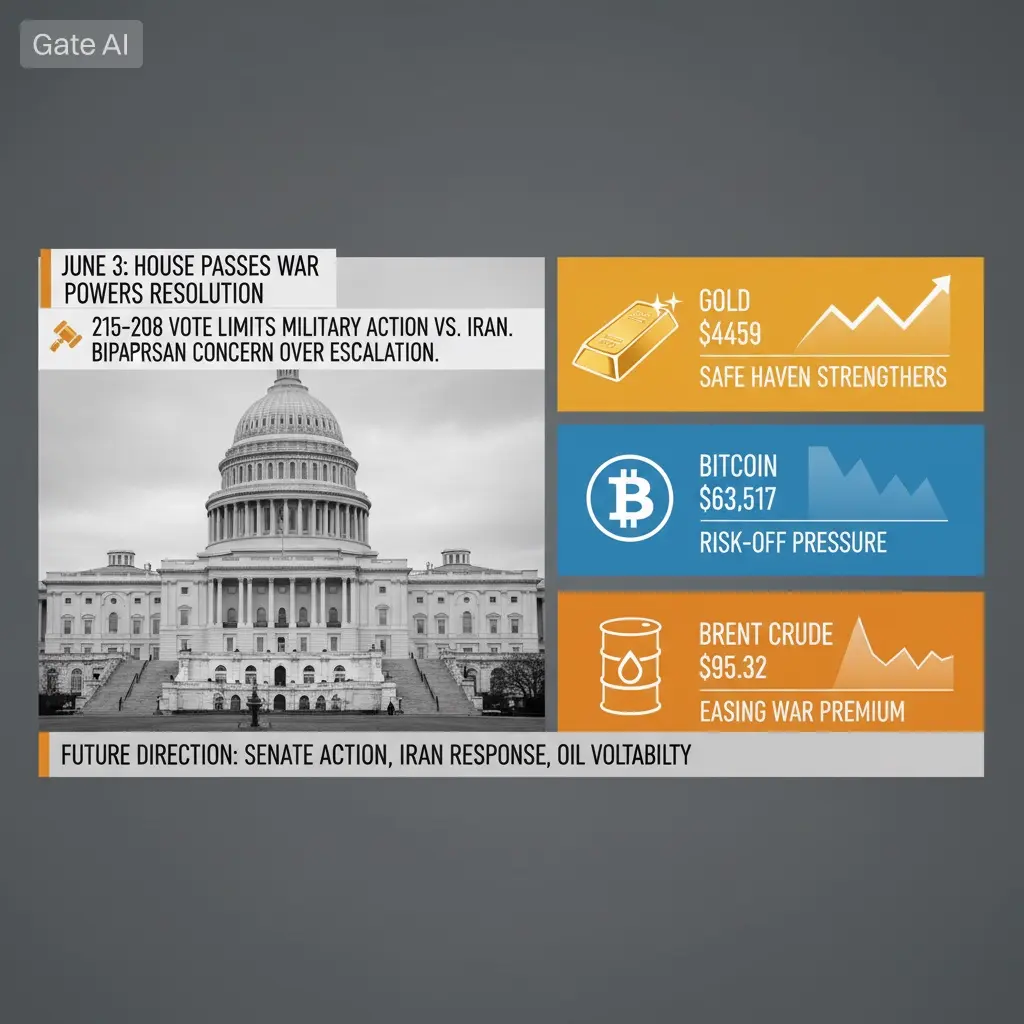
On June 3, the U.S. House of Representatives passed a War Powers Resolution with a vote of 215 to 208, demanding that President Trump cease military operations against Iran and prohibiting continued warfare without Congressional authorization. Four Republican representatives joined Democrats in voting in favor, marking the first such bipartisan rebuke since hostilities began in February. As of June 5, 2026, Bitcoin trades around $63,517 per coin, gold spot price stands at approximately $4,459 per ou
HighAmbition
#6月3日,美國眾議院以215票對208票通過戰爭權力決議,要求川普停止對伊朗軍事行動,未經國會授權不得繼續作戰。4名共和黨議員與民主黨共同投下贊成票,係2月開戰以來首次。雖決議象徵意��
On June 3, the U.S. House of Representatives passed a War Powers Resolution with a vote of 215 to 208, demanding that President Trump cease military operations against Iran and prohibiting continued warfare without Congressional authorization. Four Republican representatives joined Democrats in voting in favor, marking the first such bipartisan rebuke since hostilities began in February. As of June 5, 2026, Bitcoin trades around $63,517 per coin, gold spot price stands at approximately $4,459 per ounce, and Brent crude oil sits near $95.32 per barrel. These figures provide the baseline against which the resolution's market impact must be measured.
Bitcoin at $63,517 reflects a market already digesting geopolitical uncertainty. The resolution introduces legislative-executive friction that typically suppresses risk appetite. When government institutions display internal conflict over military policy, investors reduce exposure to speculative assets first. Bitcoin, despite its growing institutional adoption, remains classified as a risk asset during acute stress periods. Short-term downward pressure is probable, potentially testing support levels near $58,000 to $60,000 if uncertainty persists. However, Bitcoin's inflation hedge narrative gains traction if oil prices spike substantially, creating a dual dynamic where initial sell-offs may reverse as macro concerns shift from risk to inflation. The cryptocurrency's price action will depend on which narrative dominates market psychology at any given moment.
Gold at $4,459 per ounce already embeds significant geopolitical premium, rising over 34% year-over-year according to Trading Economics data. The resolution reinforces gold's upward trajectory by validating concerns about policy instability. Legislative constraints on military action create two gold-positive scenarios. First, if the resolution limits executive response capability, perceived deterrence against Iranian escalation weakens, and safe-haven flows intensify. Second, domestic political fragmentation itself drives gold demand as investors hedge against governance dysfunction regardless of military outcomes. Gold could push toward $4,600 to $4,800 in coming weeks if Senate consideration follows or Iranian rhetoric escalates. The precious metal's performance inversely correlates with Bitcoin during pure geopolitical stress, meaning capital flowing into gold may simultaneously exit cryptocurrency positions.
Brent crude at $95.32 per barrel, down from $101.36 just two days earlier on June 3, demonstrates the market's initial reaction to the resolution. The sharp decline suggests traders interpreted legislative constraints as reducing escalation probability, thereby lowering supply risk premiums. However, this interpretation may prove premature. If military limitations embolden Iranian strategic posturing near the Strait of Hormuz, the initial relief rally in oil could reverse dramatically. Brent could spike back above $100 and potentially reach $110 to $120 per barrel if supply disruption fears resurface. Each $10 increase in oil prices adds approximately 0.3 to 0.5 percentage points to headline inflation, compressing Federal Reserve easing room and strengthening the dollar, which pressures Bitcoin downward while supporting gold further.
The dollar's trajectory becomes complex under this resolution. Reduced military engagement could lower fiscal expenditure projections, modestly supporting dollar strength. Conversely, oil price volatility and governance uncertainty could undermine confidence in American policy coherence, weakening the dollar. Dollar strength generally suppresses Bitcoin by tightening global liquidity and making dollar-denominated alternatives more attractive. Dollar weakness from governance concerns could temporarily support Bitcoin's narrative but simultaneously accelerate gold accumulation as a non-dollar hedge. The net effect depends on which channel dominates, and markets often oscillate between these interpretations during resolution aftermath periods.
Ethereum and the broader altcoin market amplify Bitcoin's movements with higher beta. If Bitcoin tests $58,000 support, Ethereum could decline 8 to 12 percent, and smaller-cap tokens could lose 15 to 25 percent. DeFi protocol activity typically contracts during such periods as users retreat to stablecoins. Stablecoin supply growth decelerates when policy uncertainty prevails, as capital stays in traditional banking rather than entering crypto on-ramps. This creates a liquidity vacuum that exacerbates price declines across the cryptocurrency ecosystem.
Treasury yield dynamics matter for crypto valuation models. Acute geopolitical stress initially pushes yields lower as safety demand rises. If oil spikes above $100 again, inflation fears reverse this pattern, pushing yields higher and flattening the yield curve's growth signal. Bitcoin's risk-adjusted valuation becomes less attractive when real yields rise, creating a structural headwind beyond sentiment-driven selling. The 10-year Treasury currently reflects this tension, and its direction provides a leading indicator for medium-term Bitcoin trajectory.
The resolution's symbolic character limits immediate structural changes but establishes precedent for expanded legislative intervention. If the Senate takes up companion legislation or bipartisan support broadens, uncertainty duration extends and volatility remains elevated across all asset classes. Rapid executive-legislative compromise would resolve uncertainty fastest, potentially triggering risk asset recovery including Bitcoin rebounds above $65,000. Presidential defiance of the resolution would maximize uncertainty and likely push oil above $100 while accelerating gold toward $4,700, with Bitcoin caught between inflation support and risk-off suppression.
Historical patterns from 2019 Iran tensions show Bitcoin initially declining with risk assets before rallying on safe-haven narratives once inflation concerns dominate. The current environment differs with higher institutional participation and spot ETF flows creating additional transmission channels from traditional market sentiment. ETF holders tend to sell during uncertainty rather than accumulate, meaning structural demand weakens temporarily. Miner economics also shift as oil-driven electricity cost increases compress margins, potentially accelerating hash rate consolidation toward renewable-energy regions.
For investors navigating this environment, reduced leverage and increased stablecoin allocations represent rational short-term positioning. Long-term holders may view price declines below $60,000 as accumulation opportunities if protocol fundamentals remain intact. The key monitoring points are Senate action timeline, presidential response signals, Iranian strategic communications, and oil physical market inventory data. Each of these variables can shift the dominant narrative from risk-off to inflation-hedge rapidly, creating whiplash potential in Bitcoin and cryptocurrency markets. Gold remains the clearest beneficiary across scenarios, oil volatility creates both inflation and growth risk, and Bitcoin's path depends on which macro channel ultimately dominates market psychology following this unprecedented legislative assertion of war powers authority.@Gate_Square #ShareYourUSStocksWinNvidia #PredictNBAFinalsWin20000U #TradeCFDWinGold

repost-content-media
  • Reward
  • 1
  • Repost
  • Share
HighAmbition:
Steadfast HODL💎
#ChipStocksCrashedDowHitRecordHigh
The semiconductor sector suffered a sharp sell-off on June 4, 2026, after Broadcom's earnings report disappointed investors. Although the company beat revenue and profit estimates, its guidance projected third-quarter AI chip revenue of $16 billion versus Wall Street expectations of $17.2 billion. Broadcom also refused to raise its fiscal 2027 AI semiconductor revenue target beyond $100 billion despite growing investor expectations.
The reaction was severe. Broadcom plunged 14%, erasing more than $310 billion in market value. The weakness spread across the s
HighAmbition
#ChipStocksCrashedDowHitRecordHigh
The semiconductor sector suffered a sharp sell-off on June 4, 2026, after Broadcom's earnings report disappointed investors. Although the company beat revenue and profit estimates, its guidance projected third-quarter AI chip revenue of $16 billion versus Wall Street expectations of $17.2 billion. Broadcom also refused to raise its fiscal 2027 AI semiconductor revenue target beyond $100 billion despite growing investor expectations.
The reaction was severe. Broadcom plunged 14%, erasing more than $310 billion in market value. The weakness spread across the sector. Marvell Technology fell over 6%, Micron nearly 8%, Intel 3%, and AMD 4%. Asian chipmakers were also hit, with Samsung Electronics down almost 7% and SK Hynix falling more than 8%.
The broader issue extends beyond one earnings report. Semiconductor stocks had been priced for near-perfect execution after years of AI-driven gains. Markets assumed hyperscaler spending would continue accelerating indefinitely. Even a modest slowdown in expectations triggered a violent repricing. The Broadcom miss simply exposed how fragile those assumptions had become.
The Link Between Chip Stocks and Bitcoin
The relationship between semiconductor stocks and Bitcoin has strengthened significantly. Bitcoin's correlation with the S&P 500 has climbed near historic highs, meaning crypto increasingly trades alongside traditional risk assets rather than independently.
On June 4, Bitcoin traded around $63,000 to $66,000 and declined roughly 3% to 4% during the semiconductor sell-off. Michael Saylor noted that approximately $400 billion flowed into AI infrastructure over the previous six months while roughly $4 billion left US-listed spot Bitcoin ETFs since mid-May, highlighting institutional capital rotation.
However, Bitcoin is not entirely dependent on stocks. Research suggests only about one-quarter of Bitcoin's volatility comes from equity markets, while the majority is still driven by crypto-specific factors such as regulation, adoption, and market structure. When semiconductor sentiment weakens, Bitcoin often follows, but its reaction is usually less extreme because of its independent drivers.
NVIDIA Corporation (NVDA): Detailed Analysis
NVIDIA remains the dominant AI semiconductor company. Following June 4 volatility, NVDA traded roughly between $214 and $224 after swinging from a low near $210 to a high near $221. The 52-week high stands at $236.54, while the 52-week low is $138.83.
Major support sits around $183, with secondary support near $174. Resistance is concentrated around $225 and the $235-$236 all-time-high region.
Analyst sentiment remains bullish. The consensus target is approximately $298. Daiwa Securities raised its target from $215 to $255, while Argus increased its target from $220 to $270.
NVIDIA's future direction depends heavily on whether upcoming hyperscaler earnings confirm continued AI spending strength. A positive outlook could send shares back toward $235 and beyond. Additional AI spending concerns could push the stock toward the $183 support zone.
Importantly, NVIDIA's decline was driven largely by sector contagion rather than company-specific weakness. Its GPU ecosystem remains the industry standard, leaving the long-term AI thesis largely intact.
AMD: Detailed Analysis
AMD remains NVIDIA's primary competitor in AI accelerators. As of June 4, AMD traded around $523 after falling 3.56% from $542.52.
Key support sits at $458.79, while stronger support exists near $402. Resistance remains near $521 and $542.52.
Analyst opinions remain mixed. Some maintain conservative targets while others expect AMD to revisit the $542-$570 range if MI300 adoption accelerates among major hyperscalers.
From a trading perspective, holding above $458 is critical. Stabilization could support a recovery toward $523 and $542. A break below $458 would expose the stock to downside toward $402.
AMD's decline was largely sector-driven rather than fundamental. If additional AI customers validate MI300 deployments, the stock could rebound quickly. However, if AI spending slows further, AMD may face greater pressure than NVIDIA because it lacks the same level of ecosystem dominance.
Why the Dow Jones Hit Record High on the Same Day
While semiconductor stocks collapsed, the Dow Jones Industrial Average surged 875 points, or 1.73%, to a record close of 51,562.
The rally was led by UnitedHealth Group, which gained 5.36%, and Goldman Sachs, which rose 4.98%. Capital rotated aggressively from AI and technology stocks into financials and healthcare. Lower oil prices, easing Treasury yields, and strong corporate earnings further supported the move.
UnitedHealth exceeded expectations with Q1 adjusted EPS of $7.23 and raised full-year guidance above $18.25. Goldman Sachs benefited from strong trading activity and improving investment banking conditions.
The Dow's price-weighted structure amplified gains because high-priced stocks such as Goldman Sachs carry significant influence within the index.
Goldman Sachs (GS): Detailed Trading Strategy
Goldman Sachs traded between approximately $1,041 and $1,095 on June 4 after a near 5% surge. The stock has climbed substantially from roughly $820 earlier in 2026.
Major support remains near $820.94, with secondary support around $900. Previous resistance at $907.36 has been decisively broken. Current resistance stands near $1,095, followed by the psychological $1,100 level.
The bullish case remains supported by rising trading revenue, improving deal activity, and ongoing capital rotation into financial stocks
Entry near $1,040 with a stop below $1,000 targets a move toward $1,100 and potentially $1,150 if momentum continues.
Goldman currently benefits from multiple macro environments. Market volatility boosts trading revenue, while improving economic conditions support investment banking and asset management operations.
UnitedHealth Group (UNH): Detailed Trading Strategy
UnitedHealth traded between roughly $378 and $401 after gaining 5.36% on June 4. The company reported adjusted EPS of $7.23, beat estimates by roughly 10%, raised guidance above $18.25, and generated $8.9 billion in operating cash flow.
Support sits near $363.36, while resistance remains around $401.60. A successful breakout could target approximately $435.
A trading strategy favors entries around $370-$380 with stops below $363. Initial upside targets remain near $401, followed by $435.
UnitedHealth represents a unique blend of defensive healthcare exposure and technology-driven growth through its Optum division. This combination allows it to attract both value-oriented and growth-focused investors during periods of sector rotation.
The Big Picture: What This Divergence Really Means
The June 4 divergence between collapsing semiconductor stocks and a record Dow Jones close represents a major market rotation rather than a random trading event. For years, capital concentrated heavily in AI-related investments.
Broadcom's guidance challenged assumptions that AI spending would continue accelerating without interruption, triggering a rapid shift toward financials, healthcare, and other value-oriented sectors.
For semiconductor investors, the lesson is that even the strongest growth stories remain sensitive to valuation and expectations. For Bitcoin investors, the decline reinforces that crypto now behaves increasingly like a risk asset tied to broader market sentiment. For Dow investors, the gains demonstrate the benefits of diversification and sector rotation.
Ultimately, markets continue to teach the same lesson: concentration creates vulnerability, while diversification creates resilience. When expectations become too one-sided, even a small disappointment can trigger a major reallocation of capital.@Gate_Square #ShareYourUSStocksWinNvidia #PredictNBAFinalsWin20000U
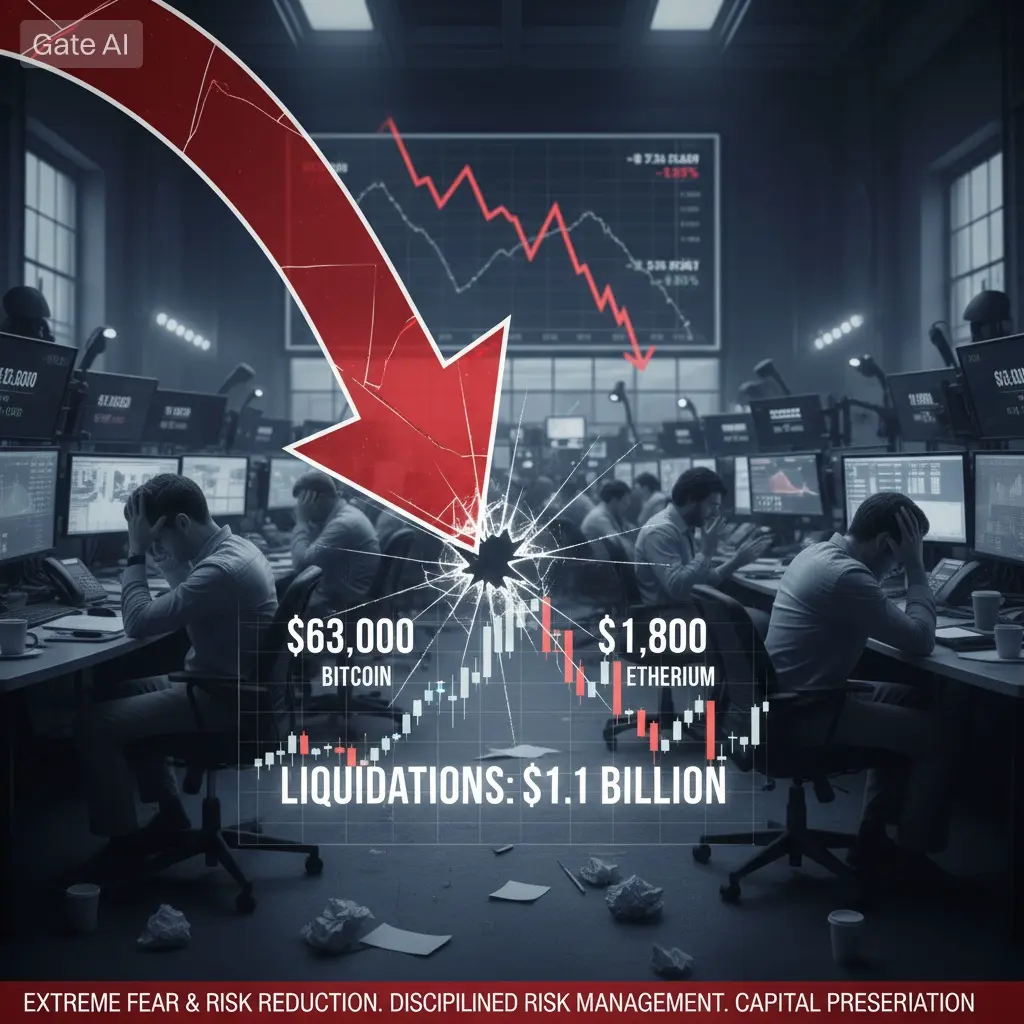
repost-content-media
  • Reward
  • 1
  • Repost
  • Share
HighAmbition:
Steadfast HODL💎
#BitminePlans300MPreferredStockOffering BitMine Immersion Technologies Announces Three Hundred Million Dollar Preferred Stock Offering
BitMine Immersion Technologies, a publicly traded company operating under the ticker symbol BMNR on the New York Stock Exchange, has officially announced a significant financial initiative aimed at expanding its cryptocurrency treasury operations. The company has filed with the Securities and Exchange Commission to offer three million shares of Series A Perpetual Preferred Stock, representing a total potential capital raise of three hundred million dollars. Thi
HighAmbition
#BitminePlans300MPreferredStockOffering BitMine Immersion Technologies Announces Three Hundred Million Dollar Preferred Stock Offering
BitMine Immersion Technologies, a publicly traded company operating under the ticker symbol BMNR on the New York Stock Exchange, has officially announced a significant financial initiative aimed at expanding its cryptocurrency treasury operations. The company has filed with the Securities and Exchange Commission to offer three million shares of Series A Perpetual Preferred Stock, representing a total potential capital raise of three hundred million dollars. This strategic move positions BitMine to further strengthen its position as one of the largest corporate holders of Ethereum in the market today.
The preferred stock offering is structured with a stated value of one hundred dollars per share, making it accessible to institutional and retail investors seeking fixed income opportunities within the cryptocurrency sector. Each share carries a fixed cumulative dividend rate of nine point five percent annually, which translates to approximately nine dollars and fifty cents per share per year in dividend payments. Unlike common stock dividends that are paid at the discretion of the board of directors, cumulative dividends accumulate regardless of whether they are declared, providing investors with a degree of income predictability.
The dividend payment schedule has been set on a weekly basis, which is relatively uncommon in traditional finance but aligns with the rapid pace of cryptocurrency markets. Investors will receive cash dividends weekly in arrears, meaning payments will be made at the end of each seven-day period. The company retains the option to increase dividend payment frequency in the future at its sole discretion, which could potentially move to bi-weekly or monthly distributions depending on operational preferences and cash flow management strategies.
This preferred stock offering represents a direct emulation of the financial strategy pioneered by Strategy, formerly known as MicroStrategy, under the leadership of Michael Saylor. Strategy successfully utilized preferred stock offerings to fund aggressive Bitcoin accumulation, creating a model that other cryptocurrency-focused corporations have sought to replicate. BitMine has adapted this approach specifically for Ethereum, recognizing the staking revenue potential that Ethereum's proof-of-stake consensus mechanism provides.
The primary use of proceeds from this offering will be directed toward expanding BitMine's existing Ethereum treasury, which currently stands at approximately five point four million ETH tokens. This makes BitMine one of the largest corporate holders of Ethereum globally. The company has developed a business model centered on generating yield through Ethereum staking, where locked tokens earn rewards for participating in network validation and security.
From a financial perspective, the dividend obligations created by this offering are substantial but appear manageable based on current projections. At the full three hundred million dollar offering size, the nine point five percent annual dividend rate would create approximately twenty-eight point five million dollars in yearly dividend obligations. BitMine has projected that its annualized staking revenue could reach approximately two hundred fifty-eight million dollars, which would cover the dividend obligations multiple times over before accounting for operational expenses, taxes, and potential market volatility.
The perpetual nature of this preferred stock means that it has no maturity date and will remain outstanding indefinitely unless redeemed by the company. Perpetual preferred stock typically trades based on its dividend yield relative to market interest rates, and the fixed nine point five percent rate provides investors with clarity on their expected returns. However, the lack of a maturity date means that investors should be prepared for long-term capital commitment unless they choose to sell their shares in the secondary market.
BitMine's decision to pursue this financing strategy reflects the broader trend of cryptocurrency companies seeking innovative ways to access traditional capital markets. By offering preferred stock with attractive yields, these companies can tap into investor demand for fixed income products while simultaneously building their cryptocurrency treasuries. The model creates a symbiotic relationship where investors receive regular income payments while the company gains access to capital for digital asset accumulation.
The comparison between BitMine's offering and Strategy's preferred stock instrument reveals both similarities and distinctions. Strategy's preferred stock trades under the ticker STRC and features a variable dividend rate designed to keep the instrument trading near its one hundred dollar stated value. In contrast, BitMine has opted for a fixed nine point five percent rate, providing more predictable income but potentially creating price volatility if interest rates change significantly. Strategy pays dividends monthly, while BitMine has chosen a weekly payment schedule.
Investors considering participation in this offering should evaluate several risk factors. The primary risk relates to Ethereum price volatility, as the value of BitMine's treasury could fluctuate significantly based on market conditions. Additionally, staking yields are not guaranteed and could compress if network participation increases or if Ethereum protocol changes affect reward structures. The company's ability to maintain dividend payments depends on continued staking revenue generation and prudent financial management.
Regulatory considerations also play a role in this offering. As a registered securities offering under the Securities Act of nineteen thirty-three, the preferred stock will be subject to ongoing reporting requirements and regulatory oversight. This provides investors with greater transparency compared to unregulated cryptocurrency investments, but also means that the company must maintain compliance with securities laws and regulations.
The timing of this offering is noteworthy given current market conditions. Ethereum has experienced price volatility in recent months, and the company's decision to raise capital now suggests confidence in the long-term value proposition of Ethereum staking. The nine point five percent yield is competitive with other fixed income investments, particularly in an environment where traditional bond yields have been fluctuating.
For existing BitMine shareholders, this preferred stock offering represents a dilution event in terms of priority claims on company assets and earnings. Preferred stockholders have priority over common stockholders in dividend payments and liquidation scenarios, which could affect the risk profile of common equity. However, the successful execution of this offering could strengthen the company's financial position and support the value of common shares if Ethereum appreciates.
The broader implications of this offering extend beyond BitMine to the cryptocurrency industry as a whole. As more companies adopt treasury strategies involving digital assets, the intersection between traditional finance and cryptocurrency continues to evolve. Preferred stock offerings provide a bridge between conventional investment products and cryptocurrency exposure, potentially attracting investors who might not otherwise participate directly in digital asset markets.
In conclusion, BitMine Immersion Technologies' three hundred million dollar preferred stock offering represents a significant development in corporate cryptocurrency treasury management. The nine point five percent fixed dividend rate, weekly payment schedule, and perpetual structure create an attractive investment vehicle for income-focused investors while providing BitMine with capital to expand its Ethereum holdings. As the company executes this strategy, market participants will be watching closely to see whether this approach can replicate the success that Strategy achieved with its Bitcoin-focused treasury operations.@Gate_Square #ShareYourUSStocksWinNvidia #PredictNBAFinalsWin20000U
repost-content-media
  • Reward
  • 1
  • Repost
  • Share
HighAmbition:
Steadfast HODL💎
#分享美股交易赢英伟达股票
#EWY
EWY iShares MSCI South Korea ETF Complete Analysis:
The iShares MSCI South Korea ETF, trading under the ticker EWY, has emerged as one of the most remarkable stories in global markets during 2026. As of early June, EWY is trading around 194 dollars per share, reflecting an extraordinary long-term rally despite a recent correction from its highs above 217 dollars. This ETF tracks the MSCI Korea 25/50 Index, providing exposure to large- and mid-cap South Korean equities. Launched in 2000 by BlackRock's iShares, EWY employs a passive indexing strategy investing at least 80 p
HighAmbition
#分享美股交易赢英伟达股票
#EWY
EWY iShares MSCI South Korea ETF Complete Analysis:
The iShares MSCI South Korea ETF, trading under the ticker EWY, has emerged as one of the most remarkable stories in global markets during 2026. As of early June, EWY is trading around 194 dollars per share, reflecting an extraordinary long-term rally despite a recent correction from its highs above 217 dollars. This ETF tracks the MSCI Korea 25/50 Index, providing exposure to large- and mid-cap South Korean equities. Launched in 2000 by BlackRock's iShares, EWY employs a passive indexing strategy investing at least 80 percent of assets in index components. The fund has transformed from what many considered a traditional country ETF into one of the most important AI hardware and semiconductor investment vehicles available to global investors.
Current Price and Recent Performance
EWY is currently trading near 194 dollars after experiencing a meaningful pullback from recent highs above 217 dollars. The ETF has corrected approximately 10 to 12 percent from its peak as traders locked in profits following one of the strongest rallies among global equity ETFs. Despite this decline, the broader long-term trend remains positive, and EWY continues to trade significantly above levels seen earlier in the year. The recent weakness reflects profit-taking across semiconductor-related names rather than a complete deterioration in the fundamental outlook.
Why EWY Has Surged
The primary catalyst remains the global artificial intelligence semiconductor boom centered on high-bandwidth memory chips. Samsung Electronics and SK Hynix together comprise approximately 48 percent of EWY's total assets, making the ETF effectively a proxy for the global HBM and DRAM super-cycle. SK Hynix recently surpassed a 1 trillion dollar market capitalization, joining Samsung among the world's most valuable technology companies. SK Hynix shares surged dramatically during 2026 as demand for AI infrastructure accelerated across hyperscalers, cloud providers, and enterprise customers.
Samsung and SK Hynix produce much of the world's high-bandwidth memory, the advanced memory technology required by AI accelerators produced by companies such as NVIDIA and AMD. Regardless of which AI platform ultimately dominates, Korean semiconductor manufacturers remain essential suppliers. This gives EWY a structural advantage compared to broader international ETFs.
Beyond semiconductors, EWY includes significant holdings in Hyundai Motor, Kia Corporation, Hanwha Aerospace, and major South Korean financial institutions. However, technology still accounts for more than half of the ETF's weighting, meaning performance remains closely tied to HBM demand, DRAM pricing trends, and semiconductor capital expenditure cycles. South Korea's export-oriented economy and growing technology leadership continue supporting the broader investment thesis.
Why EWY Can Decline: Risks
Despite the powerful AI narrative, several important risks remain. Market breadth within South Korea has weakened considerably. While headline indices have remained strong, a growing percentage of stocks have underperformed, suggesting gains have become increasingly concentrated in a handful of large technology companies.
Samsung and SK Hynix account for a substantial portion of both EWY and the broader Kospi Index. This concentration creates vulnerability if sentiment toward AI infrastructure spending changes. Any slowdown in global data center expansion, weakness in HBM demand, declining DRAM prices, or reduced semiconductor spending could disproportionately impact the ETF.
Additional risks include supply-chain disruptions, labor negotiations at major chipmakers, geopolitical tensions in Asia, currency fluctuations, and continued foreign institutional selling of Korean equities. Following such a powerful rally, periodic profit-taking should also be expected.
Upside Targets and Forecasts
Several market analysts remain constructive on EWY despite the recent correction. Long-term forecasts continue pointing toward additional upside if AI infrastructure spending remains strong and memory chip demand continues expanding.
Should the semiconductor cycle remain favorable, EWY could eventually revisit the 217 dollar high and challenge the 220 to 225 dollar resistance zone. A sustained breakout above those levels could open the path toward 250 dollars over the medium term. More aggressive bullish projections continue targeting 300 dollars or higher, although such outcomes would require continued strength in both Samsung and SK Hynix alongside favorable global macroeconomic conditions.
At the same time, investors should recognize that after such a strong multi-year rally, volatility is likely to remain elevated.
Key Technical Levels: Resistance and Support
Immediate resistance now sits near 200 dollars, which has become an important psychological barrier following the recent correction.
Above that, major resistance levels are located at:
• 208 dollars
• 220 to 225 dollars
• 250 dollars
A sustained move above 225 dollars would likely confirm renewed bullish momentum and strengthen the case for a move toward 250 dollars.
On the downside, immediate support exists near:
• 190 dollars
• 185 dollars
• 176 dollars
The 176 dollar region remains the most significant structural support zone. A breakdown below that area would suggest a much deeper correction and could shift the medium-term trend from bullish to neutral.
Trading Strategy at Current Levels
For aggressive bullish traders who believe the AI semiconductor super-cycle remains intact, the current trading zone between 190 and 195 dollars may present an attractive accumulation opportunity. Entries near current levels with stop-loss protection below 185 dollars offer relatively favorable risk-reward characteristics if the ETF eventually retests 220 dollars and above.
For conservative traders, waiting for a decisive breakout above 200 dollars followed by confirmation above 208 dollars may provide greater confidence that bullish momentum has returned. Alternatively, a deeper pullback toward 176 to 180 dollars would create a more attractive long-term entry point.
Investors already holding substantial gains may consider partial profit-taking while maintaining a core position. This approach allows participation in future upside while reducing exposure to near-term volatility.
Swing traders can monitor the emerging range between 190 and 208 dollars. Buying near support and reducing exposure near resistance remains a reasonable strategy until a decisive breakout occurs.
Near-Term Outlook: Three Scenarios
In the bullish scenario, HBM demand remains strong, AI infrastructure spending accelerates further, and Samsung and SK Hynix continue delivering exceptional earnings. Under this outcome, EWY reclaims 200 dollars, breaks through 208 dollars, and advances toward 220 to 225 dollars, with potential extension toward 250 dollars.
In the neutral scenario, EWY consolidates between 190 and 208 dollars while investors assess semiconductor demand, earnings results, and global macroeconomic conditions. This would allow valuations to reset before the next major move.
In the bearish scenario, AI-related enthusiasm cools, memory pricing weakens, or broader equity markets experience risk-off conditions. Under this outcome, EWY could decline toward 176 to 180 dollars before finding stronger institutional support.
Key indicators to monitor include HBM pricing trends, semiconductor inventory levels, earnings from Samsung and SK Hynix, foreign institutional flows into Korean equities, AI capital expenditure announcements from hyperscalers, and trading volume patterns within EWY itself.
Conclusion
EWY at approximately 194 dollars remains one of the most compelling but volatile opportunities in global equity markets. The ETF's performance is heavily driven by Samsung Electronics and SK Hynix, placing investors at the center of the AI memory and semiconductor boom. Key upside levels remain 200, 208, 220 to 225, and 250 dollars, while critical support rests at 190, 185, and 176 dollars. Whether EWY resumes its advance or experiences a deeper correction will largely depend on the trajectory of AI infrastructure spending, HBM demand, semiconductor pricing, and broader market participation within South Korea. Investors should maintain disciplined risk management, monitor technical levels closely, and remain focused on the underlying semiconductor fundamentals that continue to drive the long-term investment thesis.
@Gate_Square #ShareYourUSStocksWinNvidia #PredictNBAFinalsWin20000U
repost-content-media
  • Reward
  • 1
  • Repost
  • Share
HighAmbition:
Steadfast HODL💎
#ShareYourUSStocksWinNvidia
#NOK
Nokia Corporation (NYSE: NOK) is currently trading at $15.94 per share, marking one of the most remarkable transformations in the stock market this year. From approximately $6.50 at the start of 2026, Nokia has surged roughly 140 percent year-to-date, hitting a 52-week high of $16.52 on June 1, 2026, and reaching price levels not seen in over 15 years. The stock's journey from a legacy telecom equipment maker to a leading AI infrastructure play has captivated traders worldwide, and understanding where it can go next requires careful analysis of price levels,
NOK-9.62%
NVDA-3.91%
BAC-0.77%
CSCO-5.56%
HighAmbition
#ShareYourUSStocksWinNvidia
#NOK
Nokia Corporation (NYSE: NOK) is currently trading at $15.94 per share, marking one of the most remarkable transformations in the stock market this year. From approximately $6.50 at the start of 2026, Nokia has surged roughly 140 percent year-to-date, hitting a 52-week high of $16.52 on June 1, 2026, and reaching price levels not seen in over 15 years. The stock's journey from a legacy telecom equipment maker to a leading AI infrastructure play has captivated traders worldwide, and understanding where it can go next requires careful analysis of price levels, catalysts, and trading strategies.
The primary catalyst behind Nokia's meteoric rise is its strategic pivot into AI networking and optical infrastructure. In October 2025, Nvidia invested $1 billion in Nokia at a price of $6.01 per share, taking approximately 3 percent stake and forming a partnership focused on AI-RAN technology, which combines AI workloads with wireless network infrastructure. Since that Nvidia entry at $6.01, the stock has nearly tripled, demonstrating how a single strategic partnership can transform market perception and valuation. Nokia's Q1 2026 earnings report on April 23, 2026 accelerated the rally. The company reported diluted earnings per share of $0.06, beating estimates, and raised its 2026 guidance significantly. Network Infrastructure net sales growth was upgraded to a range of 12 percent to 14 percent, up from 6 percent to 8 percent. The outlook for Optical and IP Networks combined was elevated to 18 percent to 20 percent growth, up from 10 percent to 12 percent. Sales to AI and cloud customers surged 49 percent, and Nokia booked 1 billion euros in new cloud orders during the quarter, mostly tied to optical networking equipment for massive AI data centers.
The analyst community has responded with upgrades and price target increases. Argus Research upgraded Nokia to Buy on April 27, 2026, with a price target of $15.00. Bank of America issued a Buy rating calling Nokia an optical powerhouse with a target of $11.00 in euros. Nordea Equity Research upgraded from Hold to Buy with a target of $10.50 in euros. Morgan Stanley and JP Morgan have also issued recent ratings. While some targets have been surpassed by the current $15.94 price, the trend is clear: analysts are turning bullish and further target increases are likely. The TradingView consensus among 25 analysts shows a median target around $9.93 in euros for Helsinki-listed shares, with a maximum estimate of $14.00 euros and minimum of $5.54 euros, though the NYSE ADR has outperformed these expectations.
From a technical standpoint, Nokia is in a strong bullish configuration. The 50-day simple moving average sits at approximately $11.88, well below $15.94, confirming the uptrend. The 200-day simple moving average at approximately $7.37 provides long-term bullish support. All 12 moving average indicators from MA5 through MA200 flash Buy signals with zero Sell signals. The stock gained 9.40 percent on June 1, rising from $14.85 to $16.24, with an intraday range of $14.93 low to $16.52 high, a 10.65 percent swing. Volume surged by 53 million shares above the prior day, confirming the advance. The stock has fallen in 6 of the last 10 days but remains up 16.46 percent over two weeks, showing pullbacks are bought aggressively.
Key support levels begin at $14.93, the June 1 intraday low and immediate support. Below that, $14.00 is a psychological and technical support zone. The $12.10 level corresponds to the 0.382 Fibonacci retracement as intermediate support. $11.88, aligned with the 50-day moving average, is critical trend support that must hold to maintain the bullish structure. Further down, $10.56 marks the 0.50 Fibonacci retracement. The $9.79 level was cited as a key near-term support in earlier analysis. $7.37, the 200-day moving average, represents ultimate long-term support. The Nvidia investment price of $6.01 and the early 2026 starting point around $6.50 serve as foundational levels unlikely to be revisited unless the entire AI narrative collapses.
Key resistance levels start at $16.52, the current 52-week peak and immediate hurdle. Breaking above opens the path to $17.00 psychological resistance, then $18.00 as a conservative year-end target. The $18.00 to $21.00 range represents the moderate price target zone where many see Nokia heading by year-end 2026. The $25.00 to $30.00 range represents the optimistic bull case if AI spending continues to accelerate. An algorithmic model projects an extreme scenario targeting $27.47 to $34.54 over three months, though such projections represent outlier scenarios and should be treated cautiously.
How high Nokia can go depends on multiple scenarios. In the conservative case, Nokia consolidates above $15.00 and gradually climbs toward $18.00 to $21.00 by year-end, assuming steady AI spending and continued execution. In the base case, Nokia breaks above $18.00 and reaches $21.00 to $25.00, fueled by additional analyst upgrades and strong quarterly results. In the aggressive bull case, Nokia could reach $25.00 to $30.00 if the AI data center buildout accelerates, Nokia captures disproportionate optical networking demand, and the market re-rates Nokia as a core AI infrastructure company. Jim Cramer has stated this stock could go dramatically higher, reflecting mainstream recognition of the transformation.
For the swing trading strategy, entry at $16.55 on a confirmed breakout above $16.52 resistance with volume, targeting $18.00 for approximately 9.1 percent gain. Stop loss at $14.90, just below $14.93, limiting downside to approximately 10 percent. For the pullback buying strategy, buy orders at $14.00 with stop at $12.00 targeting $18.00, a 28.6 percent potential gain with 14.3 percent risk, creating a 2 to 1 ratio. Additional buys at $12.10 near the 0.382 Fibonacci level with stop at $10.50 targeting $16.50, a 36.4 percent potential gain with 13.3 percent risk, a 2.7 to 1 ratio. For the trend following strategy, buy at $15.94 and ride the uptrend using the 50-day moving average at $11.88 as a trailing stop reference, exiting only if the stock closes below it for two consecutive days. For the partial profit strategy, buy at $15.94, sell 25 percent at $18.00, 25 percent at $21.00, 25 percent at $25.00, and let the final 25 percent ride with a trailing stop.
Nokia offers a dividend yield of approximately 1.56 percent, adding appeal for long-term holders. The next earnings on July 23, 2026, with consensus EPS of $0.06 and revenue of $4.90 billion, will be critical for validating or challenging the bullish thesis. Risk management is essential given 10.65 percent daily volatility. Position sizes should not exceed 2 to 5 percent of portfolio capital. Stop losses at defined support levels are mandatory. The 140 percent year-to-date gain means 15 to 25 percent pullbacks are possible within the uptrend. Risks include slowing AI spending, guidance disappointment, valuation ahead of fundamentals, competition from Cisco which raised its FY26 AI target to $9 billion, and analyst targets still lagging the current price.
In summary, Nokia at $15.94 stands at the intersection of a genuine business transformation and a powerful market narrative. Breaking $16.52 resistance would trigger momentum buying toward $18.00. Support at $14.93, $14.00, $12.10, and $11.88 provides layered pullback buying zones. The conservative target of $18.00 to $21.00 by year-end is achievable, while $25.00 to $30.00 represents the bull case. Disciplined risk management, defined entries and exits, and respect for the stock's volatility are essential. The AI networking transformation is delivering real financial results, and the market is re-rating Nokia from a forgotten telecom stock to a central AI infrastructure player.@Gate_Square #ShareYourUSStocksWinNvidia #PredictNBAFinalsWin20000U #TradeCFDWinGold
repost-content-media
  • Reward
  • 1
  • Repost
  • Share
HighAmbition:
Steadfast HODL💎
#GatePartnersWithAlpacaToBridgeCryptoAndStocks
The financial world has just witnessed a landmark development that could reshape how millions of people invest across both cryptocurrency and stock markets. Gate, one of the largest and most established cryptocurrency exchanges globally, has officially announced a strategic partnership with Alpaca, a leading U.S.-based brokerage infrastructure provider, to bridge the long-standing divide between digital assets and traditional financial markets. This collaboration is not merely a business arrangement; it represents a fundamental shift in how retai
HighAmbition
#GatePartnersWithAlpacaToBridgeCryptoAndStocks
The financial world has just witnessed a landmark development that could reshape how millions of people invest across both cryptocurrency and stock markets. Gate, one of the largest and most established cryptocurrency exchanges globally, has officially announced a strategic partnership with Alpaca, a leading U.S.-based brokerage infrastructure provider, to bridge the long-standing divide between digital assets and traditional financial markets. This collaboration is not merely a business arrangement; it represents a fundamental shift in how retail investors around the world can access U.S. stocks and ETFs alongside their crypto holdings, all from a single platform and a single account. For traders and investors everywhere, this partnership signals that the wall separating crypto from stocks is finally coming down, and Gate is leading the charge.
Gate was founded in 2013 and has since grown into one of the most prominent cryptocurrency and integrated financial services platforms in the world, serving more than 54 million users globally. Over the years, Gate has built a robust ecosystem that supports trading across more than 4,700 digital assets, including major cryptocurrencies like Bitcoin and Ethereum, as well as a wide range of altcoins and stablecoins. The platform has consistently pushed beyond the boundaries of a typical crypto exchange, already offering trading in equities, indices, commodities, metals, and foreign exchange markets. However, the Alpaca partnership takes this expansion to an entirely new level by adding direct access to more than 10,000 real U.S. stocks and ETFs listed on the New York Stock Exchange and Nasdaq. This is not tokenized stock representation or synthetic derivatives; these are actual, real stocks and ETFs that users can buy and sell directly, with full ownership rights including dividend payments and corporate action participation.
Alpaca serves as the critical infrastructure backbone for this integration. Alpaca is a U.S.-headquartered, self-clearing broker-dealer that holds the necessary regulatory licenses and clearing qualifications to operate as a compliant securities firm. The company is not just a name on a press release; it is the entity that handles execution, clearing, settlement, custody, dividend payments, and corporate actions for every stock trade made through Gate. Alpaca supports over 10 million brokerage accounts across hundreds of fintechs and institutions in more than 40 countries, and it has raised over $320 million in funding. Its API-first architecture was a key reason Gate selected it as an infrastructure partner rather than attempting to build an entire brokerage system from scratch. This choice ensures that the stock trading experience on Gate is powered by proven, regulated, and professionally managed brokerage infrastructure, which is essential for user trust and regulatory compliance.
One of the most revolutionary aspects of this partnership is the payment mechanism. Users can trade stocks and ETFs using USDT, the widely used stablecoin, without needing to convert their holdings to fiat currency or leave the Gate platform ecosystem. Fractional share trading is supported with a minimum purchase of just one dollar, meaning that even investors with very small amounts of capital can gain exposure to high-priced U.S. stocks. Consider that a single share of Apple might trade above $230, a share of Tesla above $340, and a share of NVIDIA above $130. For many investors, particularly in emerging markets, buying whole shares of these companies has been financially prohibitive. With fractional trading starting at just $1, a user can own a tiny fraction of these marquee companies, diversifying their portfolio incrementally without needing large sums of money. This accessibility feature alone could democratize U.S. stock investing for millions of people who have previously been excluded due to capital constraints.
Historically, accessing U.S. equity markets from outside the United States has been a cumbersome and often expensive process. Retail investors in many countries had to open separate brokerage accounts with international firms, complete lengthy and complicated onboarding procedures that sometimes required notarized documents and weeks of waiting, transfer funds across borders through banking systems that charged hefty fees, and then manage their investments across multiple platforms with different interfaces, different fee structures, and different reporting formats. The experience was fragmented, inefficient, and discouraging for many would-be investors. Gate's partnership with Alpaca addresses each of these pain points directly. By integrating stock trading into the existing Gate app and account structure, users get a unified experience where they can manage their crypto portfolio and their stock portfolio side by side, with the same interface, the same account, and the same familiar workflow they already know.
The significance of this development extends well beyond convenience. It represents a structural transformation in how financial services are delivered to retail investors globally. The crypto industry has long talked about disrupting traditional finance, but what is happening now looks less like disruption and more like thoughtful integration. Crypto-native platforms are leveraging regulated infrastructure to offer traditional financial products to audiences that conventional brokerages have struggled to reach effectively. Gate is not replacing the stock market; it is providing a new gateway into it, one that is more accessible, more efficient, and more aligned with how a growing generation of investors prefers to operate. These investors are comfortable with digital assets, comfortable with stablecoins, and comfortable with mobile-first trading platforms. Gate speaks their language, and now that language includes stocks.
From a strategic perspective, this partnership positions Gate as something far more ambitious than a cryptocurrency exchange. It is evolving into a comprehensive multi-asset trading platform, a global financial market infrastructure that covers digital assets, stocks, ETFs, commodities, indices, and foreign exchange. This is the kind of platform that financial institutions spend decades building, and Gate is assembling it at a pace that reflects the urgency and ambition of the crypto era. The platform was also among the first exchanges to implement 100 percent Proof of Reserves, a transparency benchmark that becomes even more relevant as Gate enters the more heavily regulated world of stock trading. Users need to know that their assets are safe and accounted for, whether those assets are Bitcoin or shares of Apple, and Gate's commitment to verifiable transparency provides an important foundation of trust.
Dr. Han, the Founder and CEO of Gate, framed the partnership in terms of the broader trajectory of global finance. He stated that the future of finance is becoming increasingly interconnected, and that the partnership with Alpaca will help advance that vision by providing seamless access to real stock market investing while maintaining the simplicity and efficiency that users expect from a modern digital asset platform. Yoshi Yokokawa, the Co-Founder and CEO of Alpaca, emphasized the mission alignment between the two companies, stating that Alpaca's mission is to open financial services to everyone on the planet through modern infrastructure, and that together with Gate, they are helping create a more connected and efficient global investment experience.
For the everyday trader, the practical implications are clear and compelling. Instead of maintaining separate accounts on separate platforms, one for crypto and one for stocks, everything lives under one roof. Instead of converting USDT to dollars through a bank and waiting days for the transfer to clear, stocks can be purchased directly with USDT in seconds. Instead of being priced out of premium U.S. stocks because a single share costs hundreds of dollars, fractional trading lets anyone start with just one dollar. Instead of navigating unfamiliar brokerage interfaces designed for a different era, traders use the same Gate app they already trust and understand. The reduction in friction is dramatic, and the expansion of opportunity is equally so.
This partnership is also a powerful signal about the direction of the broader financial industry. The convergence of crypto and traditional finance is no longer a theoretical discussion; it is happening in real time, with real infrastructure, and real products available to real users. When a platform serving 54 million people integrates regulated stock trading alongside cryptocurrency trading, the message is unmistakable: the future of investing does not require choosing between digital assets and traditional markets. Both can coexist within a single, unified experience, and the platforms that deliver that experience will define the next era of global finance.
Gate deserves significant recognition for this achievement. While many exchanges have talked about bridging crypto and traditional finance, Gate has actually done it, selecting a proven, regulated partner, building the integration into its existing platform architecture, and delivering a product that is accessible to users worldwide. The decision to partner with Alpaca rather than building from scratch was strategically sound, ensuring regulatory compliance and operational reliability from day one. The choice to support USDT as the payment mechanism and fractional shares starting at one dollar was user-centric, removing two of the biggest barriers that have kept retail investors away from U.S. stocks. These are not accidental design decisions; they reflect a deep understanding of what global investors actually need and a willingness to deliver it.
As Gate continues to expand its multi-asset capabilities, the Alpaca partnership stands as a defining milestone. It demonstrates that crypto exchanges can evolve into full-service financial platforms without abandoning their digital asset roots. It proves that regulated infrastructure and crypto-native innovation can work together seamlessly. It shows that 54 million users around the world can gain access to the same U.S. equity markets that institutional investors have enjoyed for decades, with lower barriers, faster execution, and a more intuitive experience. For anyone who believes that financial markets should be more open, more connected, and more accessible, this partnership between Gate and Alpaca is a reason to pay close attention. The bridge between crypto and stocks is now open, and Gate has built it with the quality, compliance, and vision that the moment demands.@Gate_Square #ShareYourUSStocksWinNvidia
repost-content-media
  • Reward
  • Comment
  • Repost
  • Share
#BTCBottomAt66000
Bitcoin has fallen to $63,380, well below the $66,000 level that many once called a bottom. The decline has been swift and punishing. On June 2, BTC dropped more than 14 percent from its recent high of $77,799, tearing through $70,000, $69,000, $68,000, $67,000, and $66,000 in just two trading days. Ether has also suffered, crashing below $1,900 to $1,839 with an 11 percent weekly loss. The broader crypto market is gripped by Extreme Fear, with the Fear and Greed Index at 24.
The crash was driven by multiple bearish catalysts hitting at once. Strategy, formerly MicroStrategy
HighAmbition
#BTCBottomAt66000
Bitcoin has fallen to $63,380, well below the $66,000 level that many once called a bottom. The decline has been swift and punishing. On June 2, BTC dropped more than 14 percent from its recent high of $77,799, tearing through $70,000, $69,000, $68,000, $67,000, and $66,000 in just two trading days. Ether has also suffered, crashing below $1,900 to $1,839 with an 11 percent weekly loss. The broader crypto market is gripped by Extreme Fear, with the Fear and Greed Index at 24.
The crash was driven by multiple bearish catalysts hitting at once. Strategy, formerly MicroStrategy, sold 32 Bitcoin worth roughly $2.5 million to fund preferred stock dividends. This was their first Bitcoin sale since 2022, breaking Saylor's famous "never sell" stance. While the amount was small, the symbolic impact was enormous, signaling that even the most committed corporate holder would liquidate under pressure. Spot Bitcoin ETFs have seen a record nine-day outflow streak totaling over $3.2 billion, with cumulative outflows since May 7 exceeding $4.01 billion. This institutional exodus is the most sustained withdrawal from Bitcoin products in the ETF era. Mt. Gox moved $739 million in Bitcoin to a new wallet, reviving fears of creditor distributions adding selling pressure. Stalled U.S.-Iran ceasefire talks have pushed oil prices higher for a third straight day amid fresh Middle East fighting, creating macro headwinds for all risk assets. A hawkish Federal Reserve stance has raised rate hike probabilities, strengthening the dollar and making speculative assets less attractive. Capital has rotated from crypto into U.S. equities, particularly AI semiconductor stocks that keep hitting records.
Liquidation data reveals the scale of leveraged position destruction. On June 2 alone, approximately $1.624 billion in crypto assets were liquidated, with $680 million in long Bitcoin positions wiped out. Over the broader sell-off, total liquidations exceeded $1.75 billion, predominantly from long positions. This cascading forced selling amplified the downside significantly beyond what organic selling alone would have produced.
Key Support Levels Below Current Price
The immediate support zone sits at $62,800 to $61,400. This area contains significant historical support from weekly and daily market structure analysis. It aligns with the 0.382 to 0.5 Fibonacci retracement zone of the broader cycle and corresponds with the top of a previous consolidation range that Bitcoin broke out from earlier in 2026. Such breakout retest zones frequently attract buying interest. This is the most likely area for a short-term bounce if Bitcoin stabilizes.
If the $61,400 level fails, the next major support cluster is $58,800 to $56,000. This deeper zone incorporates long-term volume profile references and power-law cycle supports. The $58,000 level specifically has been identified as a CME futures gap-fill target. A decisive break below $65,000 was widely viewed as opening the door to this $58,000 to $60,000 area, and Bitcoin has now fallen well below that threshold. Prediction market traders on Kalshi see it as likely that Bitcoin will fall below $60,000, which would mark a new 2026 low.
The absolute worst-case scenario discussed by some analysts involves a move toward $52,000 to $54,000, testing long-term structural support from late 2024 and early 2025. Most analysts view this as a lower probability outcome requiring significant macro deterioration or additional catastrophic events.
Key Resistance Levels Above Current Price
On the upside, the first immediate resistance sits at $71,200 to $72,000. Reclaiming this zone would signal that acute selling pressure has eased and could trigger a short-term bounce. However, this level now represents overhead supply from traders who bought in this area waiting to sell on recovery to break even. The $70,000 psychological round number adds resistance weight.
The next major resistance cluster is $74,200 to $76,000. This zone contains a dense concentration of exponential moving averages on daily and weekly timeframes, including the 20-period EMA that has been acting as dynamic resistance throughout the current downtrend. Multiple analysts have identified this $75,000 to $76,000 area as the critical barrier for any meaningful bullish reversal. Until Bitcoin clears this zone, the dominant trend remains bearish, and bounces below it should be viewed as bear-market rallies rather than trend changes.
Beyond that, the $80,000 to $82,000 zone represents the major upside target that would signal a genuine bullish structure flip. This area was where bearish momentum originally began accelerating. Reclaiming $82,000 would invalidate the bearish patterns formed during this decline. Getting from $63,380 back to $82,000 would require a roughly 29 percent rally, which is a substantial move in current conditions.
Trader Sentiment: Bearish Until Proven Otherwise
Trader sentiment across social media and trading platforms is overwhelmingly bearish on short-to-medium timeframes. The dominant narrative is "bearish until proven otherwise." Multiple analysts have pointed to ascending wedge formations breaking downward and morphing into head-and-shoulders patterns on daily and weekly charts. The loss of Ichimoku cloud support and accelerating downside momentum confirm structural deterioration. Bitcoin is below the 20-period EMA on daily and weekly timeframes, and RSI around 38 confirms weak momentum without reversal signals.
Derivatives data reinforces the bearish case. Open interest has fallen 6.44 percent over 30 days to approximately $54.02 billion, indicating orderly deleveraging rather than panic capitulation. This orderly unwinding means there are fewer conditions for a sharp short-squeeze bounce, since reduced open interest means fewer leveraged shorts to squeeze. Bitcoin perpetual futures posted negative funding rates for 46 consecutive days through mid-April, the longest such streak since before the FTX collapse bottom in late 2022. More recently, 60.3 percent of traders hold long positions, creating a contrarian setup where the majority is positioned against the prevailing trend. This suggests retail traders are attempting to buy the dip while institutional capital exits through ETF outflows.
Prediction markets show approximately 27 percent probability that Bitcoin falls below $50,000 in 2026, down from nearly 50 percent odds in early May. Polymarket traders see only about 12 percent likelihood of Bitcoin hitting all-time highs in 2026.
The Bullish Scenario and Trading Approach
Despite the bearish dominance, credible bullish arguments exist. Extreme Fear at index level 24 has historically preceded significant rebounds. When fear reaches these extremes, weak hands have usually already sold and remaining sellers are exhausted. The $1.5 billion long liquidation flush has cleared massive leveraged overhang, leaving the market less burdened by underwater margin positions.
The 46-day negative funding rate streak has a historical precedent from right before the FTX bottom in November 2022, which marked the end of the previous crypto winter and launched a massive rally. Prolonged short dominance can create conditions for a sharp reversal when a catalyst emerges. The current decline is approaching the 0.382 to 0.5 Fibonacci retracement zone of the broader bullish cycle, the typical correction depth within an ongoing bull market. If the larger bullish structure remains intact, these Fibonacci levels should attract sufficient demand to stabilize prices. Unfilled CME futures gaps around $58,000 are often visited during corrections but then serve as launch points for renewed rallies once filled.
The bullish trading approach involves scaling into long positions at identified support zones rather than trying to pick a single bottom. Consider establishing partial long positions in the $62,800 to $61,400 zone with a stop loss below $58,000. Add to positions if Bitcoin shows bullish RSI divergence, positive funding rate shifts, or reclaims the $71,200 to $72,000 resistance zone. Initial target is $74,200 to $76,000, with an extended target at $82,000 if bullish structure validates. Position sizes must be modest given current volatility, and stop losses must be firmly enforced.
The Bearish Scenario and Trading Approach
The bearish case has substantial evidence. The $4.01 billion in cumulative ETF outflows since May 7 represents the most severe institutional exit from Bitcoin in the ETF era. Institutional capital was the primary demand driver for the rally, and its removal leaves the buy side with a gaping hole. Without institutional buying, the market is vulnerable to further declines from retail panic, forced liquidations, and additional negative catalysts.
Chart pattern breakdowns support the bearish case. Ascending wedges breaking downward and evolving into head-and-shoulders patterns are among the most reliable bearish reversal signals. Loss of Ichimoku cloud support and persistent failure to reclaim key moving averages confirm structural shift from bullish to bearish. Bitcoin below the 20-period EMA on both daily and weekly timeframes with RSI at 38 confirms weak momentum without reversal hints.
The macro environment reinforces bearish pressure. Hawkish Fed stance with rising rate hike probabilities strengthens the dollar and reduces speculative asset attractiveness. Escalating Middle East tensions drive oil higher and create global risk aversion. These macro headwinds combined with crypto-specific selling create a dangerous environment where organic and forced selling reinforce each other downward.
The bearish trading approach involves maintaining existing short positions from higher levels with partial profit-taking at the $62,800 to $61,400 support zone, since bearish markets often produce relief bounces at significant support. Traders entering new shorts could wait for rejection at $71,200 to $72,000, confirming bearish structure remains intact and bounces are being sold rather than sustained. Stop loss for new shorts above $76,000, the major resistance cluster that would invalidate the bearish pattern if reclaimed. Downside targets include $62,800 to $61,400 initially and $58,000 to $56,000 as the extended target if support continues failing.
Risk Management Principles
Regardless of which scenario a trader favors, risk management must be the top priority. Position sizing should be no more than 2 to 5 percent of total trading capital per trade. Leverage should be minimal, ideally 2x to 3x maximum, since the recent $1.5 billion liquidation wave demonstrates how quickly leveraged positions can be destroyed. Stop losses must be placed at technically meaningful levels, set before entering the trade, and never adjusted to accommodate adverse moves after the fact.
Key indicators to monitor for trend change signals include ETF flow data shifting from sustained outflows to inflows, funding rate changes from negative to consistently positive, bullish RSI or MACD divergence on daily and weekly timeframes, and a conviction reclaim of the $76,000 resistance zone. The most critical principle is patience. The worst mistakes during crashes are panic selling at the bottom or aggressively buying before reversal confirmation. Waiting for clear signals before committing substantial capital preserves trading capital and provides better entries with definable risk. Bitcoin at $63,380 is at a critical juncture. The coming weeks will determine whether this area becomes a springboard for recovery or a waystation on the road to lower levels. Trade carefully, manage risk diligently, and let the market reveal its direction before committing heavily to either scenario.
@Gate_Square #TradeCFDWinGold
repost-content-media
  • Reward
  • Comment
  • Repost
  • Share
#ZECRalliesAgainstMarket
Zcash (ZEC) is currently showing one of the most powerful against-the-market performances in the cryptocurrency sector during early June 2026. Despite weakness across major digital assets, ZEC continues to maintain strong upward momentum, reflecting a clear divergence from broader market conditions.
As of June 4, 2026, ZEC is trading near $609.87, recording a 3.7% increase in the last 24 hours. The asset has moved within a daily range of $590.99 to $633.13, while maintaining a 7-day gain of 12.6%, a 30-day increase of 43.6%, and an extraordinary 1-year performance of
ZEC-34.77%
BTC-3.31%
HighAmbition
#ZECRalliesAgainstMarket
Zcash (ZEC) is currently showing one of the most powerful against-the-market performances in the cryptocurrency sector during early June 2026. Despite weakness across major digital assets, ZEC continues to maintain strong upward momentum, reflecting a clear divergence from broader market conditions.
As of June 4, 2026, ZEC is trading near $609.87, recording a 3.7% increase in the last 24 hours. The asset has moved within a daily range of $590.99 to $633.13, while maintaining a 7-day gain of 12.6%, a 30-day increase of 43.6%, and an extraordinary 1-year performance of over 1018%. With a market capitalization of approximately $10.16 billion, ZEC ranks around #13 on CoinGecko, supported by strong liquidity and over $1.04 billion in daily trading volume.
In contrast, Bitcoin has declined toward the $64,721 region, marking its weakest level in months, while broader market sentiment remains deeply fearful. This divergence highlights that ZEC’s rally is not simply market-driven, but strongly catalyst-specific and structurally supported.
Key Catalyst: Grayscale ETF Filing
The most important driver behind ZEC’s momentum is the Grayscale Zcash ETF filing. On May 12, 2026, Grayscale submitted a Form S-3 proposal to convert its Zcash Trust into a spot ETF under the ticker ZCSH, intended for listing on NYSE Arca.
This development represents a major milestone, potentially making it the first privacy-focused crypto ETF in the United States. If approved, estimated institutional inflows could range between $500 million and $2 billion, significantly impacting a relatively smaller market cap asset.
Additionally, the SEC’s decision not to pursue enforcement action against Zcash has removed a long-standing regulatory concern, improving institutional confidence and reducing perceived risk around the asset.
Institutional Positioning and Market Sentiment
Market sentiment has shifted notably due to high-profile institutional and macro voices.
Arthur Hayes has publicly expressed a bullish long-term outlook on ZEC, suggesting a potential valuation benchmark linked to Bitcoin’s market strength, alongside medium-term upside scenarios in the $1,000+ range. His broader thesis focuses on increasing digital surveillance concerns and long-term demand for privacy-preserving technologies.
At the same time, major market participants such as Multicoin Capital have disclosed significant exposure to ZEC, framing it as a strategic bet on the return of privacy-centric crypto infrastructure.
A notable shift in whale positioning has also been observed, with large traders reversing short positions in favor of long exposure to ZEC, indicating a broader sentiment realignment among high-capital market participants.
Supply Dynamics and Shielded Growth
One of the most important structural drivers of ZEC’s price behavior is its unique supply dynamics.
More than 30% of circulating ZEC supply is now held in shielded addresses using zero-knowledge cryptography. These funds are not easily tradable without unshielding, effectively reducing immediate liquid supply.
This creates a structural tightening effect, where increasing adoption of shielded transactions gradually reduces available exchange supply. Combined with treasury holdings and reduced issuance after halving events, the effective float of ZEC is significantly lower than its circulating supply suggests.
This supply compression has become a key contributor to price resilience during market downturns.
Network Stability and Recent Upgrade
The Zcash network recently experienced a brief technical disruption linked to a vulnerability in shielded transaction infrastructure. The issue was resolved through an emergency upgrade coordinated by the development team, restoring full network functionality within hours.
Despite the temporary outage, market response remained stable, with price holding above key support levels. The rapid resolution reinforced confidence in the project’s engineering responsiveness and long-term development strength.
Supply-Side Economics and Halving Impact
The post-halving environment continues to play a key role in tightening new issuance. Reduced block rewards, combined with increasing shielded supply absorption, have significantly reduced net liquid supply growth.
When combined with demand-side catalysts such as ETF speculation and institutional accumulation, the supply-demand imbalance has become increasingly favorable for price appreciation.
Forecast Scenarios
Analyst projections for ZEC vary widely depending on ETF approval and broader market conditions:
Short-term projections cluster around $600–$720 under neutral conditions
Bullish breakout scenarios point toward $800–$1,000 in momentum continuation
Long-term optimistic models suggest $1,500–$3,000 if institutional adoption accelerates
Bearish scenarios place downside risk in the $180–$350 range if regulatory pressure increases or ETF approval fails
These projections highlight a wide distribution of outcomes, driven primarily by regulatory and institutional variables.
Technical Levels
Key technical zones remain clearly defined:
Resistance Levels
$642 (recent local high)
$675 (mid-term resistance)
$742 (major breakout zone)
Support Levels
$600 (psychological pivot)
$550–$590 (demand zone)
$500–$520 (strong structural accumulation zone)
ZEC is currently trading near its 200-day moving average (~$615), indicating a technically neutral but structurally strong position.
Market Context
While Bitcoin and broader crypto markets are experiencing significant downside pressure, ZEC has demonstrated relative strength by maintaining stability above key support zones.
Liquidation data further supports this divergence, as ZEC-related liquidations remain significantly lower compared to broader market stress events. This indicates that ZEC’s movement is being driven more by spot demand and structural positioning rather than excessive leveraged speculation.
Trading Strategy Overview
From a strategic perspective, the current environment favors disciplined accumulation rather than aggressive chasing.
Accumulation Strategy
Preferred zone: $550–$590
Ideal approach: staggered entries on pullbacks
Risk Management
Invalidation level: below $500
Volatility consideration: sharp intraday swings remain possible
Profit-Taking Strategy
Partial exits near $642 and $675
Core holding retained for potential breakout continuation above $700
Outlook Medium-term bias remains positive as long as ZEC holds above key support zones and ETF-related momentum remains active.
ZEC’s current rally is driven by a rare combination of structural and narrative catalysts, including ETF speculation, institutional accumulation, supply-side tightening, and growing privacy demand in a digitally monitored environment.
While the upside potential remains significant under favorable conditions, the market structure also presents clear volatility risks, particularly around regulatory outcomes and technical resistance zones.
Overall, ZEC is currently one of the most structurally interesting assets in the crypto market, but requires disciplined risk management due to its high-beta nature and event-driven sensitivity.
repost-content-media
  • Reward
  • 2
  • Repost
  • Share
ybaser:
To The Moon 🌕
View More
#MemoryStocksRallyAgainstMarket
Memory Stocks Rally Against the Market: The Great Divergence of 2026
The Market Context: Bitcoin Crashes While Memory Stocks Soar
Bitcoin has fallen below the $63,000 level, nearly 50 percent down from its all-time high of $126,000 (Oct 2025), while memory semiconductor stocks have surged to record highs, creating one of the strongest market divergences in recent years. The decline in Bitcoin has been driven by sustained ETF outflows exceeding $3.2 billion over 13 consecutive sessions, rising macro uncertainty, and forced deleveraging across crypto markets.
Str
BTC-3.31%
HighAmbition
#MemoryStocksRallyAgainstMarket
Memory Stocks Rally Against the Market: The Great Divergence of 2026
The Market Context: Bitcoin Crashes While Memory Stocks Soar
Bitcoin has fallen below the $63,000 level, nearly 50 percent down from its all-time high of $126,000 (Oct 2025), while memory semiconductor stocks have surged to record highs, creating one of the strongest market divergences in recent years. The decline in Bitcoin has been driven by sustained ETF outflows exceeding $3.2 billion over 13 consecutive sessions, rising macro uncertainty, and forced deleveraging across crypto markets.
Strategy sold 32 BTC at $77,135, while Mt. Gox wallet transfers of $739 million added further pressure. Volatility has spiked, with BVIV reaching 53.17, its highest level since April. Analysts now watch $60,000 support, with downside risk toward $50,000 if conditions worsen.
In contrast, global equities—led by AI and semiconductors—have hit new highs, with the MSCI All Country World Index reaching record levels driven by AI infrastructure demand and memory chip strength.
Micron Technology: From Cyclical Laggard to AI Essential
Micron (MU) has become a central AI infrastructure beneficiary, transforming from a cyclical memory producer into a high-growth technology leader.
As of June 3, 2026:
Price: $1,071.91
52-week high: $1,089.29
YTD: +278%
12-month: ~900%
Market cap: $500B → $1T in 48 trading days
Growth is being driven by AI memory demand, especially HBM and cloud storage. Q1 FY2026 revenue reached $13.643B (+56.6% YoY), with the cloud unit at $5.284B (66% margin). Q2 EPS guidance is $8.42, while Q3 revenue is projected at $33.5B–$33.8B, up ~263% YoY.
Analysts expect next-quarter guidance near $40B, reflecting accelerating demand rather than peak-cycle conditions. The June 24 earnings report is now a major catalyst. Despite the rally, Micron trades at a forward P/E of ~16, still modest relative to growth expectations.
Micron Forecast and Analyst Targets
Micron holds a Strong Buy consensus, but price targets lag current levels due to the speed of the rally.
Average target: $613.23
High: $1,750
Low: $125
Recent revisions:
UBS: $1,650
D.A. Davidson: $1,500
Mizuho: $1,150
Raymond James: $1,100
Other estimates:
Avg (12-month): $726.23
GuruFocus fair value: $694.39
Key debate: whether earnings acceleration justifies current pricing or if expectations have moved too far ahead
SanDisk: NAND Pure-Play Phenomenon
SanDisk (SNDK) has emerged as the most aggressive NAND-focused winner of the cycle.
Price: $1,745.25
Market cap: $271B
P/E: ~60
YTD: +671%
Post-spin: +1500%
Range: $37.33 → $1,861.00
The rally is driven by AI-related NAND shortages and explosive SSD demand from data centers.
As a pure NAND play, SanDisk captures full upside but also carries higher cyclical risk.
Analyst targets:
Average: $1,398.27
High: $3,250
Low: $252.50
Short interest remains elevated, signaling strong disagreement about sustainability of current levels.
SK Hynix: The Korean Giant Joining Trillion Club
SK Hynix has surged over 250% YTD, crossing a $1T market cap, driven by HBM demand for AI systems.
Q1 2026 operating profit reached 37.6 trillion won (~$24.9B), up nearly 5x YoY, reflecting strong pricing power and AI-driven demand expansion.
Investors can access exposure via the DRAM ETF, where SK Hynix represents roughly 27% weighting. Goldman Sachs sees the KOSPI reaching 12,000 (+35%), driven mainly by semiconductor strength.
Samsung Electronics: The Dual Threat
Samsung has also crossed $1T market cap, supported by strong demand across DRAM, NAND, and HBM segments.
HBM3E prices are up around 20%, showing strong pricing power. Samsung trades at approximately 8.2x 2026 earnings, still relatively low versus U.S. peers.
However, Samsung and SK Hynix together account for over 40% of KOSPI, creating concentration risk in the Korean market.
Roundhill Memory ETF (DRAM): The Easy Play
The DRAM ETF, launched April 2, 2026, has rapidly grown into a major sector vehicle.
AUM: ~$10B in 45 days
Price: $68.35
Return: +77.9%
Top exposure:
SanDisk ~5%
Micron ~5%
Seagate ~4%
SK Hynix ~27% (via exposure)
However, the ETF is highly concentrated, with most performance driven by a few names.
What Traders Are Thinking
Despite extreme gains, positioning remains strongly bullish. JPMorgan notes limited profit-taking, with retail investors continuing to buy into strength.
However:
Micron RSI above 70 → overbought signals
SanDisk short interest at record highs
Gene Munster warns Nvidia weakness could spill into semis
Summit Insights downgraded Micron to Hold
Market is split between structural AI demand thesis and traditional memory cycle risk.
Trading Strategies for the Current Environment
Key strategies include:
Micron vs SanDisk relative value trade (DRAM vs NAND divergence)
DRAM ETF for diversified exposure (still concentrated risk)
Micron earnings (June 24) as main catalyst
Bull case: $1,200–$1,500
Bear case: sharp correction risk
Partial profit-taking after large gains
Monitoring crypto vs AI capital rotation trend
Next Plans and How High Can Memory Stocks Go
Bull case: AI infrastructure spending continues accelerating, driven by hyperscaler capex expansion. Gartner projects DRAM and SSD prices rising 130% by end-2026, supporting strong earnings momentum.
Upside views:
UBS: Micron $1,650
SanDisk: up to $3,250
KOSPI: +35% upside
SK Hynix: cycle still mid-phase
Bear case: Memory cycles historically end with sharp corrections once supply normalizes.
Current valuations already reflect strong expectations, increasing downside risk if demand slows.
Markets are currently defined by a historic divergence: Bitcoin is down nearly 50 percent from its peak, while memory stocks have surged 200 percent to 1500 percent in one year.
The central question is whether this represents a structural AI-driven revaluation of semiconductor memory, or the late-stage acceleration of a classic cycle.
Micron’s June 24 earnings report may be the key event that determines the next major move in this global trade.
repost-content-media
  • Reward
  • Comment
  • Repost
  • Share
#ETHPlunges5PercentBelow1800
Ethereum, the second largest cryptocurrency by market capitalization, has suffered a sharp decline of 5 percent, breaking below the psychologically critical 1800 dollar support level. This dramatic drop has sent shockwaves across the crypto market, triggering liquidations, panic selling, and a wave of uncertainty among traders and investors alike. In this detailed discussion, we will examine the root causes behind this plunge, analyze the current price action, provide forecasts for where ETH might head next, and outline a clear trading strategy with actionable ste
HighAmbition
#ETHPlunges5PercentBelow1800
Ethereum, the second largest cryptocurrency by market capitalization, has suffered a sharp decline of 5 percent, breaking below the psychologically critical 1800 dollar support level. This dramatic drop has sent shockwaves across the crypto market, triggering liquidations, panic selling, and a wave of uncertainty among traders and investors alike. In this detailed discussion, we will examine the root causes behind this plunge, analyze the current price action, provide forecasts for where ETH might head next, and outline a clear trading strategy with actionable steps for both short term and medium term participants.
Current Price Situation and Market Context
As of early June 2026, Ethereum is trading below 1800 dollars after a sudden 5 percent intraday drop. The break below 1800 is significant because this level had served as a strong support zone for several weeks. Prior to this breakdown, ETH had been consolidating in a range between 1800 and 1950 dollars, showing signs of accumulation. However, a combination of macroeconomic pressure, weakening technical indicators, and a broader crypto market sell off pushed the price through this floor with considerable volume. The sell off was accompanied by elevated trading volumes on major exchanges, indicating that the move was not merely a thin liquidity event but a genuine shift in market sentiment. Open interest in ETH futures also dropped sharply as leveraged long positions were liquidated en masse, adding further downward momentum to the cascade.
Why ETH Plunged Below 1800
Several factors contributed to this sharp decline. First, macroeconomic headwinds have intensified globally. Rising concerns about interest rate policy, inflation data surprises, and tightening liquidity conditions have weighed heavily on risk assets including cryptocurrencies. When traditional markets show stress, crypto assets often amplify that movement due to their higher beta nature. Second, Ethereum's network activity has shown signs of slowing. On chain metrics such as daily active addresses, gas usage, and transaction counts have declined over recent weeks, suggesting reduced demand for block space and lower user engagement. Third, the broader altcoin market experienced a simultaneous sell off, which dragged ETH down alongside it. When risk appetite evaporates, the correlation between ETH and smaller altcoins tightens, creating a cascading effect. Fourth, large whale transfers to exchanges were detected in the days preceding the drop, hinting at upcoming selling pressure. When whales move significant ETH holdings to exchange wallets, it typically signals intent to sell, and the market often reacts preemptively.
Technical Analysis and Key Levels
From a technical standpoint, the breakdown below 1800 dollars is alarming. The 1800 level was not just a round number psychological support; it also coincided with the 200 day moving average on the daily chart, making it a doubly important technical anchor. When a asset loses its 200 day moving average, it signals that the longer term trend has shifted from bullish to bearish. The next major support levels to watch are 1700 dollars, where a previous consolidation zone exists, and 1650 dollars, which marks the lower boundary of a larger macro range. If ETH fails to hold 1700, a swift move toward 1650 becomes highly probable. On the upside, resistance is now firmly established at 1800 dollars, which has flipped from support to resistance. Further resistance sits at 1950 dollars near the recent range high, and 2100 dollars where a previous structural resistance zone exists. The relative strength index on the daily timeframe has dropped into oversold territory around 28, which suggests that a short term bounce or relief rally is possible even within a broader downtrend. However, oversold readings alone do not guarantee reversal; they merely indicate that selling pressure has been intense and may temporarily exhaust itself.
Price Forecast — How Low Can ETH Go and How High Can It Recover
In the near term, the most probable scenario is continued weakness with potential tests of lower support levels. If macro conditions do not improve and on chain activity remains sluggish, ETH could slide toward the 1650 to 1700 dollar zone over the coming days. A worst case scenario under severe macro stress or a major negative catalyst could push ETH toward 1500 dollars, which represents the next major structural support from earlier price history. However, this extreme scenario requires a significant escalation of bearish forces and is not the base case. On the bullish side, if ETH manages to reclaim 1800 quickly and hold above it, a relief rally toward 1950 and potentially 2100 dollars becomes possible. Such a recovery would require renewed buying interest, improved macro sentiment, and ideally a positive catalyst such as favorable regulatory developments or a resurgence in network activity. For the medium term outlook over the next several months, ETH faces a bifurcated path. Under a bearish macro regime, prices could linger between 1500 and 1800 dollars for an extended period. Under a bullish scenario where macro conditions ease and Ethereum fundamentals strengthen, a recovery toward 2500 to 3000 dollars by late 2026 is achievable.
Trading Strategy — Step by Step Plan
For traders navigating this volatile environment, a disciplined approach is essential. Here is a step by step strategy. Step one, do not rush to buy the dip immediately after a major breakdown. The first reaction should be patience. Let the market establish a base and show signs of stabilization such as reduced sell off volume, a bullish reversal candle pattern, or a reclaim of a key support level. Step two, if you are already holding ETH from higher levels, evaluate your risk tolerance. If your position size is manageable and your timeframe is long term, holding through this dip may be reasonable since Ethereum remains a fundamentally strong asset. However, if your position is leveraged or your risk tolerance is low, consider reducing exposure by partially closing near current levels to preserve capital for better entry opportunities. Step three, for new entries, wait for confirmation that a support level is holding. The 1700 dollar zone is the first meaningful candidate for a bounce entry. Place limit orders near 1700 with tight stop losses below 1650 to manage risk. The risk to reward ratio at this entry would be approximately 1 to 3, targeting a return to 1800 and potentially 1950. Step four, if ETH fails to hold 1700 and slides toward 1650, that zone offers a second entry opportunity with a stop loss below 1600 and targets back toward 1800 to 1950. Step five, for leveraged futures traders, the current environment favors caution. Short positions may have already captured significant profit from the 5 percent drop, and chasing additional downside at oversold levels is risky. If you intend to trade shorts, wait for relief rallies toward 1800 to 1850 resistance zones and enter there with stops above 1950. Step six, always size positions appropriately. In a volatile breakdown scenario, position sizes should be reduced to half or less of your normal allocation to account for heightened uncertainty and wider price swings. Step seven, monitor macro developments closely. Any shift in interest rate expectations, inflation data, or regulatory news can rapidly change the trajectory for ETH and the broader crypto market.
Key Takeaways and Next Steps
Ethereum's 5 percent plunge below 1800 dollars marks a significant technical and psychological event. The breakdown of the 200 day moving average and a major support level signals that the trend has shifted bearish in the near term. However, oversold conditions and historically strong fundamental support for Ethereum suggest that this is not necessarily the beginning of a prolonged collapse. Traders should exercise patience, wait for confirmation of support holding, and enter with well defined risk management parameters. The most likely near term range is 1650 to 1800 dollars, with potential relief rallies toward 1950 if buying interest returns. The worst case downside extends to 1500, while the upside recovery potential over months can reach 2500 to 3000 under favorable conditions. Discipline, risk management, and patience are the three pillars of navigating this market phase successfully.
@Gate_Square #TradeCFDWinGold
repost-content-media
  • Reward
  • Comment
  • Repost
  • Share
📢 Gate Plaza | 6/4 Hot Topic: #ETH跌幅超5%
The crypto market has suffered a devastating crash this week, with Ethereum dropping over 5% and falling below $1,800, while Bitcoin slid under $63,000 for the first time since February. Over $1.1 billion in leveraged positions were liquidated in 24 hours, predominantly hitting long traders who expected prices to rise. The Crypto Fear and Greed Index plunged to 12, signaling extreme fear across the market. This crash did not happen overnight; it was the culmination of multiple negative catalysts stacking together throughout the week, creating a cascadi
HighAmbition
📢 Gate Plaza | 6/4 Hot Topic: #ETH跌幅超5%
The crypto market has suffered a devastating crash this week, with Ethereum dropping over 5% and falling below $1,800, while Bitcoin slid under $63,000 for the first time since February. Over $1.1 billion in leveraged positions were liquidated in 24 hours, predominantly hitting long traders who expected prices to rise. The Crypto Fear and Greed Index plunged to 12, signaling extreme fear across the market. This crash did not happen overnight; it was the culmination of multiple negative catalysts stacking together throughout the week, creating a cascading liquidation spiral that wiped out billions in capital.
The selling pressure on Bitcoin began on June 1 when Strategy, the largest publicly traded holder of Bitcoin, sold $2.5 million worth of BTC, shaking investor confidence in the institutional demand thesis. This was followed by 13 consecutive days of outflows from U.S.-listed spot Bitcoin ETFs totaling over $3.2 billion, signaling that institutional money was actively de-risking. On June 2, Mt. Gox moved $739 million to a new wallet, reviving fears of potential distribution-related selling. Meanwhile, stalled U.S.-Iran ceasefire negotiations pushed Brent crude oil higher for a third consecutive day on renewed Middle East fighting, fueling inflation concerns that further dampened risk appetite in crypto. As if that were not enough, traders were rotating capital out of crypto into high-flying AI stocks and IPOs, with SpaceX filing a confidential IPO and Anthropic reportedly preparing to go public, drawing speculative capital away from digital assets.
Bitcoin broke below $70,000 on June 2, then crashed below $63,000 on June 4, marking a decline of more than 14% this week and 21% over the past four weeks. The 30-day implied volatility index BVIV spiked to 53.17, its highest since early April, and protective put options at the $50,000 strike became the most traded bet on Deribit. Ethereum tracked Bitcoin's slide closely, dropping 5.52% on June 3 to $1,871.83, breaking below the critical $2,000 psychological support, and then sliding further to touch a low near $1,716 on June 4. The $2,000 zone has now flipped from a support floor into overhead resistance. From its late-May level near $2,400, ETH has lost approximately 25% in just two weeks, an extraordinary collapse for the second-largest cryptocurrency by market value. ETH trading volume surged dramatically, with daily volumes exceeding $870 million on June 4 alone, confirming aggressive panic selling rather than orderly position adjustment.
The liquidation data tells a brutal story. On June 2 alone, approximately $1.8 billion in leveraged positions were wiped out, with $1.57 billion from longs and only $215.7 million from shorts. BTC accounted for $833 million of those liquidations, and ETH contributed nearly $480 million. On June 3, another $1 billion-plus in liquidations occurred, with 91.3% of BTC liquidations on the long side. The total across the week easily exceeds $2.5 billion, making this one of the largest liquidation events in 2026. These forced closures amplified the downward spiral, as each liquidation wave pushed prices lower, triggering more liquidations in a self-reinforcing cascade that is characteristic of overleveraged markets.
Gate raised two important discussion questions for the community, and here are my detailed answers.
The first question asks about the trend analysis for BTC and ETH and future price predictions. For Bitcoin, the technical picture is deeply bearish in the short term. The daily RSI has registered around 10, approaching the February 5 low of 8.95, which is an extremely oversold reading. On-balance volume signals strong bearish pressure, and the 30-day moving average has been decisively broken. Key support lies at $60,000, which is the next major psychological and technical level. If that fails, analysts are watching $50,000 as a potential bottom, and the high volume of put options at that strike confirms that traders are hedging for precisely that scenario. The 200-day simple moving average sits near $100,887 for longer-term context, but that is far above current prices and irrelevant to immediate trading. Bitcoin dominance has fallen nearly 4% since mid-May, with its own RSI plunging to 5.56, meaning altcoins are suffering even more. In the medium term, BTC needs to reclaim $70,000 and hold it as support to signal any meaningful recovery. My prediction is that BTC will likely test $60,000 within the next week, and if macro headwinds persist, a drift toward $55,000 to $58,000 is plausible before a bottom forms. Recovery above $70,000 would require fresh positive catalysts such as resumed ETF inflows, regulatory clarity, or macroeconomic relief.
For Ethereum, the situation is even more precarious. ETH has lost the ascending trendline on the daily chart and is now trading within a descending parallel channel on the weekly chart. The $2,000 level has flipped from support to resistance, and the next defensive line is $1,800, which has already been breached. Below that, $1,700 is the immediate technical support, and if that fails, ETH could slide toward $1,500 to $1,600 based on historical support zones. The RSI on the daily chart has dipped to 11.48, marginally below its February trough, indicating deeply oversold conditions but not necessarily a reversal signal. However, there is one interesting signal: the ETH/BTC pair printed a bullish TBT divergence, hinting at relative strength versus Bitcoin. This means ETH may outperform BTC during the eventual recovery phase, even though both are falling now. My prediction is that ETH will likely continue declining toward $1,700 in the immediate term, with $1,500 as a worst-case scenario if BTC breaks below $60,000. For any meaningful rebound, ETH must first reclaim $2,000 as support, which would require BTC stabilizing above $65,000 and renewed buying interest.
The second question asks about asset allocation and risk management strategies during severe market volatility. When markets crash this violently, the first priority is capital preservation, not profit seeking. Here is how I approach it. First, reduce leverage immediately. The liquidation data proves that overleveraged long positions are the primary casualties in crashes. If you are using margin or futures, cut your position sizes to no more than 2% of total portfolio value per trade. Second, maintain a stablecoin reserve of at least 30% to 40% of your portfolio. This provides dry powder for buying opportunities and prevents you from being forced to sell at the worst possible time. Third, use stop-loss orders on every leveraged or actively managed position. Set stops at levels that limit losses to 5% to 10% per position, and do not move them wider when prices approach them. Fourth, diversify across asset classes. The current crash shows that crypto is falling while equities are hitting all-time highs driven by AI. Holding some exposure to traditional markets reduces correlation risk. Fifth, if you believe in the long-term value of BTC and ETH, consider scaling in gradually rather than buying the dip all at once. Divide your planned allocation into 4 to 6 equal purchases spaced over 2 to 4 weeks. This reduces the risk of catching a false bottom. Sixth, avoid chasing narrative-driven tokens during a crash. While some AI-related tokens like Near Protocol and Humanity Protocol have shown temporary gains, these are highly speculative and can reverse just as quickly. Stick to the top two assets, BTC and ETH, for your core holdings during high-volatility periods.
My personal view on the current situation is that this crash is primarily driven by macro and structural factors rather than fundamental deterioration in crypto itself. The combination of ETF outflows, Mt. Gox fears, geopolitical tension, and capital rotation into AI and IPOs created a perfect storm. However, oversold RSI readings near 10 on BTC and 11 on ETH suggest that a short-term bounce is likely within days, even if the broader downtrend continues. I would not rush to buy the dip aggressively. Instead, I would wait for signs of stabilization such as declining liquidation volumes, a bounce with follow-through buying, and BTC holding above $60,000 for at least 48 hours. Once those conditions appear, I would begin scaling into ETH and BTC positions gradually, because prices near $1,700 for ETH and $60,000 for BTC could represent significant value if the macro environment improves later in 2026. For now, caution and capital preservation should be the overriding priorities.@Gate_Square #ShareYourUSStocksWinNvidia #DailyPolymarketHotspot #TradeCFDWinGold
repost-content-media
  • Reward
  • Comment
  • Repost
  • Share
  • Pinned