


#ETHMarketAnalysis Ethereum Market Analysis — The Battle for $2,000
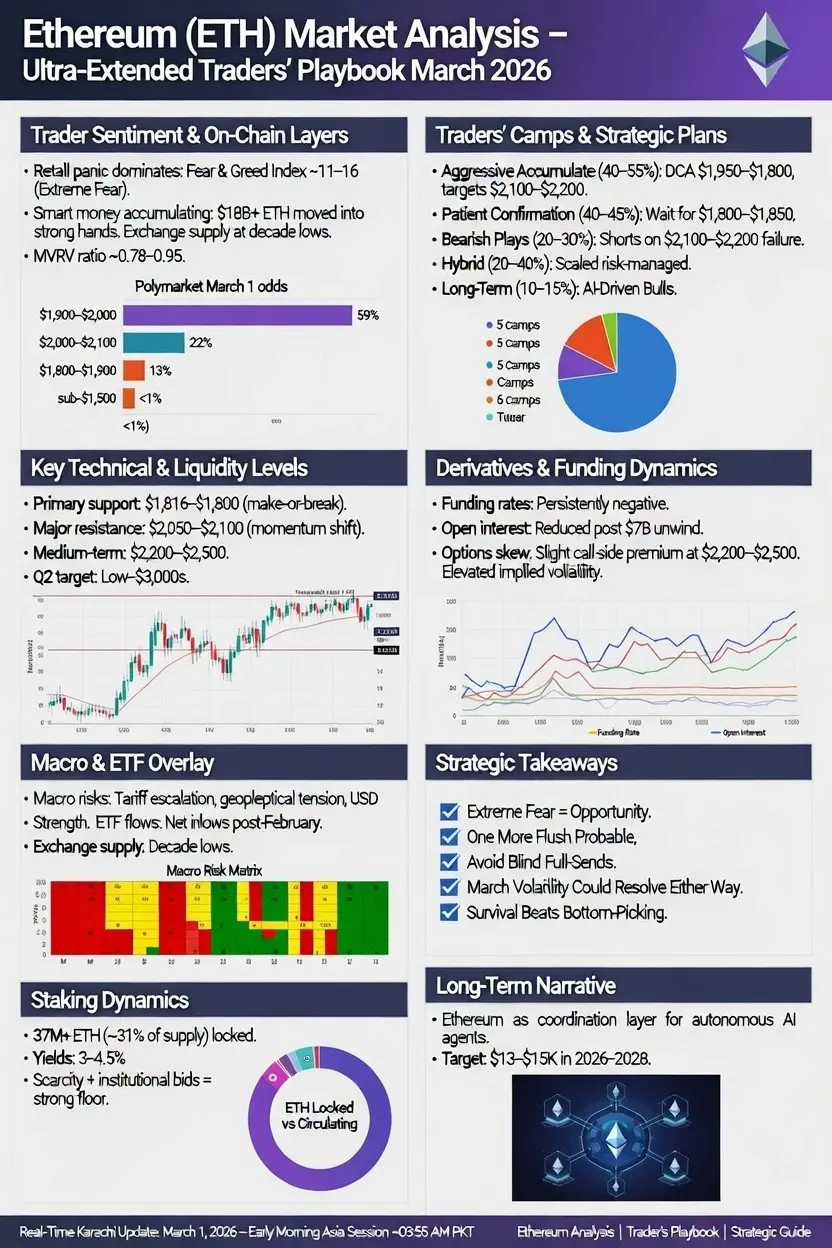
It’s March 1, 2026, and Ethereum is trading around $1,937 after a recent -4.4% correction, placing the psychological $2,000 level at the center of market attention. The $2K zone has now flipped from former support into a major resistance barrier, meaning that sustained weekly closes above this level will be required to restore bullish structural momentum. At the moment, price action remains below the 50-day, 100-day, and 200-day exponential moving averages, suggesting that the broader trend is still technically weak despite short-term rebound attempts. The Relative Strength Index is hovering near 38, reflecting proximity to oversold territory but without confirming a durable market bottom.
Immediate support is forming near $1,901, which is acting as a short-term buffer zone. If this level holds through weekly market closure, traders may witness a liquidity-driven squeeze that could push prices toward $2,100. The deeper structural support sits around $1,800, corresponding to the February low region, and a breakdown below this zone could open a capitulation risk scenario toward approximately $1,744 if panic selling accelerates. Market participants are closely watching these thresholds as they define the near-term directional bias.
On the supply side, treasury distribution activity has added downward pressure. Large-scale token movements from institutional or strategic reserves have created what analysts describe as a psychological ceiling on recovery rallies. Meanwhile, flow data from U.S.-listed spot Ethereum exchange-traded products shows a shift from net outflows toward net inflows, suggesting that institutional investors may be quietly accumulating at discounted price levels despite short-term volatility.
The regulatory landscape is also acting as a major macro catalyst following the advancement of the CLARITY Act (U.S. 2026 crypto law). The policy framework is expected to increase market transparency and institutional participation in digital assets. However, traders are divided on whether the announcement will trigger a “sell-the-news” volatility event or instead fuel a second-quarter bullish narrative driven by regulatory certainty.
From a strategy perspective, price action below $2,000 is being treated by long-term investors as a potential accumulation zone, but leverage exposure remains risky due to expected volatility expansion. Holding above $1,901 would strengthen short-term recovery momentum, while a break below that zone may activate liquidity magnets around $1,800. Market sentiment is now focused on whether March 2026 will mark continuation of consolidation or the beginning of a higher-timeframe breakout cycle.
The key question remains — is the $2,000 level a resistance wall for this month, or the launchpad for a move toward $2,500 as institutional demand grows? Traders are watching the next price structure shift very closely.
It’s March 1, 2026, and Ethereum is trading around $1,937 after a recent -4.4% correction, placing the psychological $2,000 level at the center of market attention. The $2K zone has now flipped from former support into a major resistance barrier, meaning that sustained weekly closes above this level will be required to restore bullish structural momentum. At the moment, price action remains below the 50-day, 100-day, and 200-day exponential moving averages, suggesting that the broader trend is still technically weak despite short-term rebound attempts. The Relative Strength Index is hovering near 38, reflecting proximity to oversold territory but without confirming a durable market bottom.
Immediate support is forming near $1,901, which is acting as a short-term buffer zone. If this level holds through weekly market closure, traders may witness a liquidity-driven squeeze that could push prices toward $2,100. The deeper structural support sits around $1,800, corresponding to the February low region, and a breakdown below this zone could open a capitulation risk scenario toward approximately $1,744 if panic selling accelerates. Market participants are closely watching these thresholds as they define the near-term directional bias.
On the supply side, treasury distribution activity has added downward pressure. Large-scale token movements from institutional or strategic reserves have created what analysts describe as a psychological ceiling on recovery rallies. Meanwhile, flow data from U.S.-listed spot Ethereum exchange-traded products shows a shift from net outflows toward net inflows, suggesting that institutional investors may be quietly accumulating at discounted price levels despite short-term volatility.
The regulatory landscape is also acting as a major macro catalyst following the advancement of the CLARITY Act (U.S. 2026 crypto law). The policy framework is expected to increase market transparency and institutional participation in digital assets. However, traders are divided on whether the announcement will trigger a “sell-the-news” volatility event or instead fuel a second-quarter bullish narrative driven by regulatory certainty.
From a strategy perspective, price action below $2,000 is being treated by long-term investors as a potential accumulation zone, but leverage exposure remains risky due to expected volatility expansion. Holding above $1,901 would strengthen short-term recovery momentum, while a break below that zone may activate liquidity magnets around $1,800. Market sentiment is now focused on whether March 2026 will mark continuation of consolidation or the beginning of a higher-timeframe breakout cycle.
The key question remains — is the $2,000 level a resistance wall for this month, or the launchpad for a move toward $2,500 as institutional demand grows? Traders are watching the next price structure shift very closely.